
Hindi
Alternative distribution plans for indie films


MUMBAI: There are nearly 1,000 movies that are made in India every year, but only about 35-40 per cent actually mange to get a proper release across the nation. This is one of the major obstacles for small time independent filmmakers who work on a shoe-string budget on their dream projects.
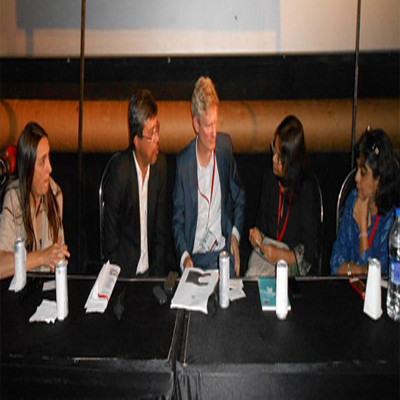
The Mumbai Film Festival in its fifteenth edition is trying to plug that hole. In what could have been termed as an intellectually and thought provoking discussion, a panel of dignitaries from the media and film space came together on one stage to show the way to independent filmmakers.
The session held at Metro Cinema, was moderated by AV Pictures MD Chris Hainsworth and discussed the various alternative distribution avenues for independent films and filmmakers. The panel consisted of Guneet Monga, a film producer and CEO with Anurag Kashyap Films since 2009; Isabelle Dubar, head of distribution at Hapiness Distribution based in France; Anil Wanvari, Founder, CEO & Editor-in-Chief at indiantelevision.com; Nandini, a film producer and finally Shubhra Gupta, a film critic with Indian Express over the past two decades.
The discussion kicked off with Guneet Monga who briefly started out by talking about her journey so far. “I started producing movies nearly six years ago, but started taking movies to festivals only with That Girl in Yellow Boots. I had no clue how to go about looking for buyers for the movie. But gradually, I realised that the deliverables that we have here in India is nowhere close to the scale at which films are marketed in the international film circuits, and I have learnt things the hard way.”
On being quizzed on what would be the right place to look for buyers in the overseas market, Monga quips, “Why go anywhere when we have two very good home grown festivals – The MAMI (Mumbai Academy of Moving Image) and the Film Bazaar held in Goa every year – but yes, the scope for buyers is in plenty overseas as well. It’s just about delivering the right mix of content that is of universal appeal. And it is also important that those in the business get to know you and take you seriously because you are meeting them again and again.”
Isabelle Dubar steps in while speaking about distribution of films. She was the one to take Gangs of Wasseypur (Part I & II) to the French market. “The French market is very outhouse in nature, with approximately 600 films from all over the world coming to the market every year,” says Dubar.
She further clarifies that the French market is still not that open to Bollywood films and it never really caught on it in a big way, but after observing the response for Gangs of Wasseypur (GOW) at various festivals world over and the appreciation it got at Cannes, she was egged on to give it a shot.
“We didn’t want to risk releasing both the parts together as a six hour long single feature film and thus adapted to how it was released in India. So, the first part was released around July and we promoted and marketed it like a contemporary Indian take on The Godfather,” Dubar remarks. The results were very pleasing. Though the expectations were high they still managed to get people to watch the movie.
Dubar says, “We expected nearly 30,000 admissions, but we got 15,000 which is still a sizable number. The second part that we released during Christmas the same year didn’t get much favourable response with only 5,000 attendees. But Anurag Kashyap’s work has been appreciated and the market is open to more Indian films now, so that’s a positive sign.”
Dubar further threw light on the fact that Kashyap’s Ugly will also be distributed by Hapiness Distribution in and around the French market. “We are also releasing The Lunchbox – a co-production with a French producer – on 11 December in France,” adds Dubar.
Dubar finally went on to say that be it any language or genre what matters at the end is that the story and the characters should be able to have an universal connect and nothing can stop the film from being accepted and doing well globally.
The point in question now is how will a film get the right platform to get buyers? “There are bigger markets than just festivals to be tapped into by independent filmmakers. There is Mipcom, Mip Doc and Mip TV, where nearly 11,000 people spend 1,300 Euros a piece to look for buyers or sellers of content, It’s the biggest content trade market in the world,” says Anil Wanvari.
He further urges the independent filmmakers’ community to unite and pitch for more funding from the government in their distribution efforts. He gave the example of the UK where 50 per cent of all costs to market films and TV shows internationally at markets are paid back to the filmmakers to encourage them to find alternate streams of revenue while pushing the British perspective and culture. “Even the Andhra Pradesh and Karnataka government offer incentives to producers of animation and gaming to attend markets worldwide to find new customers for their offerings,” he said and added, “Other state governments should be urged to do the same.”
“Earlier, Prasar Bharti used to screen movies on Sundays from independent filmmakers, maybe that is one thing that needs to be started again. But the need of the hour is for the filmmakers’ community to get together and help raise awareness for these films. Use of social media to bring the importance of independent cinema to the government’s notice and also to transform it into a movement is very essential. More importantly, filmmakers and producers should be aware of the rights they should retain with themselves whether it is SVOD or PPV or NVOD or online or airline or shipping or DTH or whatever right. Never give away all the rights for the movies at once just because a distributor demands them and because you are a first time filmmaker struggling to get your film on the screen. You need to learn to monetise and keep monetising from the product you have created,” Wanvari expounds.
Film producer and founder of Idyabooster.com Nandini Masinghka too thinks that the need of the hour is to get more clarity as a filmmaker whether the film he is making is for artistic pleasure or for monetising it. “Be clear about your audience; be clear how you will market, how will you distribute. Don’t just put all your money into creation and production,” she highlighted. “If you don’t have the expertise to manage this, then bring in someone who does. Thus, the industry needs more independent producers, who don’t just finance the project but are also responsible for monetising it rightly,” Nandini explains.
After patiently listening to the conversation, film critic Shubhra Gupta says, “I am surprised that we are discussing the business of cinema without considering the art of it. If the movie is not made artistically, you anyway won’t get buyers for it.”
Gupta also points out that after the emergence of multiplexes not many films from the independent space get their due at the box-office. “I am forced to see a Besharam on a Friday, when the movie I so wanted to see has been removed. So how will these movies get their due,” Gupta quizzes. She refers to the situation in Chennai where individuals backed and pushed the cause of independent cinema such as Pizza and made it successful.
Monga highlighted one case in point during her early days as a film maker. “My first film was on cricket and the prints were in the theatres when news emerged that India has been eliminated from the World Cup in 2007. Immediately, the exhibitors sent me back my prints. So I took up the cause of distributing the film myself in Delhi and encouraging schoolchildren to watch it in their schools. I also sold the tickets to universities myself. I then moved this concept similarly to Punjab and made money there. I even made money on the DVD which a home video company had given up on by selling them in the foyers of the theatres where I screened the film. I never gave up on my dream and pursued monetisation from every angle.”






