eNews
AI innovation takes center stage at Global AI conclave

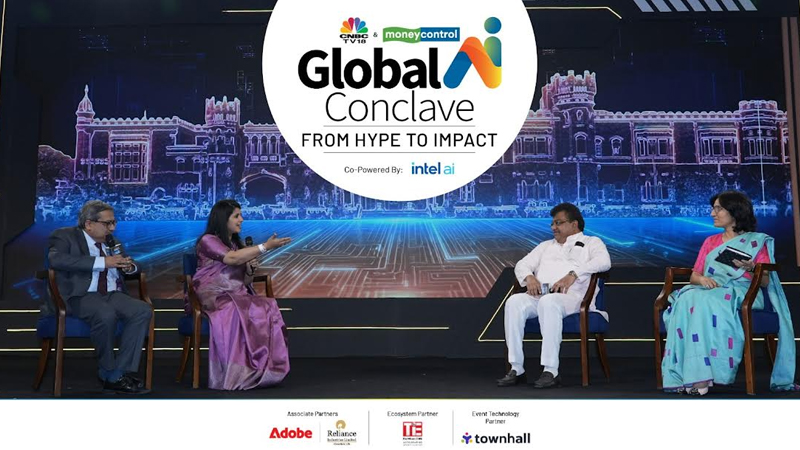
Bengaluru – The Global AI Conclave, hosted by Moneycontrol and CNBC-TV18, concluded its second edition in Bengaluru, showcasing how artificial intelligence (AI) is transforming industries, governance, and society. With the theme ‘From Hype to Impact,’ the event brought together global leaders, innovators, and policymakers to explore AI’s potential to solve pressing challenges and drive real-world change.
The event highlighted advancements in AI across sectors like healthcare, governance, urban planning, and more. Attendees included visionaries, industry leaders, and investors, offering insights into AI’s risks, rewards, and transformative possibilities.
Moneycontrol managing director Nalin Mehta emphasised India’s pivotal role in the AI revolution:“India is at the forefront of an AI-powered transformation, with ₹10,300 crores committed to the India AI mission. It’s time to move beyond the hype and deliver real-world impact.”
Intel India VP & MD Santhosh Viswanathan celebrated India’s unique strengths:“This is an extraordinary moment for India to lead, fuelled by abundant data, scalable solutions, and frugal innovation.”
The session progressed into a thought-provoking discussion on ‘Reimaging Governance with AI’ featuring former union minister of state for electronics and information technology, skill development & entrepreneurship & Jal Shakti, Rajeev Chandrasekhar. He stated, “The Prime Minister envisions the next phase of governance, propelled by the monumental success of Digital Public Infrastructure that has already redefined citizen interactions. Leveraging vast datasets, the focus is on enhancing public services and decision-making, much like how UPI transformed financial inclusion, aiming to redefine governance for the modern era.”
The conclave continued with two interesting fireside chats on ‘Decoding the AI Gold rush’ with General Catalyst CEO & managing director Hemant Taneja. He stated “India stands at a pivotal moment, driven by global resilience and shifting geopolitics. With strategic focus on core industries like defence, healthcare, and energy, its high growth and entrepreneurial spirit make it an ideal global leader. The success of quick commerce in India reflects more than convenience—it highlights transformative infrastructure like UPI. It’s the bold aspirations of visionary founders that are driving this change, and it’s inspiring to support their journey.”
The sessions then further delved intoan insightful fireside chat with Ministry of Electronics & IT secretary S. Krishnan GoI on ‘Inside the India AI mission’, he shared “India’s AI initiatives are progressing rapidly, with significant investments and over 1,000 proposals already under review. The next phase will focus on trusted technologies and advanced computing under the National Supercomputing Mission, emphasising a balanced, inclusive approach to drive transformative growth.”
Among the many highlights was a fireside chat with Adobe senior director & head of digital media business, India/South Asia, Girish Balachandran on ‘Digital Transformation in the Era of Gen AI’. Further enriching the discourse were panels such as, ‘Can AI reshape healthcare and diagnosis’ with Dr H. Sudarshan Ballal, Chairman, Manipal Hospitals; Dr Geetha Manjunath, CEO and Founder, Niramai Health Analytix and Laina Immanuel, Co-founder & CEO, BrainSightAI.
The event proceeded with another fireside chat on ‘From India to the world: How Premji Invest built a world-beating global AI portfolio from Bengaluru’, featuringTK Kurien, Chief Executive Officer , Premji Invest. . Following this insightful discussion, the focus shifted to a dynamic panel on ‘AI for All: Building a Future where AI benefits everyone’ with Manish Gupta, Director, Google Deepmind; Kalika Bali, Senior Principal Researcher, Microsoft Research India; Shri Nand Kumarum, President and CEO, National e-Governance Division, Ministry of Electronics and Information Technologyand Manu Chopra, Founder, Karya.
The summit then transitioned to another fireside chat on ‘Can AI solve the traffic woes of India’s tech capital?’ with M.N. Anucheth, IPS, Joint Commissioner of Police (Bengaluru Traffic). He said “Bangalore is implementing smart traffic signalling at 165 junctions by February, with adaptive systems at 200 locations to prioritise flow based on density. These measures, already cutting travel times by 17-22 per cent, aim to manage the city’s rapidly growing vehicle population, which has doubled in a decade, now surpassing Delhi.”
The conclave concluded with a special address on ‘Karnataka’s Path to Becoming India’s AI Powerhouse: What does it take?’ by Dr M. B. Patil, Minister for Commerce & Industries and Infrastructure-GoK and Gunjan Krishna, Commissioner for Industrial Development and Director, Department of Industries & Commerce, Government of Karnataka. Sharing his thoughts Dr M. B. Patil said”Karnataka, India’s IT capital, is now a global leader in machine learning, robotics, and quantum computing. With 1.2 million skilled professionals and contributing 60% to biotech, defence, and aerospace, the state’s talent and infrastructure make Bengaluru a vibrant hub of innovation and creativity.”
Adding to this Gunjan Krishna said “At the Global Investors Meet in February 2025, Karnataka will unveil a new industrial policy focused on high-value industries, boosting employment with an emphasis on women, and advancing technologies like EVs and hydrogen. The goal is to raise manufacturing growth to 12 per cent, attract Rs seven lakh crore in investments, and create 25 lakh jobs, solidifying Karnataka as a hub for sustainable growth.”
The second edition of the Global AI Conclave was not only celebrated AI’s transformative journey but also set the stage for future breakthroughs that promise to redefine industries, improve lives, and propel India as a global AI leader. As the curtains close on this year’s edition, the commitment to leveraging AI for a better tomorrow continues to inspire.