News Broadcasting
Agrani reacts favourably to budget


NEW DELHI: Agrani Satellite Services has reacted in a positive manner to the tax holiday extended to domestic satellite companies. ASS is a subsidiary of the Subhash Chandra-promoted ASC Enterprises Ltd, which is the only player in this field.
Speaking to indiantelevision.com, a company official said, “As per the policy, a company has to choose any 10 years in continuation within the first 15 years of operation. This policy provides 100 per cent tax holiday for the first five years and a 30 per cent relief for the next five years. It is a welcome relief for Indian satcom industry from government.”
What is the impact on the satellite industry? According to figures collated by indiantelevision.com, it seems that in a scenario where the government has so far been the only provider of satellite capacity, there is a large demand-supply gap, which needs to be filled by capacity on other systems. Experts in satellite broadcasting feel that private players will have to be involved in greater numbers in the provision of infrastructure and services under a facilitative regulatory regime.

India will face a major shortage of transponder capacity with the demand expected to increase to about 315 by 2004 but the supply not going above 235, notwithstanding the recent permission to a private sector satellite service company to induct foreign equity. Furthermore, India is expected to take a leap forward in the convergence arena with rapid expansion in the fixed-line and mobile telephone networks, Internet user base, long distance infrastructure, cable and Direct-to-Home television households, training and educational networks of businesses and institutions.
The country utilised 154 transponders in 1999, of which 28 transponders were for international communications operations of VSNL. Of the 128 transponders for domestic applications an estimated 69 transponders were used by Government, private Indian and foreign broadcasters to provide around 120 TV channels for Indian audiences. Eight transponders were used for business and other network services. Internet backbone applications accounted for 12 transponders, domestic telecom applications for 47 transponders and international voice and data communications for 18. Of the 154 transponders, 75 were provided by the INSAT system (including 10 transponders leased on a foreign satellite system) and the rest (79) were leased on foreign satellite systems.
With only INSAT 3C and 3A being launched over the next two years, the capacity of INSAT satellites in is estimated to be around 75 transponders. The estimated increase to 316 includes 10 ten per cent for reserve and backup capacity. This increase in demand is largely due to projected growth in telephone network (52 million lines); Internet subscribers (18 million), Cable TV channels (85) and DTH TV channels (85), VSAT terminals (50,000), and education/training networks (28 channels).headlines/y2k3/feb/feb200.htm







News Broadcasting
CNN-News18 to host Fury in the Gulf conclave on West Asia crisis
Three-hour summit to unpack geopolitical fallout and impact on India
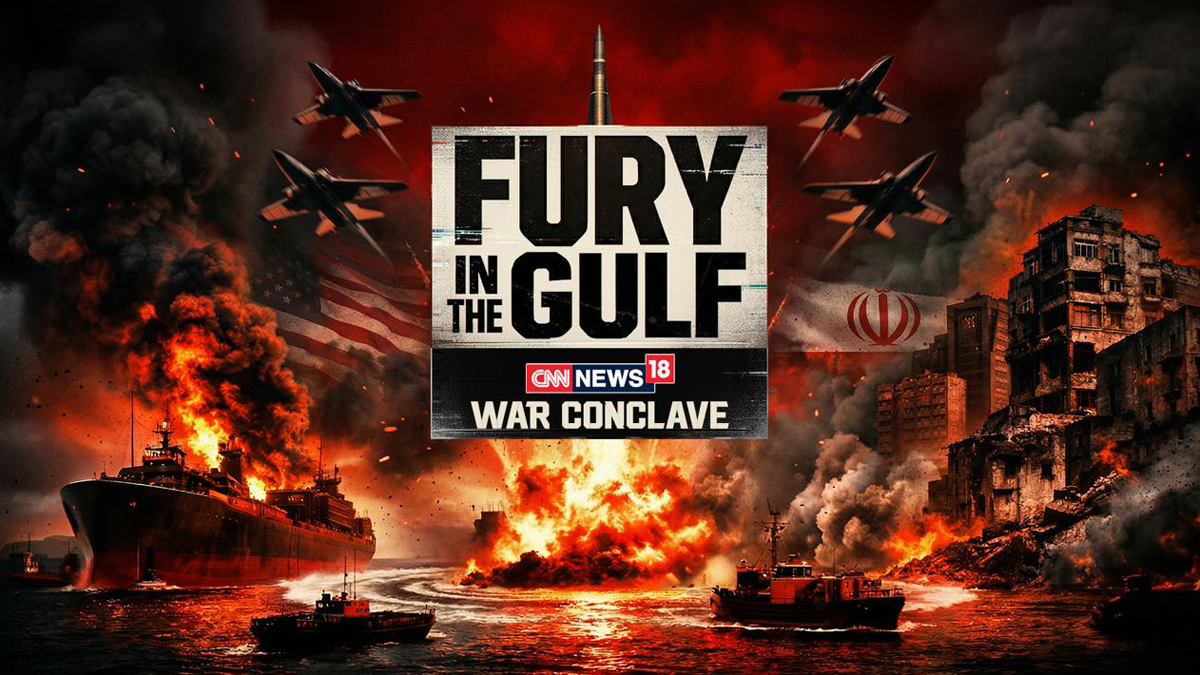
MUMBAI: CNN-News18 is set to host a special three-hour broadcast, Fury in the Gulf – War Conclave, on April 7, aiming to decode the escalating West Asia crisis and its far-reaching implications for India.
Scheduled from 4:00 PM to 7:00 PM, the conclave comes at a time when tensions between Iran and the United States are reshaping global geopolitics and triggering economic uncertainty. With India’s deep energy ties, trade links and large diaspora in the Gulf, the developments carry significant domestic relevance.
Built around the theme ‘Conflict, Consequences, and The Future,’ the programme will feature six curated sessions combining one-on-one interviews and panel discussions. The focus is to cut through the clutter and offer viewers a clearer understanding of the fast-evolving situation.
Key sessions include ‘Diplomacy in Times of War’ featuring Shashi Tharoor, and ‘World After the Iran Conflict’ with voices such as Ram Madhav, Reuven Azar, representatives from the European Union and the Iranian Deputy Envoy. Another session titled ‘Another Dunkirk?’ will bring together K. J. S. Dhillon and Jitin Prasada among others.
CNN-News18 editorial affairs director Rahul Shivshankar said, “In times of war, clarity becomes the most powerful tool. Fury in the Gulf – War Conclave brings together credible voices to address the questions and confusion that arise amid an overwhelming influx of information.”
He added that the initiative is aimed at delivering “facts, perspective, and insight” at a time when misinformation can easily cloud public understanding.
Echoing the sentiment, CNN-News18 CEO– English and business news Smriti Mehra said the conflict marks a defining global moment, with consequences that extend well beyond the region. She noted that the conclave seeks to present the crisis with “depth, nuance and responsibility” so audiences can better grasp its real-world impact.
As geopolitical tensions continue to dominate headlines, the conclave positions itself as an attempt to bring order to the noise, offering viewers a structured, insight-led look at a complex and rapidly shifting global situation.






