Connect with us

iWorld

5G to have 400 mn connections worldwide by 2022: report

Published

on

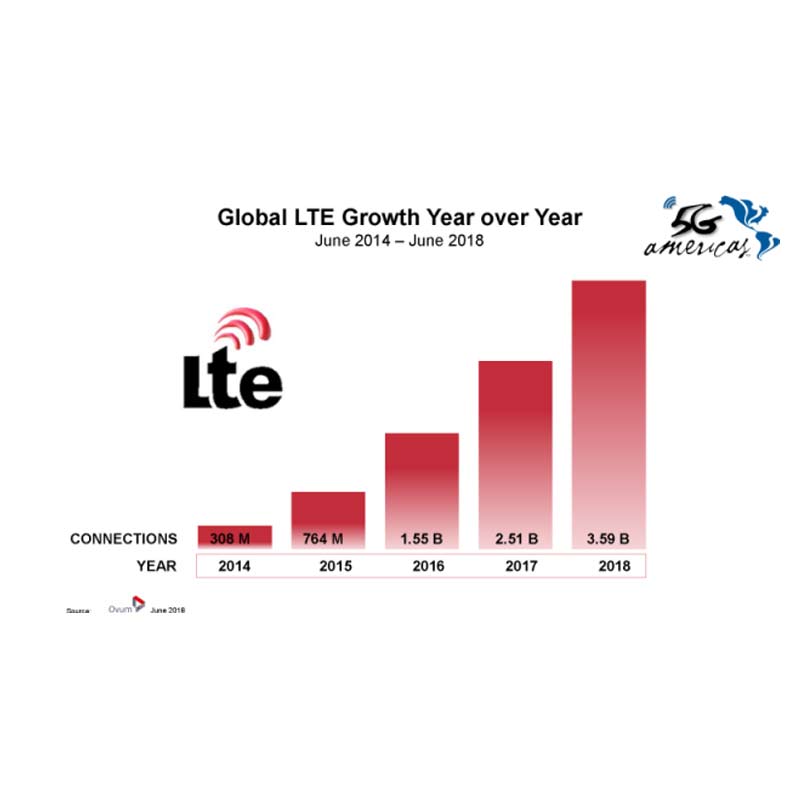
MUMBAI: A report by 5G Americas states that 5G is expected to accumulate connections starting in late 2018 and by 2022, it is forecast to have almost 400 million connections worldwide. 4G LTE is expected to reach over 5.6 billion connections globally in 2022 at which time LTE market share will stand at 60 per cent, according to a report by ET Telecom.
5G America, in a statement citing Ovum data, said that the global LTE connections grew by more than one billion connections from June 2017 to June 2018 with a growth rate of 43 per cent. With all subscription data provided by Ovum, the LTE market share compared to all other mobile wireless technologies achieved 42.3 per cent at the end of the second quarter of 2018 with a global total of 3.6 billion LTE connections.
Ovum senior analyst Kristin Paulin said, “Globally, total mobile connections grew by 6 per cent in the year to the second quarter of 2018, while LTE connections grew a stronger 43 per cent during this time. This substantial LTE foundation leads to the anticipation that soon we will start to see 5G make inroads.”
Latin America and the Caribbean added 82 million new LTE subscriptions with 52 per cent growth year over year from June 2017. At the end of the second quarter, there were nearly 241 million LTE connections in the Latin America region on commercial LTE networks across all countries.
5G Americas president Chris Pearson said, “These are exciting days for North America as the early commercial realisation of 5G technology is just around the corner. At the same time, the US and Canadian service providers are heavily invested in the innovation roadmap of LTE to deliver tremendous throughput speeds and coverage as the foundation for future 5G networks.”
Compared to the population of 365 million in North America, LTE achieved a penetration rate over 103 per cent with 376 million connections. North America holds the largest market share for LTE at 77 per cent and 376 million LTE connections. This penetration rate compares to the next two highest regions, Oceania, Eastern and Southeastern Asia at 88 per cent and Western Europe at 66 per cent.


Click to comment

Leave a Reply

Your email address will not be published. Required fields are marked *

iWorld

Telcos push for unified rules as spam shifts to OTT platforms

Over 80 per cent fraud moves online, operators seek common framework.

Published

on

MUMBAI: The spam may have left your phone network but it hasn’t left you alone. India’s telecom operators are once again dialling up the pressure for a unified regulatory framework, warning that fraud is rapidly migrating to internet-based platforms where oversight remains far looser. According to industry communication, a leading operator has written to multiple arms of the government including the Department of Telecommunications, the Ministry of Electronics and Information Technology and the Ministry of Finance arguing that tighter controls on traditional telecom networks are inadvertently pushing bad actors towards over-the-top (OTT) communication platforms.

The concern is not new, but the framing has sharpened. What was once an industry grievance is now being positioned as a consumer protection issue. Operators say that tackling spam in silos no longer works, as fraudsters seamlessly shift across platforms, exploiting regulatory gaps. The result: a moving target that traditional safeguards struggle to contain.

Executives point to a clear shift in fraud patterns. OTT platforms are increasingly being used for phishing links, impersonation scams and bulk unsolicited messaging, with industry estimates suggesting that over 80 per cent of spam activity has now migrated online. In this environment, the lines between telecom networks, messaging apps and financial fraud are blurring fast.

Advertisement

At the heart of the industry’s demand is a call for a technology-neutral regulatory framework, one that applies consistently across telecom and internet-based communication services. Operators argue that the absence of uniform safeguards, such as sender verification systems, robust spam filters and clearly defined accountability mechanisms, has created enforcement blind spots that fraudsters are quick to exploit.

The proposal is straightforward but far-reaching. Telcos are pushing for baseline anti-fraud measures across all communication platforms, alongside faster response systems and deeper coordination between ministries. Given the interconnected nature of telecom networks, digital platforms and financial systems, they argue that fragmented oversight only weakens the overall defence.

The broader issue is regulatory arbitrage, the ability of bad actors to hop between platforms based on which is least regulated at any given time. Without harmonised rules, operators say, efforts to curb fraud risk becoming a game of whack-a-mole.

Advertisement

As digital communication continues to expand, the debate is shifting from who regulates what to how consistently it is regulated. For now, telecom operators are making their case clear: in a world where spam travels freely, regulation cannot afford to stay fragmented.

Continue Reading

Advertisement News18
Advertisement
Advertisement
Advertisement Whtasapp
Advertisement Year Enders

Indian Television Dot Com Pvt Ltd

Signup for news and special offers!

Copyright © 2026 Indian Television Dot Com PVT LTD

This will close in 10 seconds