iWorld
“2021-22 will see a convergence of television and digital:” Arnab Goswami
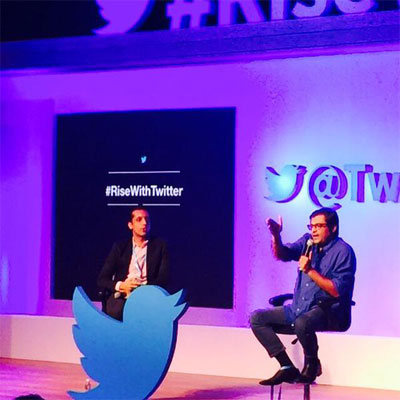
MUMBAI: “Twitter has opened up avenues and forced people to be more spontaneous,” said Times Now and ET Now news president and editor in chief Arnab Goswami. He was speaking at #RiseWithTwitter, organised by Twitter India on the occasion of ‘World Social Media Day.’
Goswami, who himself has stayed away from Twitter, unlike his counterparts, further said, “The channel has been getting million impressions since we broke the Lalit Modi scandal, which subsequently saw Lalit-gate trending. Though, these numbers are highly helpful, I don’t get swayed by it. I like to be focused and let my craft which is journalism and storytelling, do the talking.”
The veteran journalist did touch upon the emergence of digital and predicted a point of convergence around 2021 -2022. “Television gives me five times more viewership compared to digital and certainly is the largest medium at this point of time. So I would request people to neither overestimate nor underestimate the power of digital. The kids in kindergarten now will mark the real emergence of digital and that will happen once they start earning their livelihood, which will take time,” added Goswami.
Goswami informed the audience of how the behaviour of journalism in Delhi had almost forced him to take a decision to leave journalism. He said, “In 2001, I had almost decided to quit journalism. But today, thanks to the stories and a few moments, I feel journalism is the best profession for me to be in.”

e-commerce
American Express to acquire AI startup Hyper to boost automation
Deal targets expense management as AI reshapes corporate spending tools.
MUMBAI: From receipts to robots, the expense sheet is getting a brain upgrade as American Express moves to bring artificial intelligence into the heart of corporate spending. The company has announced plans to acquire Hyper, a relatively young but fast-rising startup founded in 2022 that builds AI-powered agents capable of organising expenses, generating reports, verifying compliance with budgets and policies, and nudging users with timely reminders. The deal, expected to close in the second quarter of 2026, underscores a growing shift among financial institutions to automate traditionally manual, time-heavy workflows.
Hyper counts Sam Altman among its backers, adding a layer of Silicon Valley credibility to the acquisition. While financial details remain undisclosed, the strategic intent is clear: deepen automation capabilities and sharpen American Express’s position in the competitive corporate spending ecosystem.
The two companies are not strangers. They previously collaborated in 2024 on a co-branded credit card product, suggesting that the acquisition is less a cold buy and more an extension of an existing relationship. With this move, American Express is effectively bringing that capability in-house, aiming to embed AI directly into its commercial services stack.
Chief executive Stephen Squeri had already signalled the direction of travel in a recent shareholder letter, describing AI as a “structural shift” in how businesses operate. The Hyper acquisition appears to be a direct response to that shift, particularly in expense management, where processes such as approvals, compliance checks and reporting remain ripe for automation.
Alongside the acquisition, the company is also expanding its product suite. A recently launched business credit card offers cashback and benefits at an annual fee of $295, with another card expected later this year moves that complement its broader push into commercial services.
Taken together, the strategy points to a future where managing expenses may require fewer spreadsheets and more algorithms. For American Express, the bet is simple, if businesses are rethinking how work gets done, the tools that power that work need to evolve just as quickly.