Hindi
Siddharth Roy Kapur says Indian studios need capital to scale globally
At CII Big Picture Summit 2026, the producer discusses investment, AI, box office trends and the value of human creativity


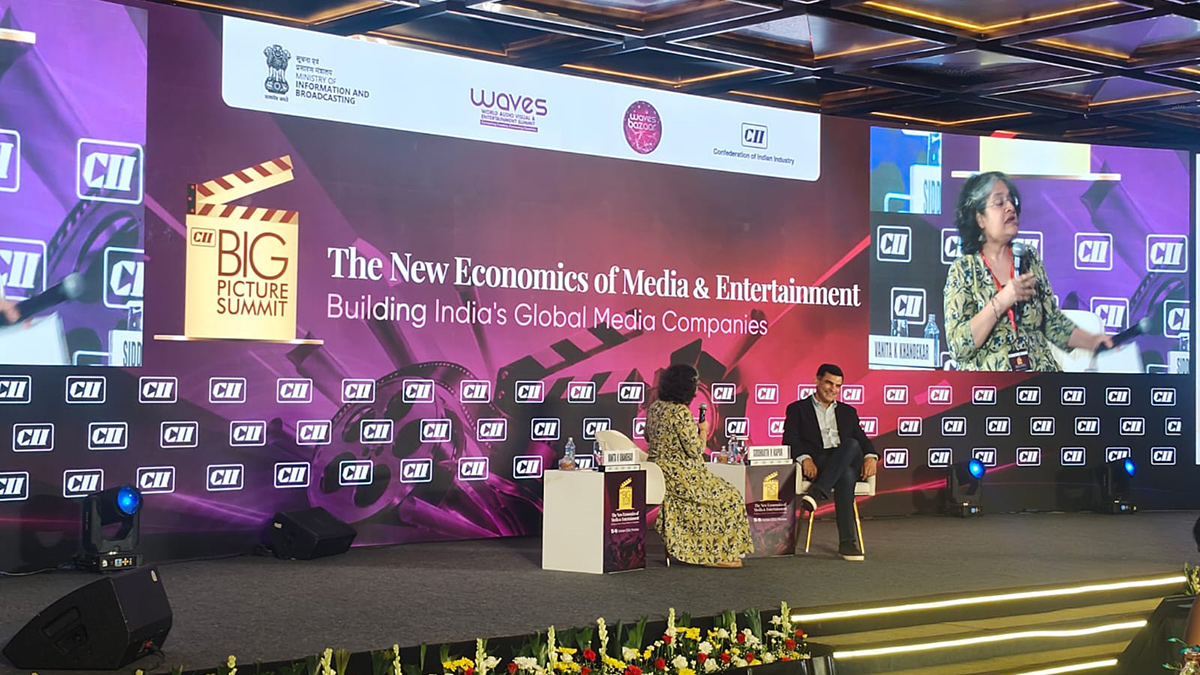
MUMBAI: India’s entertainment industry has no shortage of stories, stars or creative ambition, but turning that talent into globally competitive studios will take more than a good script. At the CII Big Picture Summit 2026, Roy Kapur Films founder and managing director Siddharth Roy Kapur argued that greater access to capital, stronger intellectual property (IP) and a willingness to embrace technology without sidelining human creativity will be crucial to building the next generation of Indian media businesses.
Speaking at the marquee session, ‘Content, Capital and Craft: The New Indian Studio’, moderated by author and journalist Vanita Kohli Khandekar, Roy Kapur examined the economics of building production houses into scaled-up studios. The discussion ranged from investment and consolidation to artificial intelligence (AI), changing audience habits and the growing pressure on films to justify a trip to the cinema.
Roy Kapur said Indian production houses had considerable room to grow, particularly because consolidation had been more visible among studios and streaming platforms than among production companies. He sees that gap as an opportunity for production houses to evolve into studios, raise capital and gain greater control over the stories they choose to tell.
For that transformation, he identified two essential ingredients: capital and creativity. Investment is needed to develop intellectual property, attract the right talent and back stories that deserve to be told. Creativity, meanwhile, determines how effectively those stories connect with audiences.
The challenge is to bring the two together in a business model that can withstand the risks inherent in entertainment. A production house cannot rely entirely on a handful of expensive films or series. It needs a diversified slate spanning large and small projects, films and long-form series, alongside a mix of commissioned productions, co-investments and projects made with studios.
Such diversification can help spread risk while allowing producers to retain a stake in the properties they create. Roy Kapur said access to financial capital from institutions and investors outside the entertainment industry could also give production houses more control over their creative decisions, rather than requiring them to depend entirely on strategic partners within the sector.
Roy Kapur argued that the scale of India’s media and entertainment industry remains small relative to the country’s wider economy, despite the nation’s appetite for films and other forms of entertainment.
During the discussion, he cited work he had undertaken suggesting that the sector’s contribution to gross domestic product was around 0.8 per cent 25 years ago. He also referred to comparisons with other markets, arguing that India’s media and entertainment industry has historically been smaller in relation to the overall economy than comparable sectors in several other countries.
He attributed some of the constraints to factors such as limits on cable rates, ticket prices and investment in media businesses. In his view, these restrictions have held back the industry’s potential, leaving considerable headroom for growth if investment and business models evolve.
Roy Kapur also pointed to the relatively small scale of India’s largest production houses compared with major international platforms. He argued that even the country’s leading production businesses have not yet achieved the scale that their creative output and the size of their domestic audience might suggest is possible.
The opportunity, he said, lies in attracting the investment required to build businesses that can develop and own intellectual property, support talent over longer periods and distribute content to wider audiences around the world.
There are already signs of movement. Roy Kapur cited investments in production businesses such as Dharma Productions and Maddock Films, alongside Yash Raj Films’ established studio operations, as examples of the sector preparing for a more ambitious future.
As production houses become studios, he argued, they can increase their capacity to take creative risks and back stories without necessarily having to persuade another company to finance every project. That could broaden the range of content being made while giving producers a stronger position in the value chain.
He also rejected the idea that India lacks the talent required to support this expansion. Instead, he said the country has a substantial pool of raw, often untrained creative talent that could be developed if the industry secures adequate capital and improves its ability to distribute content globally.
The conversation also turned to artificial intelligence, which is beginning to change how content is developed and produced. Roy Kapur said the industry could not afford to ignore the technology, warning that refusing to learn or adopt new tools could prove costly in the long run.
However, he argued that AI’s impact would differ depending on what audiences are consuming.
He divided viewing into two broad categories: content people watch to pass the time and content for which they deliberately set aside time. The first includes short-form videos, cat clips and microdramas watched during brief breaks or while waiting for something else. In this space, the threshold for acceptance can be relatively low, provided the content captures attention quickly.
Roy Kapur expects AI to disrupt this category rapidly, allowing large volumes of short-form content to be produced efficiently. He referred to developments in the microdrama business, including reports of production operations shifting towards AI-generated material and platforms moving away from traditional production approaches.
Long-form entertainment presents a different challenge. Films, concerts, theatre performances and series that audiences deliberately choose to watch have a higher bar for quality and emotional engagement. AI can still play a role in pre-production, visualisation and post-production, he said, but the value of human creativity and storytelling remains more pronounced.
Roy Kapur cited filmmaker Ben Affleck’s AI-related production venture, which he said had recently been sold to Netflix, as an example of how the technology could be used in filmmaking. He also referred to Affleck’s film Animals, arguing that AI could support aspects of production without replacing the human story at its centre.
The broader question, he said, is not simply whether AI can reduce production costs, but what might be lost in the pursuit of efficiency. While there is considerable scope for cost savings, the industry must consider how those savings affect the creative process and the final product.
Roy Kapur said he does not instruct the creative teams he works with to use AI in every instance. Instead, he encourages writers and directors to form their own views on a script before seeking feedback from an AI model. The technology can then act as a sounding board, offering alternative perspectives and ideas while leaving the final creative decisions to people.
He described the approach as a way to use AI as a sparring partner rather than a substitute for human judgement.
Changing audience behaviour is adding another layer of complexity to the economics of entertainment. While viewers have become accustomed to short videos and rapid-fire digital content, Roy Kapur argued that the same audiences are still willing to commit several hours to a film when they believe the experience will be worthwhile.
He pointed to the performance of long films as evidence that attention spans cannot be reduced to a simple preference for shorter content. A viewer may scroll through reels during idle moments and still remain engrossed in a lengthy cinematic experience if the story holds their attention.
The distinction, he suggested, is between content that fills spare time and entertainment that people actively choose to experience.
That choice is becoming more consequential for cinemas. Roy Kapur said revenue from live events had risen by 47 per cent in the previous year. He also suggested that the film industry could record its highest-ever box office in the current year, with cinema footfalls potentially increasing by 5 per cent.
At the same time, he cautioned that more than 50 per cent of the year’s box-office revenue could come from just the top 15 films. The figures were cited during the session and were not accompanied by a detailed methodology in the transcript.
The concentration of revenue underlines the challenge facing producers. Audiences may still want the big-screen experience, but they are increasingly selective about which films justify the ticket price and time commitment. Roy Kapur said viewers are less likely to turn up at a cinema simply to see what is playing; they want a compelling reason to go.
That does not mean the industry should focus exclusively on big-budget productions. Responding to a question about why producers continue to back expensive films when smaller titles can deliver strong returns, Roy Kapur said the market had begun to demonstrate that films of different scales can succeed.
He cited titles such as Drishyam, Dhamaal, Hanu-Man and the Gujarati film Laalo as examples of films that illustrate the range of projects capable of attracting audiences. His broader point was that star power and production scale alone do not guarantee success. Viewers will support a smaller film if it offers strong entertainment, just as they will turn away from a major production that fails to meet expectations.
For studios, that makes portfolio thinking particularly important. A slate of varied projects can create opportunities across budgets and genres, rather than placing the entire business on the performance of a few high-cost titles.
The discussion also raised questions about the future of AI-generated films, the protection of intellectual property and the rights of artists whose work could be used to train or imitate AI systems.
Roy Kapur said the industry was still working through these questions and that a fully AI-generated film could emerge sooner than many expect. The bigger uncertainty, he suggested, is how audiences will respond and whether they will care about the extent to which AI has been used.
He argued that creators should embrace the technology where it can improve efficiency, quality or cost, while protecting intellectual property, respecting artists’ rights and keeping human creativity at the forefront.
He also referred to efforts within the international film industry to develop guardrails for ethical AI use, noting that clear, consistent rules were still evolving. The discussion did not establish a definitive framework for how AI-generated work should be treated across the industry.
For Roy Kapur, the answer is not to compete with AI by trying to make human creators behave like machines. Instead, the industry should use technology to strengthen the creative process while preserving the contribution of writers, directors, actors and other key personnel.
He cited a US study suggesting that 65 per cent of people still preferred content featuring human beings over AI, while acknowledging that the finding represented a snapshot in time rather than a permanent verdict on audience attitudes.
Ultimately, Roy Kapur’s argument returned to the relationship between capital, craft and creativity. Investment can help Indian production houses build scale, technology can make parts of the process more efficient, and intellectual property can create lasting value. But none of these can guarantee success without stories that audiences genuinely want to experience.
For Indian studios looking to compete globally, the task is to build businesses strong enough to take risks, diverse enough to manage uncertainty and creative enough to give audiences a reason to look up from their screens and, when the story demands it, settle in for the full show.