Hindi
Rustom for ‘Independence Day’; Mohenjo Daro, a poor film


MUMBAI: Of late, Akshay Kumar starrers have become much-awaited. His transition from action to comedies were taken as they came; without much expectations. But, while an interesting story as the mainstay of a film is becoming rarer in Hindi films, Akshay’s films have strong tales to tell lately. And some of his recent films like Oh My God!, Special 26, Airlift, Holiday: A Soldier Is Never On Leave etc have relied on interesting stories mainly providing no scope for his kind of action and romance let alone comedy.
If one cared to, there are many real life human-interest stories to find in the country and the media if the filmmakers tried to look beyond crime and mafia stories. In fact, Akshay’s recent films, Special 26 and Airlift were also inspired from such real life events.
Though the film runs a disclaimer to the contrary, Rustom is based on the real life 1959 incident of a senior naval officer of the Indian Navy murdering the paramour of his English wife and the sensation that the court proceedings that followed created. Even as the murder looked like a simple adultery-incited rush of blood, the real life as well as the reel life hint at deeper conspiracy related to the defense system in the country towards which the film deals with towards the end.

Akshay is Rustom Pavri, an officer of Parsi origin with the Indian Navy, much respected as well as admired by his colleagues as well as friends. He has been sent to UK on a long assignment the purpose of which is to check on an aircraft carrier the Indian Navy plans to acquire.
Akshay’s stay in UK has been curtailed and his arrival back in Bombay happens before schedule. When back, to his surprise, his wife, Ileana D’Cruz, has been away for a couple of days. She, it seems, has been cheating on Akshay and is shacking up with one of Akshay’s close friends, Arjan Bajwa, on a regular basis in his absence. Arjan is a suave imported-car dealer and, thanks to his clientele, has unhindered access to high society dos and the wives of his clients.
Devastated by the revelation, Akshay walks into Arjan’s apartment and fires three bullets at him killing him instantly. He then walks into a police station and surrenders to the station in charge, Pawan Malhotra.
The murder by a naval officer of a high society Sindhi businessman makes banner headlines in the newspapers among which there is a tabloid owned by a fellow Parsi, Kumud Mishra, who sees this as an opportunity to salvage his almost defunct publication as well as to run a crusade to create a sympathy wave in favour of Akshay because he is a Parsi. With Esha Gupta taking on cudgels to avenge the death of her brother, Arjan, this literally turns into a war between Parsi and Sindhi communities. So much so even the public prosecutor appointed is a Sindhi.
As the court proceedings begin, Akshay refuses to appoint a lawyer, deciding to defend his own cause. It was the era of jury system where a bunch of court-appointed individuals from society sat in judgment while the judge only conducted the proceedings. Akshay works on winning over the sympathy of the jury members while the tabloid supporting him paints him as a true patriot. The judge too picks on the public prosecutor, Sachin Khedekar, from time to time creating more sympathy for Akshay. The court proceedings are meant to cater to the gallery as it regales both, the ‘crowd’ gathered in the court as well as the viewer.
Written by Vipul K Rawal, himself an erstwhile naval officer, the film has the tricky task of blending a real life saga with fiction as well as to decide where one ends the other takes over. It also applies to execution as recreating 1950s/60s era Bombay has never been convincing on screen. Here, as a compromise, some scenes have been shot in London around its Victorian architecture buildings. What works for the makers is that most of the film is shot in a court room. While the scripting is more like a stage play, the film sags in the first half as the narration moves from scene to scene at fast pace. This may seem to quicken the pace of the film but gives no time for the viewer to digest what just went past. The director shows ample confidence as a first timer. Songs have no place in the story and whatever is there is functional. Editing needed to be much sharper. Dialogue is good at places.
As for the performances, this is an Akshay Kumar vehicle all the way. He looks dignified and the uniform of a naval officer only adds to his persona. He does not have to act after that. Ileana carries a singular look throughout the film, weather she is romancing with Arjan or is facing the betrayed Akshay or in court scenes. Esha Gupta’s role is about sneering and jeering alternately. Sachin Khedekar, Anang Desai and Kumud Mishra play up to the masses. Pawan Malhotra and Usha Nadkarni are good in support. Arjan Bajwa is okay in a brief role.
Rustom has had a decent opening and the Monday, 15th August, Independence Holiday should add to its kitty to see it through safely.
Producers: Arun Bhatia, Nittin Keni, Aksah Chawla, Virender Arora, Ishwar Kapoor, Arjun N Kapoor, Shital Bhatia.
Director: Tinu Suresh Desai.
Cast: Akshay Kumar, Ileana D’Cruz, Arjan Bajwa, Esha Gupta, Usha Nadkarni, Sachin Khedekar, Lakshman Khangan, Kumud Mishra, Pawan Malhotra.
Mohenjo Daro…Bad idea!
Ashutosh Gowariker is said to have been inspired by the sites of the ruins of Dholavira, an excavated city from an ancient civilization in Kutch, Gujarat. That made him think of Mohenjo Daro, (now in Sindh, Pakistan) where the biggest city of an ancient Indus Valley Civilization was excavated in 1922 and, then, declared a Heritage Site by the UNESCO in as late as 1980.
All that is known about the find is its name, Mohenjo Daro (Mound of the Dead, when translated in English), there is nothing more on record or known to the archeologists who worked on the sites. While some assumptions may have been made about the culture as it existed then and the lifestyle of the people, there are no myths, legends or folklore related to Mohenjo Daro available anywhere or with anybody. In such a situation, a great imagination is needed to build a story around this civilization.
Here goes the story: we have Hrithik Roshan is a tiller of neel (indigo) in a small town in pre-historic land mass, later called Hindustan. Like all small town lads, he aspires to go to the big city, Mohenjo Daro, on the banks of Indus River. These days, all those who come to big cities become dons or their goons. In the good old days, they became saviours of the masses. Hrithik arrives in the new city and is impressed by its sights, its architecture and the scope for enterprise since people from other worlds also come here to trade.
The city is throbbing with people all around so much so that there is even a traffic cop to control these people and direct those like cops nowadays direct traffic in big cities! As he learns the tricks of the trade, Hrithik realizes that such big cities have two strata to society: the mass and the elite. Here too the city is divided between them demarcated by Lower City and Upper City settlements.
Like all such cities, Mohenjo Daro too has its share of evil in the form of Kabir Bedi, who rules the place with an iron hand, and his son, Arunoday Singh. Seeing their tyranny and having his first brush with Singh, Hrithik soon decides to leave the place and return to his own village. But, that is when he spots Pooja Hegde and it is love at first sight. For her sake, he now wants to stay put. In the process, he gets involved with events in the city and sees how injustice is being meted out to people by Bedi and Singh.
Hrithik has competition when it comes to Pooja as Singh wants her for himself and that has been decided at her birth by the prophesy makers of the city. Determined to stay back and fight with Singh and Bedi for the girl as well as the people, Hrithik’s resolve is only strengthened when he learns that his father, Sharad Kelkar, was one of the ministers in the darbar of Bedi but was murdered for opposing him.
As the film, which started bad, goes on to becoming worse, there are more treacheries by Bedi and Singh and some song and dance and some fights including an arena fight a la old Hollywood films, between Hrithik and two monstrous cannibal men. Hrithik overcomes all odds and vanquishes the evildoers. Don’t know why maneaters fight with Hrithik instead of just eating him up and be done with it? This was probably their idea of cooking their meal!
Talking about the imagination needed for a story to fit into the Mohenjo Daro civilization, there is none. In fact, whatever has been conjured up in the name of a great saga is childish to put it mildly. For instance, Hrithik is named Sarman and Singh is Munja; Sarman Munja was the name of a don in the city of Porbandar in Gujarat after whose death his wife, Santokba, went on to become India’s first all-powerful woman don who also has a film to her name. Kelkar is a good guy so Surjan while his brother who fails to stand by him is Durjan! It can’t get any more juvenile!
The story as such can fit into any B grade film of today if you replace the locale but keep the characters and the story same.
A poor story idea and a poorer script make for a directionless film: here we have props that loom totally out of place in the viewer’s perception of Mohenjo Daro. There are regular ration shops, costumes few can identify with! There is also word Haramkhor in Bedi’s vocabulary. The romance does not convince and there is no music to back it save for one song, Tu hia…. Dialogue lacks spirit. Cinematography is fair. Choreography is good. Special effect are routine. Editing is not evident in this film.
Performances are routine with Hrithik Roshan carrying on with same expressions from Koi… Mil Gaya. Pooja Hegde looks charming but can’t perform. Kabir Bedi is okay. Arunoday Singh is the victim of a routine role. Of the rest, only Manish Choudhary shows some conviction with what he is doing.
Mohenjo Daro is a poor film in all respects. If cost is considered, worse still.
Producers: Siddharth Roy Kapoor, Sunita Gowarikar.
Director: Ashutosh Gowariker.
Cast: Hrithik Roshan, Pooja Hegde, Kabir Bedi, Arunoday Singh, Suhasini Mulay, Nitish Bharadwaj, Kishori Shahane, Sharad Kelkar, Manish Choudhary, Narendra Jha, Casey Frank, Diganta Hazarika.



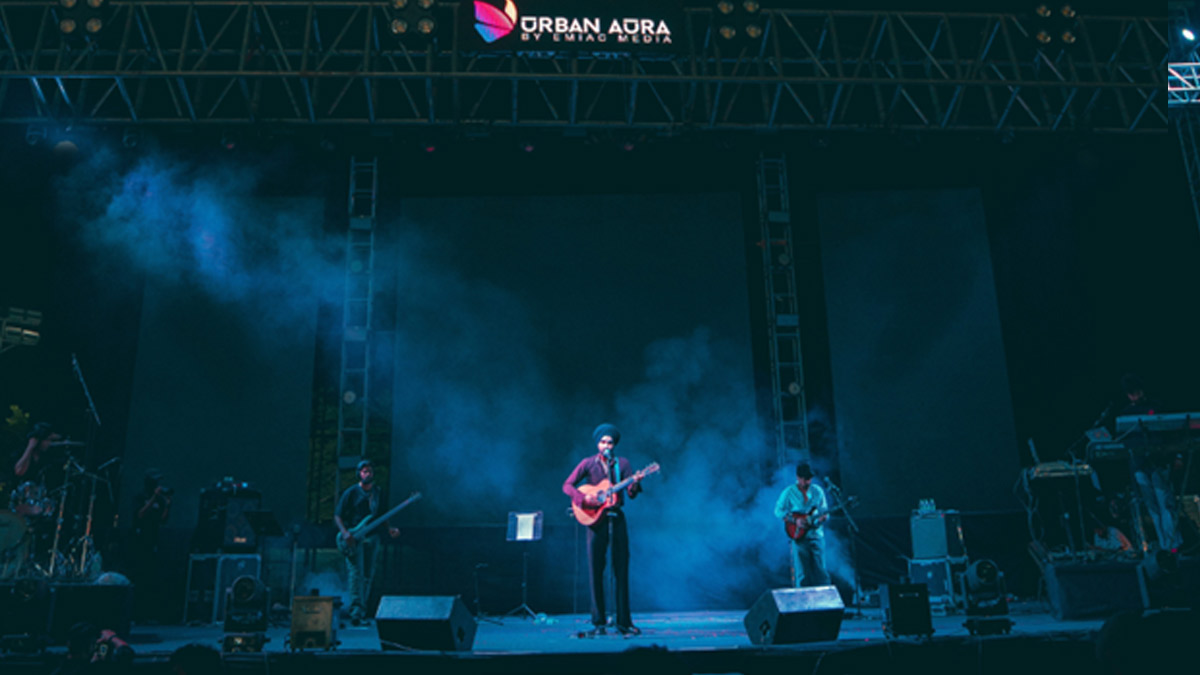
In a music industry that often rewards speed, spectacle, and instant recall, Navjot Ahuja’s journey feels refreshingly different. His story is not built on noise. It is built on patience, discipline, emotional honesty, and a quiet commitment to becoming better with every passing year. After 14 years of struggle, learning, performing, and writing, Navjot stands today as an artist whose success has not changed his centre. If anything, it has only made his purpose clearer.
For Navjot, music has never been about chasing fame alone. It has always been about expression. It is about writing more truthfully, singing more skillfully, understanding himself more deeply, and becoming a kinder human being in the process. That rare clarity is what gives his journey its beauty.
Where It All Began: A Writer Before a Singer
Indian singer and songwriter Navjot Ahuja’s musical journey began in the most familiar of places: school assemblies. But even then, what was growing inside him was not only the desire to sing. It was the need to write.
Long before he saw himself as a performer, he had already discovered the emotional release that writing offered him. For Navjot, words became the first true channel for feeling. Songwriting came before singing because writing was the only way he could let emotions flow through him fully. That inner pull shaped his artistic identity early on.
Like many young musicians, he sharpened his craft by creating renditions of popular songs.
Those experiments became his training ground. But the turning point came in 2012, when he wrote his first original song. That moment did not just mark the beginning of songwriting. It marked the beginning of self-definition.
A Calling He Did Not Chase, But Accepted
What makes the latest Indian singer-songwriter Navjot’s story especially compelling is the way he describes his relationship with music. He does not frame it as a career he aggressively pursued. In his own understanding, music was not something he chose. It was something that chose him.
There was a time when he imagined a very different future for himself. He wanted to become a successful engineer, like many young people shaped by ambition and conventional expectations. But life had a different script waiting for him. During his college years, around 2021, music entered his life professionally and began taking a firmer shape.
That shift was not driven by image-building or industry ambition. It came from acceptance. Navjot embraced the fact that music had claimed him in a way no other path could. That sense of surrender continues to define the artist he is today.
An Artist Guided by Instinct, Not Influence
Unlike many singers who speak openly about idols, icons, and musical role models, Navjot’s creative world is built differently. He does not believe his music comes from imitation or inherited influence. He listens inward.
He has never considered himself shaped by ideals in the traditional sense. In fact, he admits that he does not particularly enjoy listening to songs, especially his own. His decisions as a songwriter and singer come from instinct. He writes what feels right. He trusts what his inner voice tells him. He positions his music according to what he honestly believes in, not what trends demand.
That creative independence gives his work a distinct emotional sincerity. His songs do not feel calculated. They feel alive.
The Long Years of Invisible Struggle

Every artist carries a chapter of struggle, and Navjot’s was long, demanding, and deeply formative. One of the biggest challenges he faced was building continuity as the best new indian singer songwriter in an era where musical collaboration is increasingly fluid.
For emerging singers, especially those trying to build with a band, consistency can be difficult. Instrumentalists today have more opportunities than ever to freelance and perform with multiple artists. While that growth is positive and well deserved, it can make things harder for singers who are still trying to establish a steady team and sound around their work.
For Navjot, one of the most difficult phases came during 2021 and 2022, when he was doing club shows almost every day. It was a period of relentless performance, but not always personal fulfillment. He was largely singing covers because clubs were not open to original songs that audiences did not yet know.
For a new Indian singer and songwriter, that can be a painful compromise. To perform constantly and still not have the freedom to share your own voice requires not just resilience, but restraint.
“Khat” and the Grace of Staying Unchanged
After 14 years of effort, Navjot’s new love song Khat became a defining milestone. Professionally, he acknowledges that the song changed how society viewed him as a musician. It strengthened his place in the public eye and altered his standing in meaningful ways.
Yet personally, he remains unchanged.
That is perhaps the most striking part of his story. Navjot says his routine is still the same. His calm is still the same. His writing process is still the same. He does not want success or failure to interfere with the purity of his art. For him, emotional detachment from public outcomes is essential because the moment an artist becomes too attached to validation, the writing begins to shift.
His joy comes not from numbers, but from the attempt. If he has tried to improve his skill today, if he has written his heart out more honestly than before, then he is at peace.
Growth, Not Glory, Remains the Real Goal
Even now, Navjot is not consumed by labels such as singles artist, performer, or digital success story. His focus remains deeply personal. He wants to sing better. He wants to play instruments better. He wants to understand himself more. And he wants to become a kinder person.
That is what makes Navjot Ahuja’s journey so moving. It is not simply the story of a musician finding recognition. It is the story of an artist who continues to grow inward, even as the world begins to look outward at him. In an age obsessed with applause, Navjot reminds us that the most meaningful success often begins in silence, honesty, and the courage to remain true to oneself.






