Hindi
Raees…..Don: The twisted tale

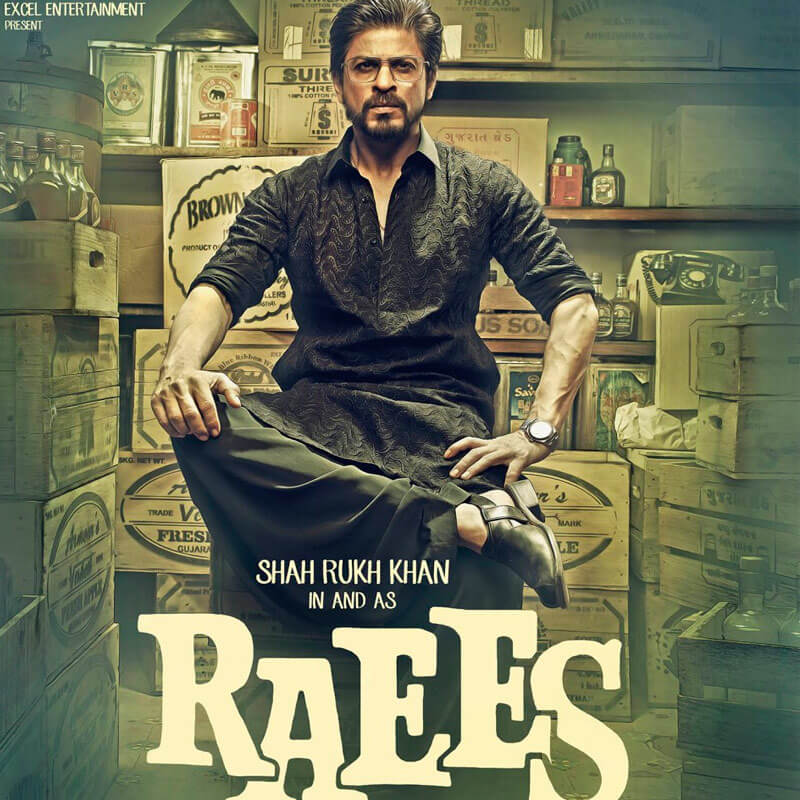
MUMBAI: Playing a fictional don is not good enough, every hero wants a Deewar of his own, the film that cemented Amitabh Bachchan’s arrival as a star after Zanjeer. Deewar was the legendary film based on the life of Haji Mastan, Mumbai’s first don. But, Deewar was only inspired by Haji’s life with clever writing by the Salim-Javed duo which, without depicting violence in anyway, charted the life of a don more as a family drama as well as a conflict between law and outlaw.
There have been more attempts recently at adapting real life criminals’ stories for films. None of these films tried to pass judgment on the criminal in its theme or paint him other than what he was. To see where things go wrong with Raees, it is necessary to know what the real don was and how the film presents him.
Raees, though it does not credit the film as one based on the notorious Ahmedabad based criminal Latif, tries to present him as a benevolent do-gooder, a Robin Hood kind of don. Latif was a petty bootlegger in the city of Ahmedabad who, with the backing of various other criminals started out as a courier boy for a major bootlegger, eventually turning into one independently. Since alcohol in the totally dry state of Gujarat was the privilege of rich and influential,Latif seemed to be dealing with the right kind of people when it came to furthering his career.

Latif specialized in inciting communal riots and soon became a tool in the hands of politicians. The city faced regular bouts of communal tensions during two occasions: the annual Rath Yatra and Makar Sankranti, the kite festival. Latif was known to play the lead role in inciting these riots. The local goon Latif graduated to become a don when he came into contact with Dawood and was instrumental in transporting the RDX used in the Mumbai bomb blasts. He later took refuge in Karachi with the aid of Dawood.
Shah Rukh Khan plays the character based on the life of Latif. Suffering from weak eyesight, he can’t read the blackboard in school when asked. The family is very poor and can’t afford to buy him specs. Latif goes and steals the frame from a statue of Mahatma Gandhi. Poverty and his mother’s helplessness lead him to a local bootlegger, Atul Kulkarni, delivering bottles in his school sachet. As he grows up, he plans to start his own business. Talking about “Baniye ka deemag” and “Miyabhaiki daring”, it is strange that he plans to buy supply from Kulkarni himself to compete with him!
Shah Rukh is now rich as well as influential. Everybody loves him be it Hindu or Muslim for he is a messiah who always stands for the poor and needy. He donates sewing machines to local women and gets justice for unpaid workers. He even plans a huge colony to settle poor people of his locality. So what if they are well settled in the heart of the city!
There are riots in the city and Shah Rukh has nothing to do with it. He, in fact, is worried about people and children and provides food and milk for families and kids affected by the riots and the curfew-bound city.By now, Hindu and Muslim, both the communities adore him. Shah Rukh attacks an opposition leader’s rally and is asked by the CM to agree to go to jail to save face. He soon realises that the CM has betrayed him. He decides to fight the local municipal elections and wins to avail him bail from jail. (The real Latif fought the elections from six wards and won five.)
But, now the CM is irritated with Shah Rukh and makes his life miserable. All his resources dry up and he is forced to seek financial help from a Mumbai don who asks him to run an errand for him: deliver a certain amount of smuggled gold which turns out to be RDX used for Mumbai bomb blasts of 1993.
There is nothing about Shah Rukh aka Latif running away to Dubai and later finding refuge in Pakistan.
The film comes across all throughout as making a martyr out of a bad man. And, even otherwise, if one watches the film as a total work of fiction, it is a poorly conceived and executed film. A score of movies have been made on similar don stories and they only get worse with each attempt.
There are two other tracks, both predictable; one is that of romance. Romance in this film is given. Shah Rukh and Mahira Khan seem to be in love with each other from the first time they meet. Soon they marry and Mahira joins in his illegal business as a helping hand. The other is that of the cop, Nawazuddin Siddiqui, who has sworn not to spare Shah Rukh, wherever he is transferred for doing that.The rest of the characters are mere caricatures. The first half of the film comes across as any making of a don story, the second half turns into a typical South Indian film where the bad man is good man.
Raees has just about everything going wrong for it, from the choice of subject and the way it is moulded to make Shah Rukh a larger than life character, to the choice of female lead. While Shah Rukh plays his two faced personality sans conviction, Mahira Khan neither charms with her presence nor impresses with her performance. Nawazuddin promises to salvage the proceeds initially but the script holds him back as things proceed. However, he is the best part of the film.
The direction is patchy and attempts to portray the 1980s lacks conviction. Sets are shabby. Music is of no help. There is little scope for the editor. The film makes a hero out of criminal Latif in the process of making the film’s hero, Shah Rukh, larger than life.
Raees has the advantage of a decent opening and a Republic Day holiday as a bonus but adverse reports will soon catch up with its box office status.
Producers: Ritesh Sidhwani, Gauri Khan, Farhan Akhtar.
Director: Rahul Dholakia.
Cast: Shah Rukh Khan, Nawazuddin Siddiqui, Atul Kulkarni, Mahira Khan, Mohammed Zeeshan Ayyub.
Kaabil….For select audience..
Sanjay Gupta’s inspiration usually comes from South-East Asian films at times blended with a film from the West. Kaabil finds resemblance with Blind Fury (1989) and Broken (2014), from the US and Korea, respectively.
That said, the film turns into a typical vendetta film, a trend started by South Indian films.When an injustice is done to a loving couple or a hero’s sister or mother falls prey to the villains, the hero seeks revenge. What is different here is that the lead actors, Hrithik Roshan and his lady love, Yami Gautam, are both blind.That adds a sympathy factor to the revenge saga. The handicap of momentary blindness has been used in various Kung Fu films over the years so the viewer would be quite familiar with the idea.
Hrithik is a blind man living on his own. He has a talent for using different voices and is a popular dubbing artist for animation films. Through a common friend who is a matchmaker, he is introduced to Yami, who is also blind. She works for an NGO and also plays piano at a dance academy. While both are independent and reluctant to marry, they plan to meet again. What both also have in common is a sense of perception, a strong sixth sense.
So far the going is good as there are some nice as well as emotional moments as both discover each other. The initial friendship turns into love and the couple decide to marry. The proceeds become heavy thereafter as a troublemaker, Rohit Roy, has bad intentions for Yami.
Once while Hrithik is away at work, Rohit along with his sidekick, Md Sahidur Rehman, rapes Yami knowing both are blind and there is little they could do. Going to the police is of no help since Rohit’s politician brother, Ronit Roy, is a local councilor and can pull strings. Encouraged, Rohit decides to make it a routine to take advantage of Yami’s helplessness leading her to end her life.
Frustrated by the police inaction, Hrithik decides to take matters in his own hands to settle score. This is what the film is about; a blind man plotting and taking revenge while making sure there is no way the cops can nail him. For he challenged the police that he will get even on his own.
He plots each villain’s death differently using his talent of modulating his voice.
Kaabil starts off well but the idea of bringing in a local politician, and a municipal councilor at that, makes the villain angle weak. That such a politician should be able to call the shots with a major metro police force does not quite convince.
Seeking revenge one by one is also oft seen in many films. That a blind man does all this is the USP of the film which may not be enough. The film’s music is a plus with the title song, Mai tere kaabil hun…… being the pick of the lot while Kuchh din se….. and Kissise pyar ho jaaye…. (Remix of old hit, Dil kya kare…. from film Julie) also being hummable. The cinematography is good. Editing could have been crisper. Action is commendable.
The best part of the film is the performances by the lead pair, Hrithik and Yami. Hrithik is totally convincing as a blind man carrying a blank sort of look in his eyes through the length of the film. Yami complements him though her role is shorter. Ronit, Rohit and Sahidur are routine. Girish Kulkarni and NarendraJha as the cops are effective.
Kaabil has had a weak opening. Thursday holiday and the weekend are expected to fare better but the target for the film is too high.
Producer: RakeshRoshan.
Director: Sanjay Gupta.
Cast: HrithikRoshan, YamiGautam, Ronit Roy, Rohiit Roy.







In a music industry that often rewards speed, spectacle, and instant recall, Navjot Ahuja’s journey feels refreshingly different. His story is not built on noise. It is built on patience, discipline, emotional honesty, and a quiet commitment to becoming better with every passing year. After 14 years of struggle, learning, performing, and writing, Navjot stands today as an artist whose success has not changed his centre. If anything, it has only made his purpose clearer.
For Navjot, music has never been about chasing fame alone. It has always been about expression. It is about writing more truthfully, singing more skillfully, understanding himself more deeply, and becoming a kinder human being in the process. That rare clarity is what gives his journey its beauty.
Where It All Began: A Writer Before a Singer
Indian singer and songwriter Navjot Ahuja’s musical journey began in the most familiar of places: school assemblies. But even then, what was growing inside him was not only the desire to sing. It was the need to write.
Long before he saw himself as a performer, he had already discovered the emotional release that writing offered him. For Navjot, words became the first true channel for feeling. Songwriting came before singing because writing was the only way he could let emotions flow through him fully. That inner pull shaped his artistic identity early on.
Like many young musicians, he sharpened his craft by creating renditions of popular songs.
Those experiments became his training ground. But the turning point came in 2012, when he wrote his first original song. That moment did not just mark the beginning of songwriting. It marked the beginning of self-definition.
A Calling He Did Not Chase, But Accepted
What makes the latest Indian singer-songwriter Navjot’s story especially compelling is the way he describes his relationship with music. He does not frame it as a career he aggressively pursued. In his own understanding, music was not something he chose. It was something that chose him.
There was a time when he imagined a very different future for himself. He wanted to become a successful engineer, like many young people shaped by ambition and conventional expectations. But life had a different script waiting for him. During his college years, around 2021, music entered his life professionally and began taking a firmer shape.
That shift was not driven by image-building or industry ambition. It came from acceptance. Navjot embraced the fact that music had claimed him in a way no other path could. That sense of surrender continues to define the artist he is today.
An Artist Guided by Instinct, Not Influence
Unlike many singers who speak openly about idols, icons, and musical role models, Navjot’s creative world is built differently. He does not believe his music comes from imitation or inherited influence. He listens inward.
He has never considered himself shaped by ideals in the traditional sense. In fact, he admits that he does not particularly enjoy listening to songs, especially his own. His decisions as a songwriter and singer come from instinct. He writes what feels right. He trusts what his inner voice tells him. He positions his music according to what he honestly believes in, not what trends demand.
That creative independence gives his work a distinct emotional sincerity. His songs do not feel calculated. They feel alive.
The Long Years of Invisible Struggle

Every artist carries a chapter of struggle, and Navjot’s was long, demanding, and deeply formative. One of the biggest challenges he faced was building continuity as the best new indian singer songwriter in an era where musical collaboration is increasingly fluid.
For emerging singers, especially those trying to build with a band, consistency can be difficult. Instrumentalists today have more opportunities than ever to freelance and perform with multiple artists. While that growth is positive and well deserved, it can make things harder for singers who are still trying to establish a steady team and sound around their work.
For Navjot, one of the most difficult phases came during 2021 and 2022, when he was doing club shows almost every day. It was a period of relentless performance, but not always personal fulfillment. He was largely singing covers because clubs were not open to original songs that audiences did not yet know.
For a new Indian singer and songwriter, that can be a painful compromise. To perform constantly and still not have the freedom to share your own voice requires not just resilience, but restraint.
“Khat” and the Grace of Staying Unchanged
After 14 years of effort, Navjot’s new love song Khat became a defining milestone. Professionally, he acknowledges that the song changed how society viewed him as a musician. It strengthened his place in the public eye and altered his standing in meaningful ways.
Yet personally, he remains unchanged.
That is perhaps the most striking part of his story. Navjot says his routine is still the same. His calm is still the same. His writing process is still the same. He does not want success or failure to interfere with the purity of his art. For him, emotional detachment from public outcomes is essential because the moment an artist becomes too attached to validation, the writing begins to shift.
His joy comes not from numbers, but from the attempt. If he has tried to improve his skill today, if he has written his heart out more honestly than before, then he is at peace.
Growth, Not Glory, Remains the Real Goal
Even now, Navjot is not consumed by labels such as singles artist, performer, or digital success story. His focus remains deeply personal. He wants to sing better. He wants to play instruments better. He wants to understand himself more. And he wants to become a kinder person.
That is what makes Navjot Ahuja’s journey so moving. It is not simply the story of a musician finding recognition. It is the story of an artist who continues to grow inward, even as the world begins to look outward at him. In an age obsessed with applause, Navjot reminds us that the most meaningful success often begins in silence, honesty, and the courage to remain true to oneself.






