
Hindi
Nana Patekar: The actor who played larger-than-life characters, but chose to live for people beyond the screen
There are actors who entertain us, actors who move us and then there are those whose presence becomes inseparable from the very idea of Indian cinema. Nana Patekar belonged to the last category.


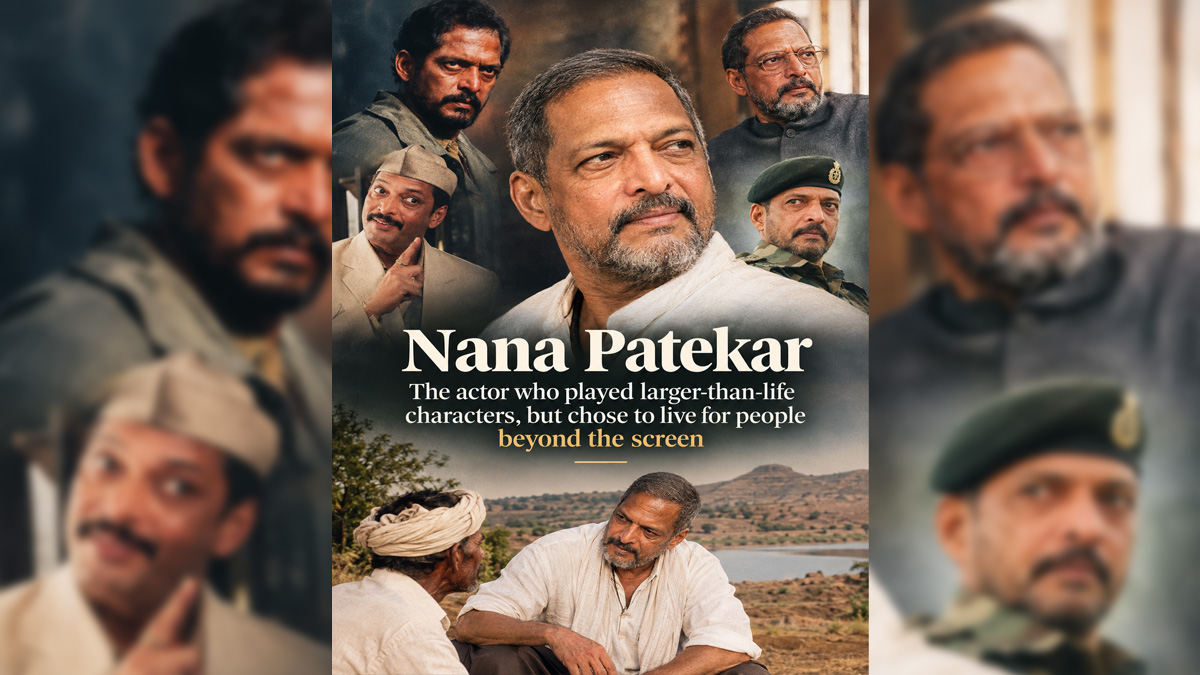
GOA: For nearly five decades, Patekar inhabited characters with an intensity that could make a theatre fall silent. From Parindaand Krantiveer to
Away from the cameras, Patekar chose to spend much of his energy on people whose stories rarely made it to the screen.
And perhaps that is where the real story of Nana Patekar lies.
From the spotlight to the drought-hit villages
Patekar’s association with social work was not built around celebrity appearances or occasional charity. It became a deeply personal commitment, particularly towards Maharashtra’s farmers.
In 2015, as reports of farmer suicides and the devastation caused by drought continued to emerge from Maharashtra, Patekar began visiting affected families and distributing financial assistance. He personally helped families who had lost their primary earners to debt and drought. In August 2015, he distributed cheques of Rs 15,000 each to 62 families in Vidarbha, followed by assistance to another 113 families in Latur and Osmanabad.
The experience changed him.
Patekar spoke openly about how seeing the lives of farmers and their families had affected his understanding of life. He once recalled watching a television report about farmer suicides and changing his plans to spend his savings on a car. Instead, he decided to put that money towards helping affected families.
What began as individual assistance eventually became something much larger.
NAAM Foundation became his most enduring social legacy
In September 2015, Patekar and fellow Marathi actor Makarand Anaspure established the NAAM Foundation in response to the agrarian crisis in Maharashtra.
The foundation was created to address the consequences of drought, farmer distress and rural deprivation, but its work evolved beyond simply distributing money. NAAM began focusing on water conservation, rural infrastructure, agricultural sustainability and the restoration of water sources.
According to the foundation, between 2015 and 2025 its water-conservation work restored 2,246 water sources and rejuvenated 178 rivers. It also carried out deepening and widening work on 515 streams and nalas, restored 769 percolation tanks and worked on dams and watershed projects. The organisation says these efforts created substantial additional water-storage capacity and benefited more than 77 lakh farmers.
The numbers are significant. But for Patekar, the work was never really about numbers.
It was about giving a farmer a reason to remain on his land.
In 2026, while speaking about the agrarian crisis, Patekar made another emotional appeal to distressed farmers, urging those experiencing suicidal thoughts to seek help rather than take an irreversible step. He spoke about the families he had encountered in places such as Beed and the young widows and children left behind by farmer suicides.
His words revealed how deeply the work had affected him.
The actor who had spent his career portraying characters fighting against injustice was now confronting a very real crisis outside the screenplay.
His charity began long before NAAM
NAAM Foundation may be the most visible chapter of Patekar’s social work, but it was not the beginning.
He had previously contributed towards rebuilding flood-ravaged villages in Bihar through the charitable organisation Anubhuthi. In 2010, he also refused to take his remuneration for Paathshaala. Instead, he asked that the money be given to charitable organisations.
There was another telling gesture when he received the Raj Kapoor Special Contribution Award, which carried a cash prize of Rs 10 lakh. Patekar donated the entire amount towards drought-relief work in Maharashtra.
These were not isolated gestures. They reflected an approach to money and fame that remained remarkably consistent: whatever came from the industry could also be channelled back into society.
The soldier beyond the actor
Patekar’s sense of service was not confined to philanthropy.
He joined the Territorial Army and underwent military training. During the Kargil War, he served with the Maratha Light Infantry. He eventually retired from the Territorial Army as a lieutenant colonel in 2013.
For an actor who had spent years portraying soldiers, policemen, gangsters, politicians and ordinary men pushed to extraordinary circumstances, military service became one of the rare instances where the uniform was not a costume.
It was service.
That part of his life also adds another dimension to his public persona. Patekar did not simply play men who fought battles. At different points in his life, he chose to participate in battles outside cinema too.
A career built on characters, not celebrity
Patekar’s contribution to Indian cinema is difficult to reduce to a handful of films.
He began with theatre before making his film debut with Gaman in 1978. His breakthrough performances established him as one of Hindi cinema’s most formidable actors. Parinda earned him his first National Film Award, followed by another for Krantiveer and a third for Agni Sakshi.
He directed Prahaar: The Final Attack, continued working across Hindi and Marathi cinema and later delivered one of his most celebrated performances in Natsamrat.
And then there was Welcome, where his portrayal of Uday Shetty introduced another side of Nana Patekar to an entirely different generation. The same actor who could deliver monologues with devastating intensity could make an audience laugh with a single look.
That versatility was his gift.
But perhaps his greatest contribution was that he never seemed entirely interested in behaving like a conventional star.
His public image was often that of a man who preferred simplicity to spectacle. Even after achieving national recognition, he remained closely associated with rural Maharashtra and repeatedly spoke about the sense of purpose he found there.
In recent years, he said he felt increasingly disconnected from urban life and more alive in villages.
That statement perhaps explains the second half of his life better than any award citation ever could.
When the applause stopped mattering
Cinema gave Nana Patekar fame, money, awards and some of the most memorable characters in Indian film history.
But social work gave him something he repeatedly said was more valuable: purpose.
The irony is difficult to miss.
The man who spent decades making audiences cry, laugh, rage and reflect ultimately devoted a significant part of his life to people who had very little reason to believe that anyone was listening.
He could have remained within the comfortable distance of celebrity charity, appearing at events, writing cheques and moving on.
Instead, he went to villages.
He met families.
He saw the consequences of drought and debt.
He spoke to farmers.
He helped build systems around water conservation.
And he kept returning.
That is what makes Nana Patekar’s social work different from a footnote in his filmography. It was not an accessory to his fame. It became part of his identity.
Nana Patekar’s lasting legacy
When Indian cinema remembers Nana Patekar, it will remember the voice first.
That unmistakable voice.
The furious speeches. The silences. The characters who seemed to carry an entire society’s frustration inside them. The laughter of Uday Shetty. The grief of Natsamrat. The anger of Krantiveer.
But beyond those frames is another image worth remembering: Nana Patekar standing among farmers, villagers and families struggling through circumstances that had nothing to do with Bollywood.
His films will remain in archives, on television and on streaming platforms.
The work of NAAM Foundation, meanwhile, lives in something much more tangible: water restored, land made more viable, families supported and rural communities given a chance to rebuild.
Perhaps that is the most fitting way to remember him.
Not simply as the actor who made us feel.
But as the man who, after spending a lifetime pretending to fight other people’s battles on screen, chose to fight some of the real ones himself.






