Movies
Microdrama editing is about addiction, not attention: Priyansh Mukherjee
Speaker outlines hook-cliffhanger formula driving mobile-first storytelling.

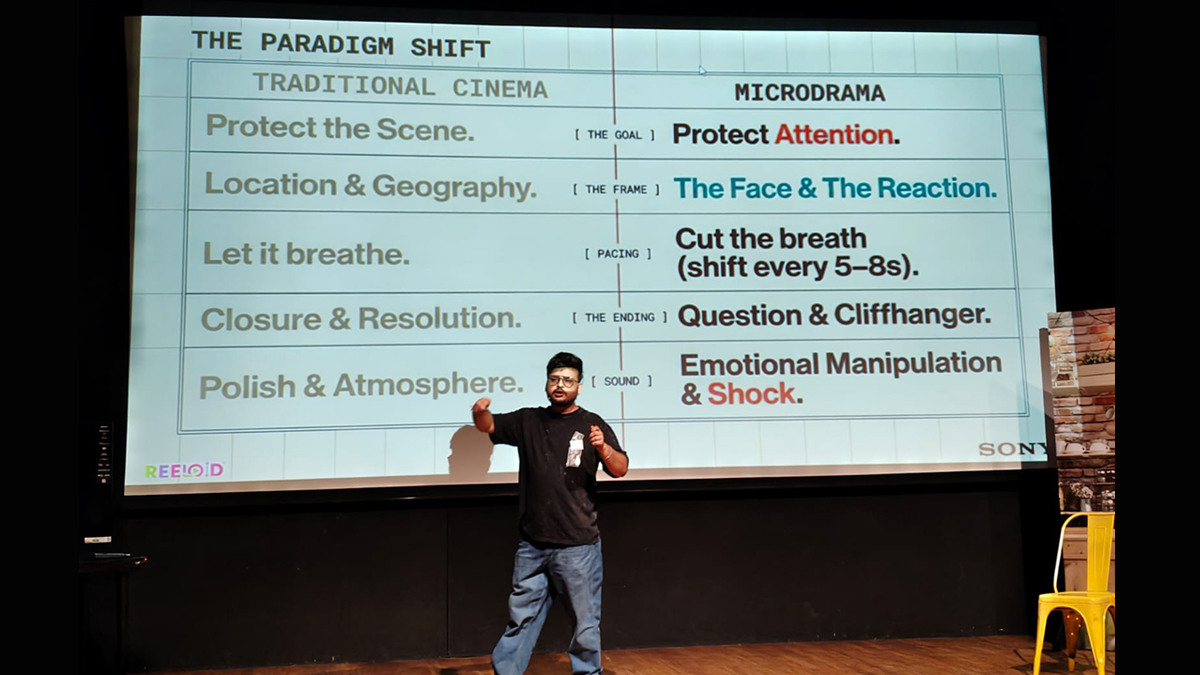
MUMBAI: The battle for audiences is no longer being fought in theatres or living rooms, it is being fought on a six-inch screen, one swipe away from abandonment. That was the provocative premise laid out by filmmaker and editor Priyansh Mukherjee during his session, The Microdrama Editing Manual, at Sony and Reloid’s The Present is Vertical: Crafting Cinematic Stories for the Mobile Generation event hosted by Rohit Guptaa. In a deep dive into the rapidly growing world of vertical storytelling, Mukherjee argued that microdramas have fundamentally rewritten the rules of narrative construction, transforming editing from a technical craft into what he described as the science of “engineering emotional addiction”.
For decades, filmmakers have been taught that great cinema immerses audiences in a carefully crafted world. Establishing shots, atmospheric locations, nuanced performances and slow-building emotional arcs have long been regarded as the cornerstones of effective storytelling. But according to Mukherjee, the rise of mobile-first content has created an entirely different set of demands.
“Microdrama is not a shorter film,” he suggested. “It is a different language altogether.”
Drawing on his own journey from theatre and filmmaking to documentaries, reality programming, animation and AI-driven storytelling, Mukherjee explained that editing has always been central to storytelling. While writers create the blueprint and directors capture the vision, it is the edit table where a story ultimately finds its rhythm, emotional cadence and audience connection.
In traditional cinema, editors guide viewers through a carefully orchestrated emotional journey. In microdramas, however, the mission is far more urgent, prevent the audience from scrolling away. The challenge stems from the environment in which the content is consumed. Unlike cinema audiences who have consciously chosen to sit through a two-hour film, mobile viewers are surrounded by endless distractions. Every swipe presents an alternative piece of content competing for attention.
As a result, Mukherjee argued that microdrama creators are not merely storytellers. They are competing in what he called an “attention war”. He likened traditional filmmaking to a royal poet performing before an attentive audience, while microdramas resemble a street performer trying to stop passers-by in a crowded marketplace. The story may still matter, but earning the right to tell it requires a completely different approach.
Central to that approach is the idea of emotional addiction. Mukherjee described microdramas as narrative experiences specifically designed to keep audiences coming back for more. Rather than offering viewers a satisfying emotional resolution, the format deliberately withholds gratification, creating a continuous cycle of anticipation, tension and curiosity.
This philosophy is reflected in what has become one of the defining structures of the genre, the cold hook and the cliffhanger.
The cold hook, he explained, serves as an immediate interruption to scrolling behaviour. Instead of gradually introducing characters or setting up a scene, microdramas often begin with their most dramatic moment. A shocking accusation, a betrayal, a slap, a proposal, an arrest or a sudden revelation can all function as hooks designed to stop viewers in their tracks.
The objective is simple, create enough intrigue within the first few seconds to earn the audience’s attention. Once that attention has been secured, the story moves into a carefully calibrated sequence of emotional turns. Mukherjee outlined a five-beat structure frequently used in the format: cold hook, context, emotional twist, escalation and cliffhanger. Unlike traditional narratives that move steadily towards resolution, microdramas are built around cycles of tension and release. Every episode introduces new questions while delaying answers for as long as possible.
The cliffhanger, therefore, becomes just as important as the hook.
Mukherjee described cliffhangers as the defining signature of the medium. Rather than ending scenes or episodes with closure, creators intentionally stop at moments of maximum emotional intensity. Just when viewers feel they are about to receive an answer, a new complication emerges, pushing resolution further away. This technique, he argued, transforms viewing into an active emotional experience. The audience is no longer passively consuming a story; they are constantly chasing answers. To sustain this dynamic, editors must think differently about pacing.
Mukherjee suggested that microdrama sequences should be broken into eight-to-ten-second blocks, with each segment introducing fresh information, escalating tension or delivering an emotional shift. If nothing significant changes within that timeframe, the risk of audience disengagement rises sharply.
In practice, this means constantly refreshing the viewer’s attention through new developments, reactions or revelations. The approach also changes how scenes are constructed. Traditional storytelling often allows moments to breathe. Characters can sit in silence, absorb information and process emotions naturally. Microdramas, by contrast, demand urgency.
“There is a price for every second,” Mukherjee noted.
As a result, many of the techniques celebrated in conventional filmmaking are either minimised or discarded entirely. Long establishing shots become less relevant. Detailed geography is often unnecessary. Silence is used sparingly. Even subtle acting choices may need to be amplified. A slight glance or understated emotional reaction that works beautifully in a feature film may be ineffective on a smartphone screen competing against hundreds of other pieces of content.
Instead, microdramas frequently rely on stronger emotional cues and more pronounced reactions. Shock, embarrassment, betrayal, fear and anger are communicated quickly and directly, ensuring audiences immediately understand the emotional stakes.
Mukherjee also highlighted the role of disruption in maintaining engagement. Whereas mainstream cinema traditionally prioritises seamless editing and narrative flow, microdramas often embrace abrupt transitions, jump cuts and sudden shifts.
The goal is not immersion. It is stimulation.
By repeatedly surprising viewers, creators can prevent attention from drifting and maintain momentum throughout an episode. Perhaps most significantly, the session underscored how the editor’s role is evolving within the vertical content ecosystem. Rather than simply assembling footage, editors are increasingly acting as audience strategists. They are responsible for identifying stronger hooks, restructuring scenes, sharpening cliffhangers and recognising moments where engagement begins to weaken.
In many cases, Mukherjee suggested, editors may even need to challenge scripts, recommending changes when the material lacks sufficient tension or emotional pull.
As microdramas continue to gain traction across platforms and markets, the discussion offered a glimpse into a broader transformation taking place across the entertainment industry. Storytelling is becoming increasingly shaped by audience behaviour, data insights and mobile consumption patterns. For creators, the implications are significant. Success is no longer determined solely by the quality of a story, but by the ability to hold attention in an environment designed to fragment it.
The rise of vertical storytelling may have changed the screen orientation, but according to Mukherjee, it has also changed the grammar of storytelling itself. And in a world where every swipe represents a potential exit, the most valuable skill may no longer be telling a great story, it may be making audiences unable to stop watching.