Hollywood
Japanese film bags first Japan-Estonia partnership award
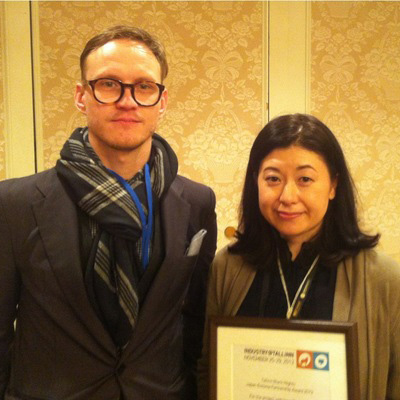
NEW DELHI: The first Tallinn Black Nights Japan-Estonia Partnership Award was presented to Kawaguchi Hirofumi’s Where the Peacocks Fly at the close of TIFFCOM Co-Pro Connection.
The award, initiated by Sten Saluveer, industry director of the Tallinn Black Nights Film Festival, goes to one of the five Japanese projects presented at TIFFCOM this week deemed to have the most potential as a European co-production.
![]() |
The winning project was chosen because the film-makers always had a European aesthetic in mind, including the hiring of a European Director of Production. The film’s producer, Kimura Misa will be invited to meet European investors in Tallinn next month.
Peacocks, a co-production between Japan and Myanmar, is about a 17-year-old cosplay idol who sets out to prove the innocence of the Burmese refugee blamed for killing her sister. She emails her fans to join her on a trip to Myanmar, transforming into a Fighting Peacock of justice.
Before presenting the award, Saluveer introduced his festival, noting that 40 per cent of the films are from Asia, and popular with their audience. He said the festival had been exploring how to work more closely with Asian producers for some time but only now has financial support from its government.
The other Japanese projects presented at the TIFFCOM event this week include Mariko Tetsuya’s exploration of violence All About Fighting, Sabu cross-media project Ten no chasuke and Jason Gray’s thriller Where Wolves Fear to Prey.
Producers attending the event said the event had been very useful in clarifying what opportunities were available in Japan. The project market operates on a small budget with no awards or official parties. It is looking at finding other partners who can present in-kind awards at next year’s event.

Hollywood
Disney to cut 1,000 jobs in major restructuring drive
Layoffs span ESPN, studios and tech as company pivots to growth
MUMBAI: The magic isn’t disappearing but it is being reorganised. The Walt Disney Company has announced plans to cut around 1,000 jobs as part of a sweeping restructuring effort aimed at sharpening its edge in an increasingly unpredictable entertainment landscape. The move, led by CEO Josh D’Amaro, reflects a broader internal reset as the company rethinks how it operates, allocates resources and competes in a fast-evolving industry. In a memo to employees, D’Amaro acknowledged the difficulty of the decision but framed it as a necessary step to ensure Disney remains “efficient, innovative, and responsive” to rapid shifts in consumer behaviour and technology.
The layoffs will span multiple divisions, including marketing, film and television studios, ESPN, technology teams and corporate functions. Notifications have already begun, signalling that the restructuring is not a distant plan but an active transition underway.
Importantly, the company has clarified that the cuts are not performance-driven. Instead, they form part of a wider transformation strategy aimed at building a leaner, more agile organisation, one better equipped to respond to streaming dynamics, digital disruption and evolving audience expectations.
The timing is telling. The global entertainment industry is in the middle of a structural shift, with traditional television revenues under pressure and box office returns becoming increasingly volatile. Meanwhile, streaming platforms and digital-first competitors continue to redraw the rules of engagement, forcing legacy players to rethink scale, speed and storytelling formats.
For Disney, long synonymous with blockbuster franchises and timeless storytelling, the pivot is both strategic and symbolic. The company is doubling down on technology, direct-to-consumer services and content ecosystems that align with modern viewing habits, where audiences expect immediacy, personalisation and cross-platform experiences.
Even as the restructuring unfolds, D’Amaro struck a note of optimism, reiterating Disney’s commitment to creativity and long-term growth. Support measures for affected employees are expected as part of the transition, though details remain limited.
In essence, this is less about cutting back and more about reshaping forward. As Disney redraws its organisational map, the message is clear, in today’s entertainment world, even the most magical kingdoms must evolve or risk being left behind.