Hindi
Fan….For Shah Rukh fans

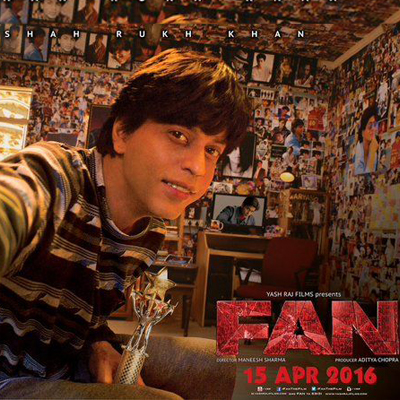
Fan is not a usual Shah Rukh Khan film in that it has no romance. While the banner, Yash Raj Films, is more known for their its for great musical scores, Fan has no scope for songs in its story.
The film is about a superstar, Gaurav Khanna, played by Shah Rukh, and his devoted fan, also played by Shah Rukh.
The fan is much younger and that look has been generated with the help of special effects. The fan’s life revolves around Shah Rukh and nature has been on his side in that his face bears similarity to that of the star. He is popular in his area as Junior (Shah Rukh), acts and behaves like the star and also imitates Shah Rukh in the local programmes to win prizes. There is not an inch left on the walls of his room which does not have pictures of various sizes and hues of his favourite star.

The fan’s one ambition is to meet Shah Rukh in person. And, he manages to win a prize of 20k at his area’s festival where he performs. He is the only son and his parents let him indulge in his hero worship. They even help as aides during his performance.
Having won the money, the fan is now ready to visit Mumbai and his star. The fan wants to follow in the footsteps of Shah Rukh and does whatever he has heard the star do on his first trip to Mumbai, that is to travel without ticket and stay in the same hotel and same room where Shah Rukh stayed. His parents also pack in a box of famous halwa for Shah Rukh.
Having reached Mumbai and checked into the same hotel room where his idol stayed, he is now ready to visit the star. Once there, he realizes that he is only one of the thousands thronging the bungalow of the star. His attempts to sneak in with the media inside the bungalow fail. The fan has not given up yet. He watches an interview of some new hero who has had a problem with Shah Rukh and got slapped in return. The fan barges into his vanity and forces him to tender an apology to Shah Rukh on record.
And the apology by the new star makes it to the media. But, in an unexplained way, the exploits of the fan are also recorded and somehow land up on Shah Rukh’s table. Worried that this may harm his image, Shah Rukh gets the fan arrested requesting the police to not put it on record, keep him for a couple of days and then dispatch him off back to Delhi. When they meet, the fan wants Shah Rukh to apologise to him for getting him beaten so badly by the cops which, the star refuses to do.
The fan has now turned vengeful. He won’t let the star get away without apologising. He now stalks Shah Rukh who is on a show tour of UK to be followed by a dance appearance at a big shot wedding. The fan is one step ahead and does things that would ruin the hero and succeeds so much so that Shah Rukh gets arrested in UK and gets accused of molestation at the wedding tamasha.
The police have no proof against the fan and it is now left to Shah Rukh to find the fan and put an end to his mischief which is costing him dearly. He tracks down the fan to his home in Delhi when, again, it is the time for the annual festival and for the fan to do his Shah Rukh act. Some gunshots, a chase and a hand to hand follow. Shah Rukh’s problem ends but not the way he wanted and not sure the viewers would want either.
Fan is a dry film which does not quite manage to take a grip. With just Shah Rukh on the screen in either of his versions, and not much of a supporting cast, it provides no relief of any kind. The fight between two Shah Rukh is not convincing and looks lopsided with the fan looking like a kid being beaten up mercilessly by the star. The climax is not justified. The film needed some more trimming. There are some variations in the look of the Shah Rukh the fan.
Performance wise, while the star Shah Rukh is his usual self, Shah Rukh the fan is excellent. Sayani Gupta, Yogendra Tiku and Deepika Amin are good in support.
Fan has had a fair beginning, cashing in on a general holiday (Ram Navami) opening, and has appeal mainly for die hard Shah Rukh Khan fans.
Producer: Aditya Chopra.
Director: Maneesh Sharma.
Cast: Shah Rukh Khan, Deepika Amin, Yogendra Tiku,
Sayani Gupta.






Hindi
Rashmika Mandanna, Shanaya Kapoor and Naila Grrewal climb IMDb’s Indian celebrity rankings
Upcoming films and returning shows are driving fan interest across Bollywood and streaming

MUMBAI: Bollywood’s popularity contest has a new weekly scorecard, and the numbers are telling. IMDb’s Popular Indian Celebrities list for this week places Shanaya Kapoor at number six, buoyed by buzz around her film Tu Yaa Main. Naila Grrewal slots in at seven on the back of the returning comedy series Maamla Legal Hai, while Rashmika Mandanna climbs to eighth, riding mounting anticipation for Cocktail 2.
The list, available exclusively on the IMDb app for Android and iOS, tracks trending Indian entertainers and filmmakers each week, drawing on data from more than 200m monthly visits to the platform worldwide.
Further down the rankings, Raaka is keeping two of its biggest names in the spotlight. Deepika Padukone holds 11th position, with Allu Arjun close behind at 13th, as the film continues to find traction with audiences.
The list offers fans a weekly pulse on who is breaking through, who is holding steady, and who is fading. It is a barometer as unsparing as the box office itself.







