MAM
WPP Q1 2013 revenues grow 6%; looks to maintain tempo

MUMBAI: Sir Martin Sorrell‘s charge is doing very well, thank you. Take a dekko at the Q1 2013 financials that the global advertising and marketing leader WPP has posted. Revenue growth is at 5.85 per cent, which seems not much, but it is far better than some of its peers‘ performances (Omnicom at 2.8 per cent and IPG at 2.4 per cent). Revenues were at ?2.53 billion as against Q1 2012‘s ?2.39 billion.
On a like-for-like basis, excluding the impact of acquisitions and currency fluctuations, revenues were up 2.1 per cent with gross margin up 1.9 per cent compared with the same period last year.
North America led the media communications conglomerate‘s growth by contributing 35 per cent of the total revenue pie followed by the Asia Pacific, Latin America, Africa & Middle East and Central & Eastern Europe region at 29.1 per cent. Western Continental Europe accounted for 23.4 per cent of WPP‘s Q1 2013 revenues while United Kingdom pitched in the rest 12.5 per cent. The UK and the Asia Pacific Asia Pacific, Latin America, Africa & Middle East and Central & Eastern Europe region were the only two regions which showed a growth in share of the revenue pie.

Business sector wise, advertising and media investment management continued to be the strongest sector accounting for 40.8 per cent of the total revenues, followed by branding and identity, healthcare and specialist communications with 27.3 per cent, while consumer insight and public relations and public affairs made up 23.2 per cent and 8.7 per cent respectively.
In line with the group‘s strategic focus on new markets, new media and consumer insight, WPP completed 13 transactions in the first quarter. Nine acquisitions and investments were classified in new markets (of which eight were in new media), two in consumer insight, including data analytics and the application of technology and two driven by individual client or agency needs.
Specifically, in the first quarter of 2013, acquisitions and increased equity stakes have been completed in advertising and media investment management in Canada, Colombia, Hong Kong, Indonesia, Myanmar, Philippines and Thailand; in consumer insight in the United States and Myanmar; in public relations and public affairs in China; in direct, digital and interactive in the United States, the United Kingdom, South Africa, Turkey, Argentina, Brazil, Colombia, Uruguay and Australia, says the media group‘s release.
WPP gained a total of ?940 million in net new business wins (including all losses) in the first quarter, compared to ?1.159 billion in the same period last year and in line with the quarterly average in 2012 of approximately ?940 million. Of this, JWT, Ogilvy & Mather, Y&R, Grey and United generated net new business billings of ?281 million.
Also, out of the group total, GroupM, its media investment management company,which includes Mindshare, MEC, MediaCom, Maxus, GroupM Search and Xaxis, together with tenthavenue, generated net new business billings of ?465 million ($743 million).
In its financial guidance for the rest of 2013, WPP says “our prime focus will remain on growing revenues and gross margin faster than the industry average, driven by our leading position in the new markets, in new media, in consumer insight, including data analytics and the application of technology, creativity and horizontality. At the same time, we will concentrate on meeting our operating margin objectives by managing absolute levels of costs and increasing our flexibility, in order to adapt our cost structure to significant market changes and ensuring that the benefits of the restructuring investments taken in 2012 are realised.” It has targeted like-for-like revenue and gross margin growth of 3 per cent and also improving its operating margins by half a point.







MAM
One Hand Clap acquires Agenseed to enter distribution space
Creative agency expands into full-stack services with strategic buyout.
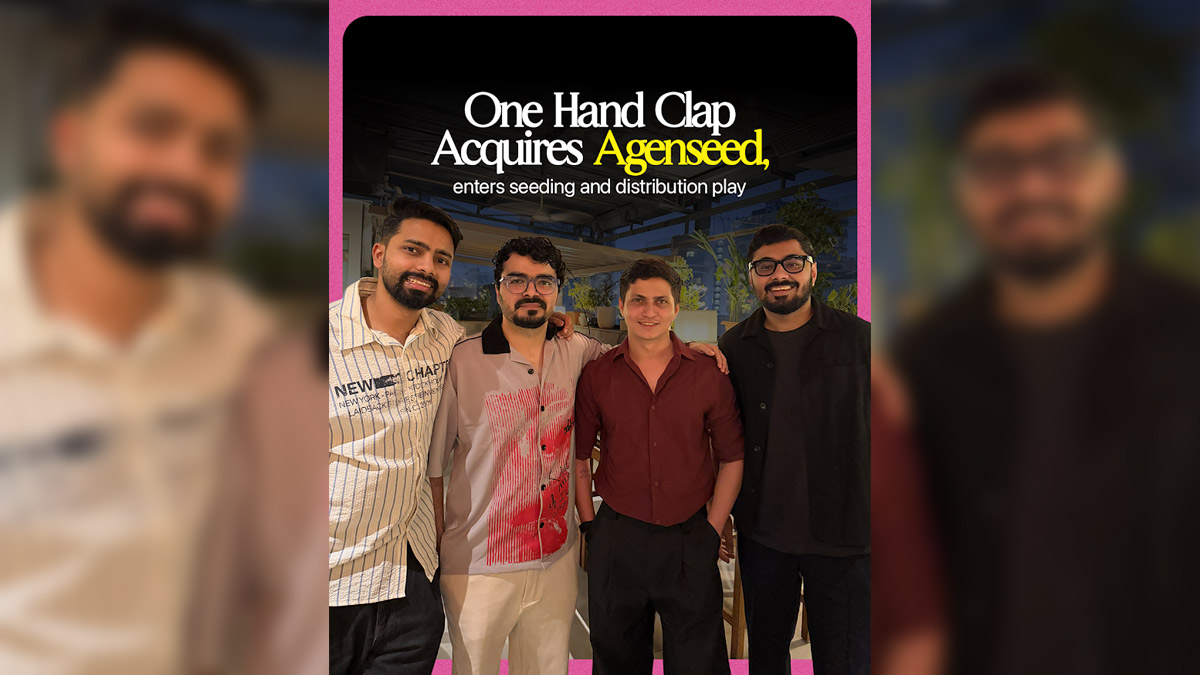
MUMBAI: One Hand Clap has decided to stop just clapping for great ideas now it wants to make sure they actually travel. The leading new-age creative agency and production house has acquired Agenseed, a seeding and distribution firm, marking its formal entry into the distribution segment. The move is aimed at expanding its role across the entire marketing value chain and unlocking new growth opportunities.
One Hand Clap expects the new distribution vertical to contribute up to 15 per cent of its overall revenues over the next 12–18 months, signalling a clear strategic shift beyond pure creative services.
Agenseed, founded by Monish Hardasani and Akram Malik, will function as the agency’s dedicated distribution arm. This acquisition strengthens One Hand Clap’s position as it aims to become a full-stack creative and distribution company in India’s rapidly growing digital advertising market.
With over 90 million posts shared daily on Instagram and brands allocating 25–35 per cent of their digital budgets to distribution and creator-led reach, amplification has become critical to campaign success. By integrating distribution early into the creative process, the agency hopes to help campaigns gain stronger cultural traction and momentum.
One Hand Clap founder Aakash Shah said, “The future of advertising is not just about executing great ideas, but about placing them intelligently. By owning both storytelling and distribution, we can drive greater impact for brands while opening up new revenue streams.”
Agenseed co-founder Monish Hardasani added, “The future belongs to ideas designed to travel. This partnership allows us to integrate distribution thinking at the source.”
Founded in 2019 by former AIB leaders Aakash Shah and Naveed Manakkodan, One Hand Clap has worked with major brands including Swiggy, Google, Netflix India, Crocs, Duolingo, CRED, Bumble, BGMI and Chetak. The agency also secured investment from Zerodha co-founder Nikhil Kamath last year.
In an increasingly fragmented attention economy, this acquisition reflects a broader industry shift where agencies are building end-to-end capabilities to stay competitive. One Hand Clap is clearly clapping louder and ensuring its ideas now reach much further.






