MAM
Tourism Australia’s new ad campaign invites India, the world to come and say G’day

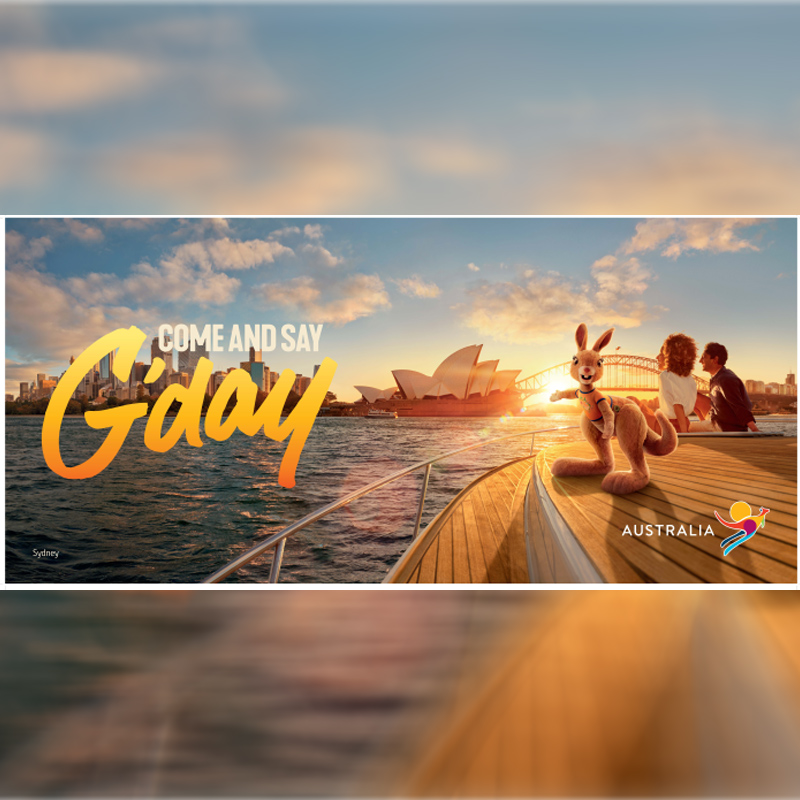
Mumbai: With the Twenty20 World Cup currently taking place in Australia, the eyes of cricket fans in India are down under. Looking to capitalise on this momentum, Tourism Australia has created a live-action short film with CGI animated characters. The short film, G’day, is part of a new global tourism campaign inviting international travellers, including those in India, to come and say G’day, and plan and book an Australian adventure of their own. Directed by Australian director Michael Gracey (The Greatest Showman) and produced by Finch, G’day, the short film shows the unlikely adventure of a plush souvenir kangaroo named Ruby, voiced by Australian actor Rose Byrne, and a toy unicorn, Louie, voiced by actor Will Arnett.
The short film follows Ruby and Louie as they ‘break out’ of a gift shop on the Great Barrier Reef and take an incredible adventure around Australia, visiting iconic sites including Sydney Harbour, Melbourne’s laneways, and stunning natural landscapes like Uluṟu and Nitmiluk Gorge. Along the way, they explore the magnitude of travel experiences Australia has to offer, connect with Australia’s Indigenous cultures, and learn why every great adventure starts with the unmistakably Aussie greeting, “G’day!”
The campaign can be seen on YouTube, Meta’s properties Facebook and Instagram, and on other programmatic video platforms. The goal is to target high-yield travellers. On 9 November, the campaign will launch on the OTT platform Disney+Hotstar for a one-month period. This deal could be extended. OOH and in-cinema advertising will also be used. Billboards across Mumbai, Delhi, and Bengaluru are being used. Print is also being used. For now, television is not being used.

The campaign video is the first iteration of a campaign that will run for three years. In terms of marketing, 10 influencers from India have been taken down. They will see the India versus Pakistan clash on Sunday at the MCG and will partake in a variety of activities. They will create content around it for their followers to consume and promote Melbourne and Australia as a destination. Tourism Australia has also taken 20 travel agents to the country for the T20 World Cup. On the ground, there will be Ruby On Tour roadshows across seven cities in India next month and in December.
The campaign video will be edited into nine minutes, one minute thirty seconds, and fifteen seconds. In some markets, like Japan, the campaign is being fine tuned through the use of local talent. Tourism Australia added that visitor arrivals from India have reached 86 per cent of pre-covid in the April-August 2022 period compared to the same period in 2019. The aim is to go to 100 per cent in the coming few months. Earlier, Tourism Australia had set a target of 18,000–20,000 visitor arrivals from the country to see the T20 World Cup. While the International Cricket Council (ICC) will officially reveal visitor figures at a later date, Tourism Australia is confident that its target will be achieved. The marketing programme is pretty robust, it added.
In fact, visa processing is still going on for Indians who want to travel to see Sunday’s clash between archrivals India and Pakistan. In the long run, the goal is for one million Indians to visit Australia each year by 2030. For that to happen, direct aviation capacity will have to rise fourfold at least. In 2019, the number was 4,00,000. Moreover, since Australia re-opened its borders and commercial flights restarted, India has been the number two market. Earlier, it was number seven. Australia’s neighbouring country, New Zealand, is the number one market. Singapore, the UK, and the US round out the top five markets. China was earlier number one in terms of visitors to Australia, but it has been badly affected by the pandemic.
Tourism Australia MD Phillipa Harrison said, “Come and Say G’day is unashamedly and unmistakably Australian. After a challenging time around the world, our uplifting and joyful campaign will stand out in what is a highly competitive international tourism market.”
The campaign activity will be further amplified by partnership activity with airlines, state tourism organisations, and key distribution partners, including Thomas Cook, SOTC, PickYourTrail, and Kesari Tours, among others.
G’day, Indigenous cultures and peoples are at the heart of the story, and their warmth can be felt throughout, explains tourism in Australia. The musical score, written by Australian composers Jonathan Dreyfus and Amy Andersen, features Indigenous Australian musicians including William Barton, Frank Yamma, the Marliya Gondwana Indigenous Girls Choir, and the Iwiri Choir. Notably, the film features a fresh new cover of the classic Aussie song Down Under, which was produced in collaboration with Men At Work’s Colin Hay for the campaign and film.
Harrison concluded, “Another hero of the campaign is the remake of the Australian classic song Down Under by up-and-coming Australian band King Stingray, who sing in both English and Yolŋu Matha, an Indigenous language from northeast Arnhem Land in the Northern Territory.”
Tourism Australia regional GM South, South East Asia Brent Anderson said, “ The campaign is a genuine, warm Aussie welcome. It is about how the world sees us. What is appealing about us? We did a huge amount of research during COVID. Ruby is an absolute icon that cannot be used by any other country in the world. She comes through really quickly in the advertising. India, among other South and Southeast Asian (SSEA) markets have been critical in Australia’s recovery and I’m really excited to reveal our new campaign to inspire even more Indian travellers to explore Australia. Through Ruby and Louie’s adventures, we are inviting travellers to Come and Say G’day – where they can build new authentic connections with friendly Australian locals and communities, our incredible nature, wildlife, islands and beaches, and enjoy our delicious food and drink. We are ready and can’t wait to welcome back our valued travellers from India. We are excited to announce that we have Qantas as our major airline partner across multiple markets, including here in India. You might see Ruby hopping on a Qantas plane in the near future.”
With issues like stagflation, inflation, the Russia-Ukraine crisis, and interest rates going through the roof, the world is a bit messed up. The world is a strange place. It needs a bit of laughter, lightness, beautiful scenery, and wide open spaces. That is the result of research conducted. Tourism Australia, he explained, studied what people look for in a vacation. Therefore, in the campaign, one sees things like wide open spaces. He said the campaign also focuses on the indigeneous experience. He added that the reason why India is the fastest growing market for Tourism Australia is that the Indian team pushes hard. There is also healthy competition from the Singapore team.
He also noted that the department of home affairs’ personalised and streamlined visa services offered for corporate incentive travel and the ICC’s official travel and hospitality agents will ensure sustained growth when it comes to MICE arrivals as well as for the on-going T20 World Cup. There has also been a tripling of direct aviation capacity. Besides India the other markets that Tourism Australia invests money in include Singapore, Malaysia, Indonesia, Japan, South Korea, Hong Kong, Germany, France, Italy, the UK, the US and New Zealand.





MAM
Lego brings Messi, Ronaldo, Mbappé, Vinicius together
Campaign clocks 314 million views ahead of FIFA World Cup 2026 buzz.
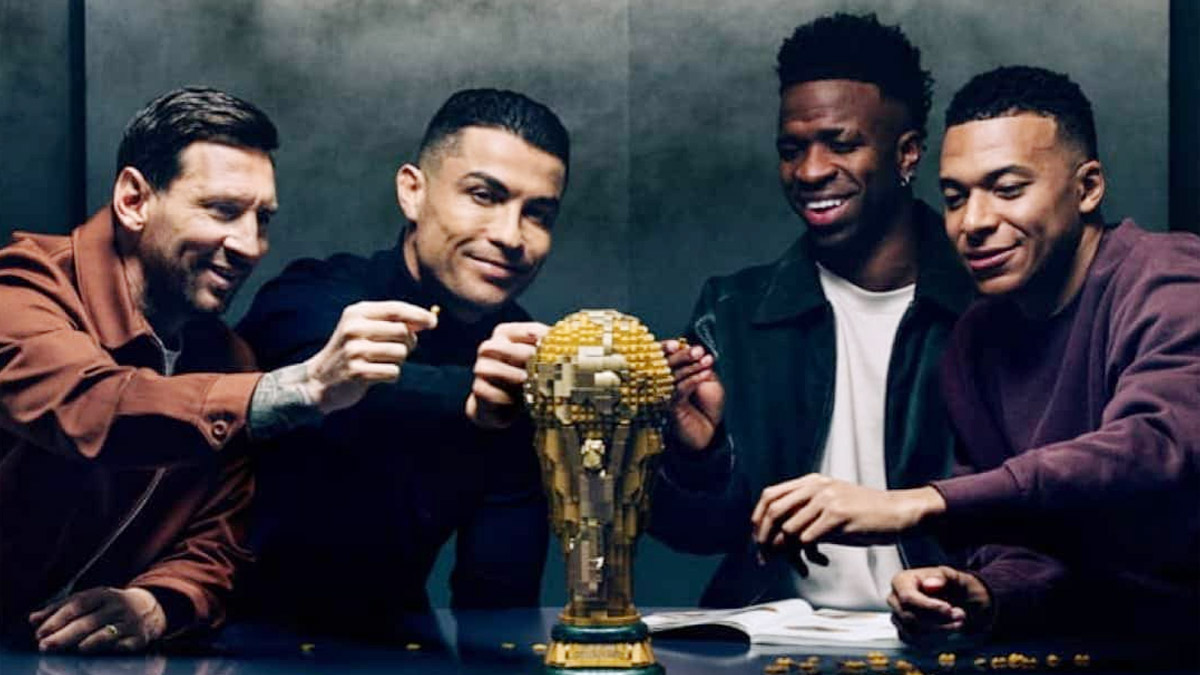
MUMBAI: Four legends, one frame and not a single tackle in sight. Lego has pulled off a crossover few thought possible, uniting Lionel Messi, Cristiano Ronaldo, Kylian Mbappé and Vinícius Júnior in a single campaign ahead of the FIFA World Cup 2026 only this time, they’re building dreams brick by brick.
Titled “Everyone wants a piece”, the campaign features the quartet assembling a Lego version of the World Cup trophy, before placing miniature versions of themselves atop it, a playful nod to football’s ultimate prize. Shared widely across social media, the ad carries a pointed disclaimer: it is not AI-generated, a subtle but telling signal in an era where even reality is often questioned.
The numbers tell their own story. The campaign has already crossed 314 million views on Instagram across the players’ accounts, with fans hailing it as a rare, almost nostalgic moment particularly for the reunion of Messi and Ronaldo, whose last shared campaign ahead of the 2022 World Cup became one of the platform’s most-liked posts.
Beyond the film, Lego is extending the play with exclusive, player-themed sets tied to each of the four stars, part of a broader football-led programme designed to ride the global momentum building towards 2026. The idea, as echoed by the players themselves, leans into the parallels between football and play experimentation, creativity, failure, and triumph.
Messi described the sets as a way to bring on-pitch moments into an imaginative, hands-on world, while Ronaldo called the transformation into a Lego figure a rare honour, blending sport with storytelling. Vinícius, meanwhile, struck a more personal note, recalling childhood moments of building with Lego and framing creativity as a universal language that transcends borders.
The timing is no accident. With the 2026 World Cup set to run from June 11 to July 19 across the United States, Canada and Mexico, and featuring an expanded 48-team format, global anticipation is already building. Argentina, led by Messi, will enter as defending champions, adding another layer of intrigue.
For Lego, the campaign does more than celebrate football, it taps into its mythology. Because when icons become figurines and rivalries turn into play, the beautiful game finds a new kind of pitch. one built, quite literally, by hand.






