MAM
Thought leaders discuss future of MarCom at IAA World Congress day 2

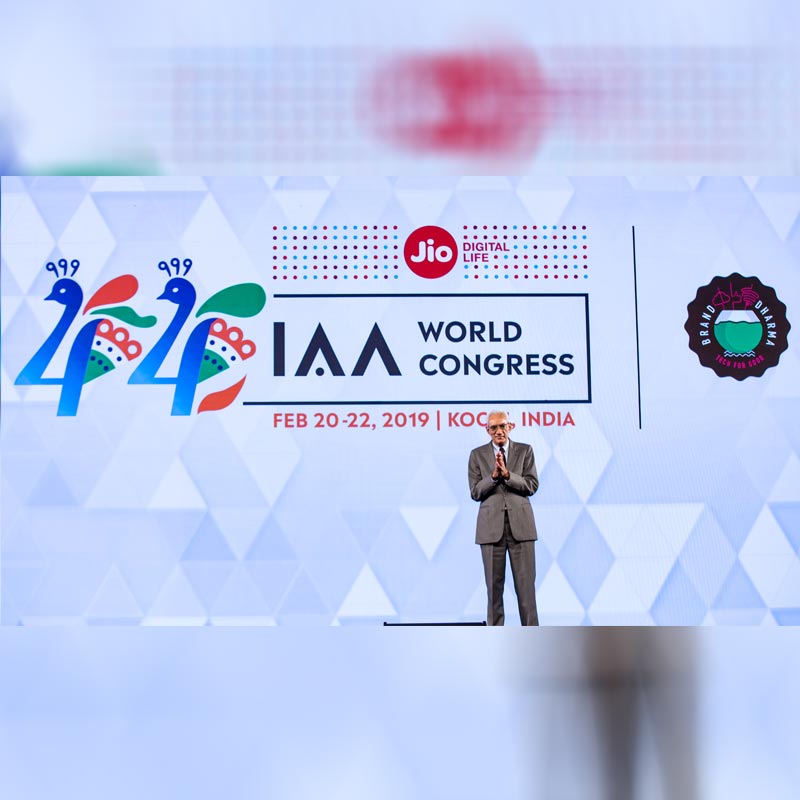
KOCHI: The International Advertising Association (IAA) had an enthralling second day of the first ever IAA World Congress in India. The second day of the event saw a great mix of thought leaders, entertainers, domain experts and industry professionals discussing the future of the marketing and communications industry through the theme ‘Brand Dharma’.
Yusuf Ali, chairman and owner, Lulu Group, was felicitated by Srinivasan Swamy, chairman & world president, International Advertising Association. In his speech, keeping with the theme of the conference, he reiterated to all the marketing and communications stakeholders to act responsibly towards the society and stay true to their business values.
The IAA Golden Compass Awards were conferred to Marc Pritchard, chief brand officer, Procter & Gamble and Andrew Robertson, president & CEO, BBDO Worldwide. The IAA Inspire Champion Awards was conferred to Raj Nayak, former chief operating officer at entertainment network Viacom18 from India. The IAA Inspire Honorary Life Member Award was conferred to Ranil De Silva from Sri Lanka.

Excerpts from key sessions:
Paul Polman, President of the ICC, Chairman of the B-Team and Vice-Chair of the UN Global Compact. CEO Unilever (Jan 2009 to Dec 2018) gave a passionate talk and urged companies to run their businesses by heart, because he felt that businesses can't succeed in a society that fails.
Polman stated that value and trust are two important elements for a company. However, currently, trust is low in the industry because of fake news, frauds, unethical employment practices, sexual harassment etc.
As advertisers, we should look and hear from a consumer’s view point since consumers judge us by what we do, not by what we say. One won't have long term profit if the business is run without purpose. Citizens expect companies to address on critical social issues. If businesses don’t have advocacy, consumers won't trust a brand.
In this world we have enough to fulfil human needs but not human greed. He mentioned to face the challenges we face today we have to look to decarbonize, have longer term business model, move towards circular economy and be sure to have inclusive economy, We have to take stereotype out of Advertisement. Drive social standards on social platforms.
He further stressed that “You cannot run business with freedom without responsibility. If we don't protect it, we won't have a future. Partnership is important to work on sustainable growth. A partnership, which is for a common good. Putting other's interests before ours is very important because although we have the resources to help the society, all we are missing is human will power. Tech has connected us better with people, but has also given us loneliness. He closed his speech by requesting the audience that “if you belong to 2% of population, think about 98% population and live responsibly.”
Simon Kahn: Chief Marketing Officer on Future of Digital Immersion
According to Kahn next wave of technology will assist us, augment our experience and will help us accelerate things we need to get done.
The digital tech has started to help us in all practical areas, most progress which we have seen is in the area of speech recognition. We are now up to near human quality in speech recognition. In India recently, we worked with Flipkart when wanted to add the experience of haggling for the big billion day sales and it the result was many millions interaction with the tool with average time of engagement for min 6 minutes. Communication is also about gesture and nonverbal cues, hence we are training computers to replicate the same hence breaking down physical world barriers
We are moving from the world from online to offline to the non-line world, augmenting our experience. Think about handmade tailor-made clothes with so many processes. We hot involved with ZoZo town, the largest online fashion store in Japan for an application called ZoZo suit that can take 15,000 measurements of your body so the clothes fit exactly as you want.
Another ability we have developed is to use camera to be able to put it for practical use and that’s why we develop google lens. You can do a lot with google lens and make it more insightful and use it for practical application
We are able to accelerate a lot of change through Tech with advancement in AI and Machine Learning, now we can address fundamental challenges of human race. We have an open source platform that help people tackle issues in developing countries. For example we have trained computer model to do diagnose health issues like diabetic retinopathy and cardiac problems and we are already close to level of specialists.
In India we are working with start-ups like nebula that is working for challenge for rural community for fair pricing of their agricultural produce. Their team uses grains to sample the quality to settle on price so they don’t have to be at a disadvantage by selling cheaper to traders at the same time consumers have the exact information on what they are buying
Radical changes are coming in next few years, digital tech s will transform and will become will assist us, augment our experience and accelerate our learning to to tackle biggest problem faced by the humanity
Tom Doctoroff, Business Leader and Global Brand Builder on Derisk the future in conversation with Michael McQueen, Trend forecaster and Author and Tim Reid, Comedy Writer and Innovation Expert
Tim Reid, Comedy writer and innovation expert: imagine the future and reinvent business:
“Best ideas come as jokes make your thinking as funny as possible” Tim started his presentation with this counter intuitive statement
He suggested, “What makes is laugh are two things, first is the truth (as it is relatable) and the second is surprise, we experience, when something doesn’t quite fit in in the normal trend. Truth with the twist is the biggest thing that make us laugh. In an idea session, if we can get people to say something which has point of truth with an element of surprise and you will probably see a genius idea there somewhere and hence there is a science behind it creativity works better with humour.
When you launch, you stimulate the part of the brain associated with problem solving and creative thinking.
· You have to Be Playful , be childish with the idea of outcome
· Be Brave best ideas come as joke I think this might people make people laugh and I am going to say it
· Act It out getting ti improv gets us to more creative with the brands
· Knowing how to Push it an idea allow us to not settling for an average idea
Michael Mcqueen, who has done a lot of work with the millennial on what are they thinking and what are they looking at, shared his insights on decoding the millennial mind-set and how do we bridge the gap with next gen the millennial in advertising world.
There are 34% millennial population in India, which is very important numerically and economically as they will enter spending peak by 2026.
The generation X, as we know, is digitally tethered and constantly switched on and addicted to the digital screens. Around 54% of their total purchase was made online and only 11% of the millennial would prefer to visit physical stores before making a purchase, and brands should remember that.
They are also experience driven as 78% of them cash on experience rather than physical item. Hence, the brands have to create an experience. The experience should also be sharable on the social media platforms as 70% of the millennial would buy a product only if it is sharable on social media platforms.
The generation is also socially minded as 2/3rd of them project their choices on the basis of corporate values and ethics. Around 73% population buys a product on the basis of how sustainable the business model is and whether or not a brand lives up to its corporate values.
McQueen also advised the marketers to market their products through them and not to them.
Marc Pritchard, Chief Brand Officer, Procter & Gamble:
Marc Pritchard started the conversation with an interesting proposition of ‘What if brand could be force for good and a force growth’. He emphasised on living the brand’s purpose and not just talk about it.
He stressed on the need of brands to align themselves with a purpose. He covered three major problems faced in the business diaspora; Gender Equality, Sustainability and Technology.
Gender equality is not equal and gap are more pronounced for women with colour, LGBT category and with physical challenge. In the advertisement industry, 29% of women are still inaccurately or negatively portrayed. He further added, people expect more from brands. They want the brand to take a stand on the social issues. 9 out of 10 consumers want brands to live with their values, they want brands to take stand.
In sustainability there is a difference between what people say and do. 67% of the population talks about sustainability but only 30% of them actually act on it. Sustainable goals are equally good for the growth of the brands. Advertising affects our language what if brands improve society buy promoting gender equality. Brands are still using 29% if time women as inaccurately or negatively we have to eliminate this stereotypes changes attitudes and drive growth. He questioned what if brand could help the environment by driving sustainable behaviour what if brands can make products that our sensitive to this issues. He spoke about how P&G is doing its bit by using technology is work on a product that can eliminate need of water in cleaning,
I urge to reduce renew and recycle water, energy and waste. It will be nice if all brands can come together. My call of action is all brands to join to achieve this.
Technology: Digital advertising. has changed the face of advertising , e commerce is growing ,new brands are bypassing media networks. The Pervasive data, analytics and tech is changing everything. Things like block chain, AR, VR and AI is affecting all aspects of daily life
I would like to Pivot and use tech go beyond and reinvent and see if brands can use cutting edge tech to improve everyday life. We have to careful of unbridled growth of tech on security and privacy, we cannot let this happen, we have to get ahead of next gen tech and hence we should unite as an industry and take action for tech for good. We have to set standard of ethical use of machine learning and my call of action is to put standard and policies in place so that tech is used for good.
If all these thee done well and together collectively we can have power full impact. This will require for all the brands to step up and become a force for good.
Chris Tung , CMO, Alibaba, A unique Alibaba model for brand growth
This is my first time India, and to personally the fastest growing economy Alibaba is constantly are posting year on year of revenue growth and I would like to share the secret of driving such growth Alibaba did start as an ecommerce company for international trade but Alibaba , as a company now does pretty much everything in china. Alibaba is now combination of Amazon+Facebook and Google Alibaba has built an ecosystem of brand building for the future. Alibaba is uniquely positioned as provider of a single source of consumer truth by Digitalising the entire lifecycle of consumer brand relationship.
Mark D’Arcy, VP of Global Business Marketing and Chief Creative Officer, Facebook
(In conversation with Neeraj Roy) on Crowd Sings Back – The Best Ideas Shaping Culture Are Shaped By Culture
India is 2nd largest market for FB. In 2 years the country has seen 10x growth in data penetration, as the data gets cheaper. In US, digital will eclipse traditional with 54% spending.
Media should shift where people are and where they consume content. There are so many changes around, that we forget the simple things around and the incredible era we are living in. People have a potential to act on any idea they have through the resources available.
He shared some interesting advice for the mainstream brands on content marketing to be always being interesting and relevant, the right place for the brands is to start is the audience and customer and how there is a constant need of listening to people and reaching out to them accordingly.
Facebook has a Fundamental responsibility to protect the data of all users and make space for everyone to connect across globe. Facebook has a responsibility to businesses and individuals to open the platform, remove barriers and take the ideas of individuals to as many people as possible.
Currently 6 million companies using are the platform to take their products to people. We would like to give control to people and transparency to be provided in terms of their data and create value out of the data consumer provides. People tell us how they want to use the tech and it's our job to meet those needs.
The journey from attention to action is interesting. All the touch-points in the journey should be engaging and seem-less. FB is deeply committed to innovation too. We have curiosity of constantly learning as an organisation is important. It helps in growing the business and help improve the culture.
Rahul Welde, EVP Digital Transformation, Unilever, Getting Future Ready – The Unilever Way
In past, the scenario was simple. A marketer would make a TVC that would create an impact which will lead to purchase of a product. In today’s digital world, there are multiple channels to reach-out to the customer making it difficult to create an impact. Hence, for the digital age five most important elements to consider in the marketing communications are technology, machine learning, data driven marketing, automation and personalization in messaging.
Today, internet is the biggest focus group where you can get 10000+ participants to share their opinion and help curate the content. All these opinions and information flows in real time helping to break customer segment and target specifically.
The biggest change in marketing and technology sector is speed. The results are quick which enables faster changes meeting the needs. Apart from technology, the most important assets in marketing are skills and talent. To make a greater impact, one needs to have a skilful leadership and talent pool in the organisation.
Lindsay Pattison, Chief Cient Officer, WPP, Getting Future Ready – The WPP Way
Disruption is affecting everybody and every brand. India has a 14% ad spent growth which is highest in the world, making it the most potential market for the advertisers.
The world of the clients is changing on following fronts:
·Intense disruption in fourth industrial revolution, transforming consumer behaviour
·New competitors making disruption a business imperative
·Mega data available but tensions of being useful vs privacy & regulation
·Making the best use of newest technologies requires open-ness
·Brand purpose is more important than ever to sustain a competitive edge
Ms. Lindsay ended her address to the congress by defining the pillars of marketing communication as:
· Communication: Breakthrough creativity and thinking that differentiates and inspires
· Experience: Experience is the interaction between business and consumer across thousands of touch-points online and offline
· Commerce: technology has upended where, how and when consumers undertake the most important action for business, Purchase
· Technology: technological innovation is the differentiator that divides the disruptor from the disrupted



Apple rarely announces minor updates with much fanfare, and iOS 26.4 is no exception. No dramatic redesigns, no flashy keynote moments. What it delivers instead is a focused set of improvements that sharpen the experience you already have. If that sounds underwhelming, spend a week with it. You will change your mind.
Apple Music Learns to Listen Better
The biggest shift in this update lives inside Apple Music. Apple has brought AI-powered playlist generation to the app, and it works on mood rather than genre. Type something like “rainy evening at home” or “running late on a Monday,” and it builds a playlist that actually fits. This is not algorithmic guesswork dressed up in new clothing. It genuinely reads the intent behind vague descriptions and responds well.
Alongside this, a new concerts feature scans your listening history and surfaces live events happening near you. It is a smart bridge between your digital music habits and real-world experiences. Apple is quietly making the case that a music app should do more than just play songs.
Shazam also gets a meaningful upgrade. It can now identify songs without an internet connection. This might sound like a minor convenience, but anyone who has tried to Shazam something at a crowded venue with patchy signal will tell you it is anything but minor. The feature works locally on-device, which also means it is faster.
CarPlay Gets Smarter Controls
CarPlay has been updated with deeper integration for intelligent voice assistants. The goal is to reduce how often drivers need to look at a screen or tap anything at all. You speak, things happen. It is a clear step toward making the driving experience safer without stripping away functionality. The integration feels natural rather than bolted on, which is a harder thing to achieve than it sounds.
The Fixes You Feel Every Day
This is where iOS 26.4 earns its keep. Keyboard responsiveness has been improved, and the difference is noticeable immediately. Typing feels more accurate and less combative. Accessibility features have been refined across the board, with better contrast options and adjusted spacing that makes the interface easier to read without forcing you into larger text sizes.
The Health app has also been updated. It now surfaces more actionable insights from your daily data rather than just displaying numbers. If your sleep patterns have shifted or your activity levels have changed, the app now contextualises that clearly instead of leaving you to interpret raw figures on your own.
These are the kinds of changes that do not photograph well for a press release. They also happen to be the ones that make your phone feel genuinely better to use.
A Few Other Additions
New emojis have been added in this update. They will find their way into your conversations faster than you expect. Family Sharing has also been updated, with more granular control over shared payments and subscriptions. If you share an Apple account with family members, this puts clearer limits on who can spend what, which has been a long-requested fix.
What This Update Actually Represents
iOS 26.4 is Apple doing what it does best when it is not trying to make headlines. Every addition here serves a clear purpose. The AI music features are genuinely useful. The CarPlay improvements address a real safety concern. The small UI fixes accumulate into a noticeably smoother daily experience.
There is no bloat. Nothing feels experimental or half-finished. That discipline is harder to maintain than it looks, especially as operating systems grow more complex with each passing year.
If you have been holding off on updating, this is the one worth installing.






