AD Agencies
The puzzling case of TRAI’s ad cap

MUMBAI: The Telecom Regulatory Authority of India (TRAI) found some unlikely supporters on the ad cap issue last week. On the one hand, Zee Entertainment, Star India and Viacom18 approached the Telecom Disputes Settlement and Appellate Tribunal (TDSAT) saying that they were in favour of a limit to how much advertising should be allowed per hour and that they would like to become respondents to the cases filed by other broadcasters. Among these figure the News Broadcasters Association (NBA), regional and music channels all of whom have been opposing the regulation and have sought relief from the tribunal. The other supporter of the ad cap is an NGO called MediaWatch which said the ad cap should be extended to cable TV also and that TRAI should also ensure that broadcasters don’t cross the line on audio levels of commercials and also specialised ad formats on the TV screen.
Though the intervention filed by Zee, Star India and Viacom18 was rejected in the hearing that took place on 31 October, the tribunal has asked the networks to file a separate application, which would be heard only after the main case filed by NBA, music and regional channels, the next court hearing for which is 11 November.
“Well! We had filed for an intervention which was postponed,” is what Star India president and general counsel – legal and regulatory affairs Deepak Jacob said when Indiantelevision.com contacted him to enquire more about the case. However, he refused to divulge any more on the matter.

The three mainline Hindi GECs have been following the 10+2 ad cap regulation since 1 October, which was the deadline set by TRAI.
Industry watchers are asking what is it that made the three networks come out so blatantly in support of the ad cap when fourth network Sony Entertainment has not been following the TRAI diktat at all?
“They are in a position of strength as they have a tremendous share of viewer eyeballs,” says a media observer. “Hence, they can afford to take a hard stance in favour of the ad cap. Their belief is that advertisers have no alternative but to advertise on their channels. Their following the ad cap allowed them to jack up air time rates which more than made up for the drop in inventory. They would ideally like the status quo of lower advertising time to continue as it has benefited them and will continue to benefit them because paucity will result in better yields and rates.”
Another media observer believes that the approaches that the leading GECs have taken will add to the chaos and confusion. “The TV broadcast industry seems to have learnt very well how to stall any disruptive regulatory changes,” says a media planner laughingly. “You have several opposing and pro-voices speaking up at the same time which tends to lead to policy paralysis.”
She elaborates: “On the one side, the advertisers, agencies, news broadcasters, music channels and niche channels are against the TRAI ad cap. One of the major networks are also opposing it; while the other three are showing that they want it. It will be tough for anyone to decide which direction should things move. If the ad cap is on – in an election year – the news channels will take umbrage and the government cannot afford to have a negative fallout in an election year. If the ad cap is stalled for a while, that is good for everyone: the leading GECs have already got rate hikes of some sort; Sony can join in and hike rates and finally the news channels will not be faced with shriveling air time revenues. So they will be happy.”
“We are also taking a leadership position by complying with the TRAI regulations,” says an executive with one of the three networks. “We believe the time for change on TV advertising is now and hence are supporting it.”
What move will the telecom industry’s conscience – the TDSAT – and the regulator – TRAI- make next? Our guess is as good as any, but the ad cap game play is surely beginning to resemble a very complicated game of chess.





AD Agencies
Kevin Vaz opens FICCI-EY report with a declaration: India’s M&E industry set to breach Rs 3 trillion mark by 2027
In a keynote address at the FICCI-EY report launch, Kevin Vaz says sport, AI and the connected TV boom are driving a multi-screen revolution with no signs of slowing
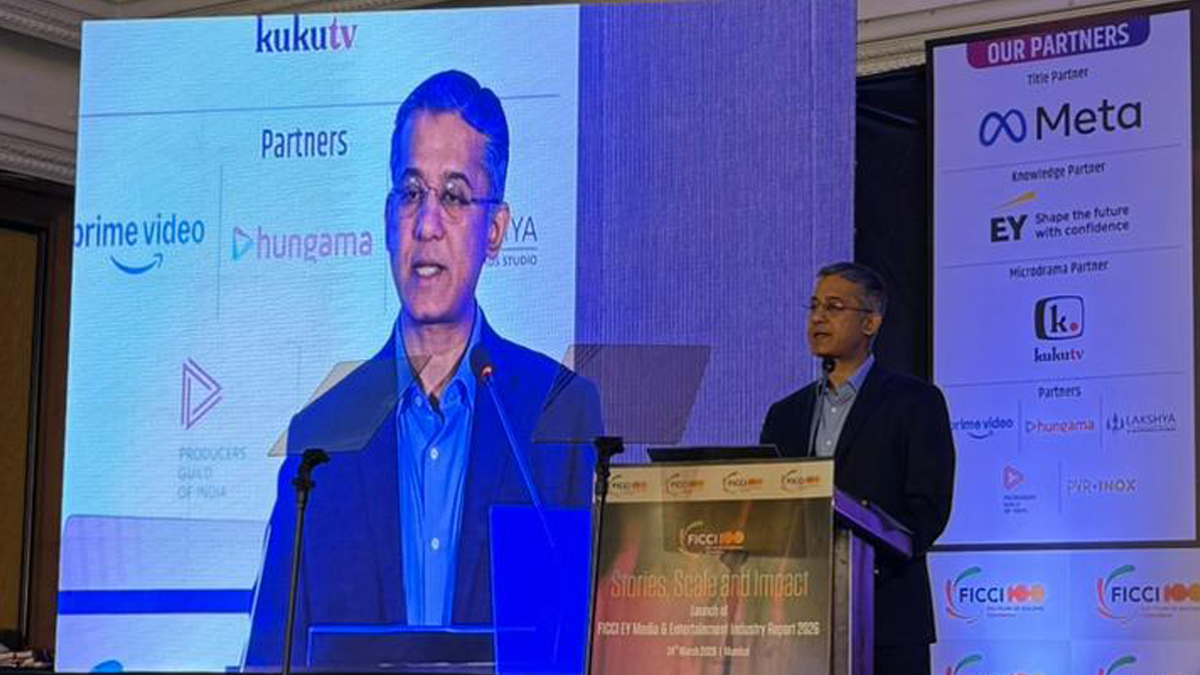
MUMBAI: India’s media and entertainment industry is growing faster than the economy, reshaping global benchmarks and is on course to blow past Rs 3 trillion by 2027. That was the headline message from Kevin Vaz, chairman of the FICCI Media and Entertainment Committee and chief executive of entertainment at JioStar, who delivered the opening keynote at the launch of the FICCI-EY Media and Entertainment Report 2026 in Mumbai on Monday. He did not waste much time on caveats.
The industry hit Rs 2.78 trillion in 2025, outpacing GDP per capita growth and surpassing even last year’s bullish forecasts. Vaz described the year in three words: scale, convergence, transformation. The numbers, he suggested, were only half the story. The other half was how that growth was happening.
Digital has become the industry’s largest segment, driven by advertising, subscriptions and commerce. But Vaz was quick to puncture the familiar narrative of digital killing everything else. India, he argued, is not an either-or market. It is an AND market. Connected TV is surging. Linear television, mobile, films and print are all still expanding. AVGC, the animation, visual effects, gaming and comics sector, is emerging as a serious growth engine, opening new storytelling formats and new global revenue streams. Nothing, he said, is replacing anything. Everything is reinforcing everything else.
Nowhere is that more vivid than in sport. In an on-demand world where audiences can watch anything, anytime, Indians still show up live. “Sports don’t fragment audiences,” Vaz said. “They unite them, just on different screens.” The ICC Men’s T20 World Cup 2026 made the point emphatically. During the final, JioHotstar delivered 72.5 million concurrent streams, a global record. Group chats exploded. Families renegotiated control of the television. Advertisers, Vaz noted with undisguised relish, stopped asking where audiences were and started asking how fast they could get in.
Cinema had its own landmark year. More than 1,900 films were released, with several crossing the Rs 1 billion mark. Dhurandhar was singled out as proof that Indian audiences will still turn up in large numbers for content that grips them. Live experiences, too, are getting bigger and more immersive, though Vaz suggested the surface has barely been scratched.
Then there is artificial intelligence, which he described as quietly, and sometimes not so quietly, reshaping everything. AI is enabling personalisation, efficiency and scale, but Vaz argued its deeper significance lies in what it is doing to creativity itself. He pointed to Mahabharat: Ek Dharmayudh, billed as the world’s first AI-produced show, as evidence that the technology can amplify creative ambition rather than hollow it out. He also used the platform to call on Indian policymakers to engage seriously with the creative industry on AI and copyright, ensuring that creators are fairly compensated as the technology spreads.
The picture that emerges from the report, and from Vaz’s keynote, is of an industry that has stopped thinking of itself as a fast-growing emerging market and started thinking of itself as a global template. Scale, diversity and innovation, he said, are no longer in tension in India. They are coexisting, and the rest of the world is taking notes.
The Rs 3 trillion milestone is two years away. As the man who chairs the committee that shapes the industry’s policy agenda and runs the country’s most powerful entertainment platform, Vaz set the tone for the day with characteristic directness: India’s media business is not just chasing growth. It is deciding what the country talks about at dinner. That is a different kind of power altogether.








