
MAM
The Onam feeling is big and brands want a piece of it
From myG to Oxygen and Kerala Tourism, campaigns blend star power, culture, commerce and digital reach


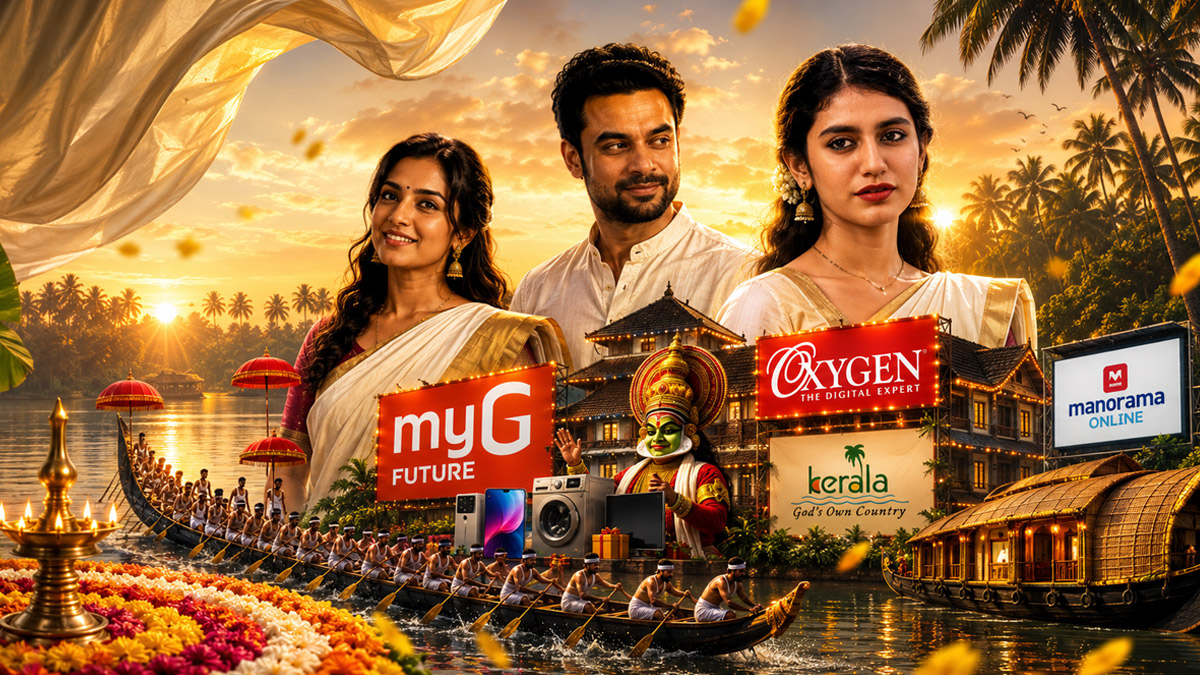
MUMBAI: Onam is getting a little more star-studded, but the real stars of this year’s advertising season are the ideas. For years, the formula for a Kerala festive campaign was fairly familiar: bring in a popular actor, add kasavu, a pookalam, a family gathering and a generous dose of celebration. In 2026, however, the more interesting campaigns are doing something more ambitious. They are using celebrity familiarity as a bridge between the emotional world of traditional Onam and the fragmented, fast-moving world of digital consumption.
That makes this year’s standout campaigns less about putting a famous face in a festive frame and more about making that face work across the entire consumer journey, from awareness and social engagement to offers, retail visits, travel and purchase.
The strongest examples so far suggest a new equation for Onam advertising: tradition supplies the emotion, celebrity supplies recall, digital supplies reach and the brand proposition supplies the reason to act.
And the campaigns that bring all four together are the ones making the most noise.
1. myG Mass Onam 2026
If there is one campaign that best captures the sheer scale of celebrity-led festive advertising, it is myG’s Mass Onam property featuring Manju Warrier and Tovino Thomas.
The strength of the campaign lies in its uncomplicated proposition. “Mass Onam” is easy to remember, easy to build around and, crucially, easy to extend beyond a single advertisement. The celebrity pairing gives the campaign two different but complementary kinds of appeal: Manju Warrier brings familiarity and cultural resonance, while Tovino Thomas adds youth, energy and contemporary mass appeal.
The larger idea is equally important. myG has turned Onam into a retail event rather than treating it simply as a seasonal advertising window. The campaign’s prize-led architecture, discounts and showroom activity give consumers a reason to move from watching the campaign to participating in it.
The scale of the underlying property is evident from myG’s previous Mass Onam execution, which carried prizes and discounts worth Rs 25 crore, including cars, scooters, cash rewards, international trips and gold. The campaign was also built with television-style production, digital content and retail conversion in mind.
That is what makes the celebrity pairing effective: the stars are not the destination. They are the entry point into a much larger commercial proposition.
myG’s own communication following the campaign also shows how the Mass Onam property extends beyond the initial advertisement, with showroom activity, social media reels, customer stories and prize distribution becoming part of the post-campaign cycle.
Why it works: celebrity recognition meets a very clear consumer proposition, with the campaign designed to travel from screen to showroom.
2. Cuticura India – Onam 2026
Cuticura India’s Onam campaign featuring Priya Prakash Varrier takes a simpler, more product-focused route, using celebrity familiarity to reinforce the brand’s core promise of freshness.
Rather than building a large retail proposition around Onam, the campaign taps into the everyday rituals that make the festival feel special family gatherings, sadya and the continuous celebrations that come with the season. Priya Prakash Varrier brings a youthful, contemporary presence to that setting, helping Cuticura speak to a younger Malayalam audience while keeping the communication rooted in a familiar Onam experience.
What works particularly well is the connection between the festival mood and the product benefit. The campaign’s idea that the freshness of Cuticura allows the festive feeling to “linger a little longer” gives the brand a natural role within the celebration, rather than simply placing the product inside an Onam-themed visual.
Priya’s presence also helps the campaign feel native to social media. Her popularity and recognisability make the communication feel less like a conventional festive brand message and more like a piece of celebrity-led social content, which is particularly relevant for a campaign designed around Instagram.
The execution is deliberately uncomplicated: Onam creates the emotional context, Priya creates attention, and freshness provides the brand’s reason to be there.
Why it works: it turns a simple product attribute freshness into a festive emotion, using a recognisable young celebrity to make the message feel contemporary and socially shareable.
3. Oxygen Digital Experts NewGen Onam 2026
Oxygen’s NewGen Onam 2026, featuring Mamitha Baiju and Sithara Krishnakumar, moves the conversation in another direction: towards a younger audience without abandoning the cultural character of Onam.
The name itself points towards the strategy. “NewGen” allows the brand to frame the festival through a younger lens while remaining firmly rooted in a recognisable Kerala occasion.
Mamitha Baiju is particularly suited to that positioning. Her popularity with younger Malayalam audiences gives the campaign an immediate digital-age quality, while Sithara Krishnakumar brings another layer, music, cultural familiarity and performance.
The campaign also goes beyond celebrity visibility into the territory of retail spectacle, with a reported prize pool of Rs 30 crore, spanning cars, bikes, gold and foreign trips.
That matters because the offer becomes content in its own right. A large prize proposition gives creators, social platforms and retail outlets something to talk about repeatedly, rather than forcing the celebrity film to carry the entire campaign.
The lesson from Oxygen is therefore slightly different from myG. If myG shows how celebrity can power mass retail, Oxygen shows how a younger celebrity vocabulary can refresh a traditional festival without making the festival itself feel old-fashioned.
Why it works: it makes Onam feel contemporary to a younger consumer while retaining the festival’s cultural familiarity.
4. Kerala Tourism Onam 2026
Kerala Tourism offers perhaps the most interesting departure from conventional celebrity advertising.
Here, the proposition is not simply to celebrate Onam but to sell the festival itself as an experience.
The tourism department has said its 2026 strategy is to position Onam as an immersive cultural tourism product, with experiences such as Aranmula Vallasadya, traditional art forms, village festivities and Vallamkali being promoted to visitors from outside Kerala. The campaign is also expected to use digital marketing, video, influencer collaborations and brand partnerships.
That makes the campaign particularly relevant to the wider celebrity-advertising story. Tourism does not necessarily need one superstar to carry the message. Instead, it can draw on Kerala’s much larger cultural and celebrity ecosystem to turn the state itself into the star.
It is a smart shift in perspective.
Rather than telling audiences, “Come to Kerala because a celebrity is here,” the proposition becomes, “Come to Kerala because this is where the experience happens.”
The timing is also significant. Kerala Tourism’s official calendar confirms a week-long Onam Tourism Week from August 24 to 30, with traditional art forms including Mudiyattam, Tholpavakoothu, Padayani and Theyyam featuring in the celebrations.
Why it works: it transforms Onam from a calendar occasion into a destination proposition, taking a local festival and giving it an audience beyond Kerala.
5. Manorama Digital The Algorithm of Onam
The fifth campaign is perhaps the least conventional and that is precisely why it deserves a place on the list.
Manorama Digital’s “The Algorithm of Onam” does not revolve around one celebrity. Instead, it packages an entire ecosystem of premium display, video, native storytelling, social amplification, influencer collaborations, interactive experiences, contests and events.
The proposition is based on a simple observation: Onam is no longer one consumer moment. It is a chain of decisions.
Homes are renovated. Gold is purchased. Cars are upgraded. Clothes and electronics are bought. Travel is booked. Families return. Brands compete for attention across each of those moments.
Manorama Digital says its platform reaches 36 million-plus monthly users, generates 250 million-plus monthly page views, has users across 160-plus global traffic markets and reaches 21 million users in Kerala. It also says 80 per cent of its audience influences household purchase decisions, while 49 per cent hold significant purchasing power and 43 per cent of its readership is female.
Those numbers explain why “The Algorithm of Onam” is an interesting counterpoint to celebrity-first campaigns.
Instead of asking one star to generate attention, the proposition is to build a system that follows the consumer from attention to intent to purchase.
In other words, the celebrity is no longer necessarily the campaign. The ecosystem is the campaign.
Why it works: it recognises that modern festive advertising is less about winning one impression and more about owning multiple moments in the consumer journey.
From endorsement to cultural translation
Taken together, these campaigns reveal something bigger about the changing nature of Onam advertising.
The celebrity has not become less important in the digital age. If anything, the right celebrity can become more valuable when attention is fragmented across television, YouTube, Instagram, influencers, retail and events.
But celebrity alone is no longer enough.
A star can make people look. A good idea makes them remember. A strong proposition gives them a reason to act.
That distinction separates the most effective campaigns from the merely expensive ones.
Manju Warrier and Tovino Thomas give myG scale and recognisability. Mohanlal gives Indigo Paints an unusually natural bridge between home and festival. Mamitha Baiju and Sithara Krishnakumar help Oxygen give a traditional celebration a younger pulse. Kerala Tourism turns the cultural capital of Onam into a tourism proposition. Manorama Digital, meanwhile, looks beyond the star altogether and maps the festival as a consumer ecosystem.
There is another common thread running through all five: none of them has to choose between modernity and tradition.
The pookalam does not disappear because Instagram exists. The family gathering does not become irrelevant because consumers shop online. Kasavu does not become old-fashioned because the campaign is digitally distributed.
Instead, the traditional symbols become raw material for new storytelling.
That may be the most significant change in Onam advertising in 2026. The festival is no longer being treated simply as a backdrop for brands to sell festive offers. It is becoming a platform through which brands can demonstrate how well they understand Kerala’s culture, consumers and increasingly digital way of celebrating.
And that is why the best celebrity campaigns this Onam are not really about stars at all.
They are about making the familiar feel fresh and making the festive message travel much further than the frame in which it first appeared.






