Digital
The digital paradox: why India’s trillion-rupee content engine is stalling on creative fuel
As AI speeds up content, writers warn of falling pay, weak credit and rushed storytelling


MUMBAI: As the Indian media and entertainment sector hurtles towards a staggering Rs 3.1 trillion valuation by 2027, a profound paradox is brewing within the industry’s engine room. While the latest FICCI-EY report celebrates “Digital Media” finally dethroning traditional linear television as the market’s dominant force, the architects of this revolution, the screenwriters, are sounding an alarm that data-driven executives can no longer afford to ignore.
The newly minted “The Right Draft 2026” report, which is a collaborative study by Tulsea and Ormax Media, reveals a sobering reality. While the “Silicon Scribe” (Artificial Intelligence) has officially taken a seat in the writers’ room, basic professional hygiene, such as equitable pay and transparent credit, is in a state of alarming decay.
The mirage of technological progress
The industry is currently enamoured with the promise of “Agentic AI” and sovereign language models. On paper, the metrics are dazzling; the report indicates that 41 per cent of Indian screenwriters have now integrated AI into their creative workflows. However, this digitisation has birthed what industry veterans are calling the “Efficiency Trap.”

There is a growing, dangerous delusion amongst production houses that storytelling can be automated without consequence. Over 50 per cent of writers now report that producers demand “lightning-fast” turnarounds because they erroneously assume that if a machine can generate a premise in seconds, a human can produce a nuanced, emotionally resonant teleplay in a weekend. This pressure to treat the craft of screenwriting like a “ghost kitchen” (fast, inexpensive, and largely anonymous) is systematically eroding the very quality that prevents OTT subscribers from hitting the ‘Cancel’ button.
A crisis of identity and credit
In an era where Connected TV (CTV) is facilitating a “living room renaissance” and bringing family viewing back to the big screen for 129 million users, one would expect the value of the script to be at an all-time high. Instead, the data suggests a disheartening regression. In 2023, 76% of writers felt their scripts were genuinely valued within the streaming ecosystem; by early 2026, that figure has plummeted to a mere 62 per cent.
This devaluation is most visible in the “Invisible Author” epidemic. More than half of the professional writing community feels they do not receive fair or equal credit when collaborating with directors or “star” showrunners. With 64 per cent of respondents noting a total absence of industry standards for credit attribution, the Indian industry finds itself in a precarious position. We are essentially constructing a multi-billion-pound skyscraper while refusing to acknowledge the architects who drew the blueprints.
The financial chasm in a trillion-rupee market
The most jarring disconnect lies in the treasury. GroupM’s TYNY 2026 report highlights an Indian advertising market growing at nearly 10 per cent, yet this wealth remains remarkably insulated from those who create the content that drives the ad spend. 74 per cent of writers now feel unfairly remunerated, which is a significant escalation from the 63 per cent recorded just three years ago.
Perhaps more damning is the state of “payment hygiene.” In a sector that prides itself on global aspirations, four out of five writers still find themselves in the undignified position of “constantly chasing” payments that are legally overdue. This is no longer a teething problem of a young industry; it is a systemic failure that threatens to drain the talent pool dry.
Restoring the soul to the machine
The findings of the 2026 report should not be viewed merely as a list of grievances but as a strategic map for survival. If India truly intends to establish itself as a global AVGC (Animation, Visual Effects, Gaming, and Comics) powerhouse, the focus must pivot from “Content Volume” to “Creative Value.”
The path forward requires a three-pronged intervention. Firstly, the industry must formalise AI policies that protect human creative timelines to ensure technology remains a tool rather than a whip. Secondly, payment discipline must be modernised; milestone payments should be treated as non-negotiable financial obligations rather than mere suggestions. Finally, the industry must move towards the “Hybrid Pay Model,” which integrates fixed fees with viewership-linked incentives, as 91 per cent of writers believe this would foster a deeper sense of project ownership.
The machine can undoubtedly help us draft faster, but it is incapable of caring about the story. If we continue to squeeze the human element out of the creative process, the “New Prime Time” of 2026 will be filled with technically proficient yet emotionally hollow noise. For Indian television to thrive, we must remember that while data might find the audience, only the heart can keep them.






Digital
Moneycontrol widens lead over Economic Times in digital reach
Comscore data shows strong gains in users, engagement and time spent
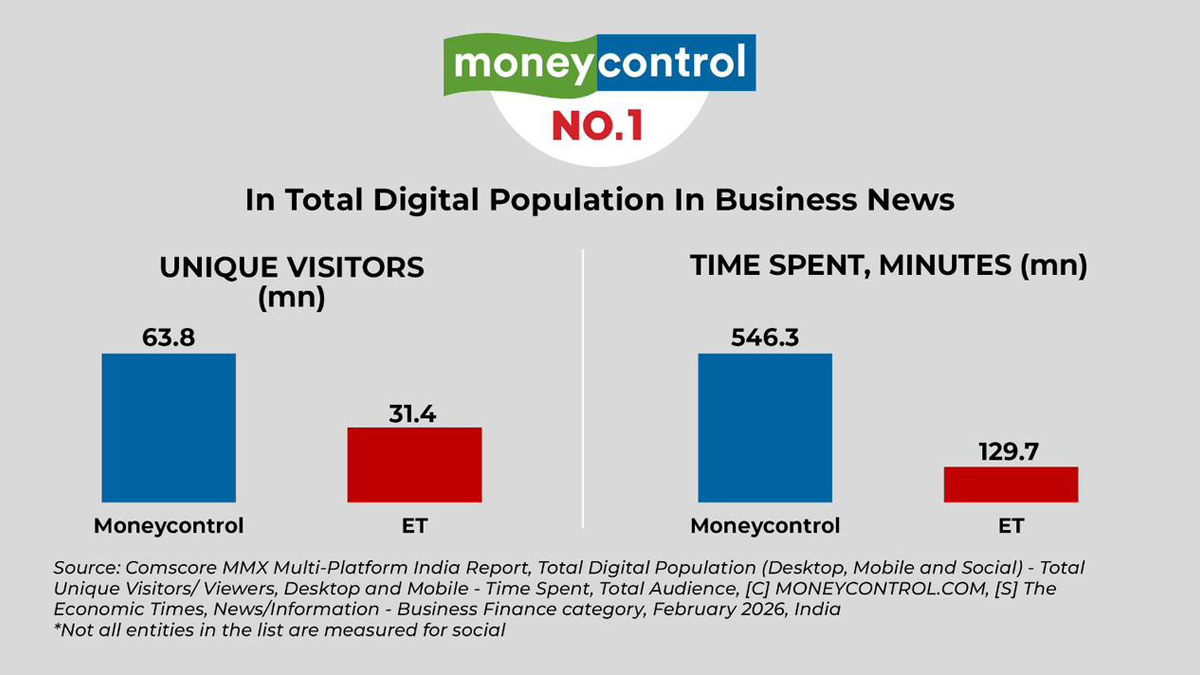
MUMBAI: Moneycontrol has tightened its grip on India’s business news landscape, pulling further ahead of The Economic Times across key digital metrics in February, according to data from global measurement firm Comscore.
The platform drew 63.8 million unique visitors during the month, more than double the 31.4 million recorded by its closest rival, underlining a growing gap in audience reach.
The story does not end with traffic. Moneycontrol also surged ahead on engagement, clocking 279.8 million page views, nearly three times The Economic Times’ 93.1 million. The numbers suggest that readers are not just dropping by, but staying longer and consuming more.
That trend becomes even clearer when looking at time spent. Users logged 546.3 million minutes on Moneycontrol in February, over four times the 129.7 million minutes spent on The Economic Times platform. In the battle for attention, Moneycontrol appears to be winning both the click and the clock.
Moneycontrol managing editor Nalin Mehta, said the surge comes at a time when audiences are grappling with global uncertainty. “As investors navigate war-related risks and geopolitical flux, the need for clarity has never been greater. Our focus remains on delivering timely and credible information to help readers make sense of the noise,” he said.
With markets on edge and headlines moving fast, Moneycontrol seems to have struck a chord, turning moments of uncertainty into an opportunity to deepen its connection with readers.








