Digital
The creative cull: how AI is coming for the marketers, ad men and researchers
Robots aren’t taking over yet, but the writing may already be on the wall for some of the US’ most glamorous white-collar jobs.
CALIFORNIA: The robots are not, it turns out, storming the factory floor. They are sitting quietly at a MacBook in a Soho agency, rewriting your copy, summarising your focus groups and generating your mood boards, and nobody has been sacked. Yet.
A new report from Anthropic, the AI company behind the Claude chatbot, offers the most rigorous look to date at what artificial intelligence is actually doing to jobs, as opposed to what doomsayers and boosters claim it might. The verdict from economists Maxim Massenkoff and Peter McCrory is nuanced but pointed: there is no mass unemployment so far, but some sectors have good reason to be nervous. Marketing, market research and the arts are squarely in the crosshairs.

The researchers introduce a new measure called “observed exposure.” It goes beyond theoretical speculation about what AI could do and instead tracks what it is already doing, drawing on real Claude usage data. The approach is clever. They weight automated uses, where the machine performs the job entirely, more heavily than augmentative ones, where it merely assists. They then map this onto roughly 800 occupations, weighted by how much time workers actually spend on each task. For now the target user base has been the US market, but the findings offer a glimpse of what may be happening in other countries as well.
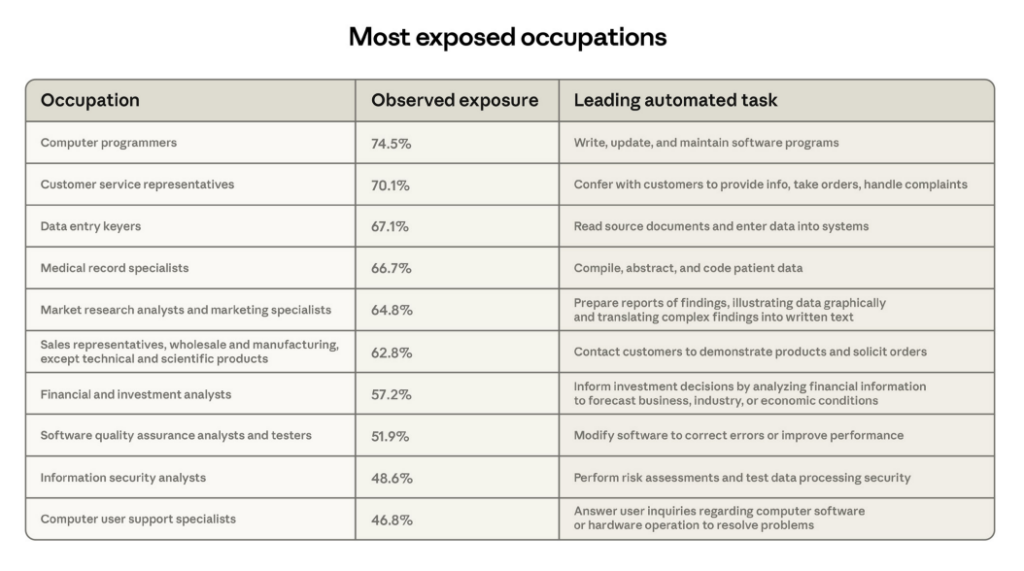
The results are sobering for the creative and analytical classes. Market research analysts and marketing specialists clock in at 64.8 per cent observed exposure, meaning nearly two-thirds of their daily tasks are already being performed, at least in part, by AI in professional settings. The leading automated task is preparing reports, illustrating data graphically and translating complex findings into written text. In other words, this is the kind of work junior analysts spend most of their days doing.
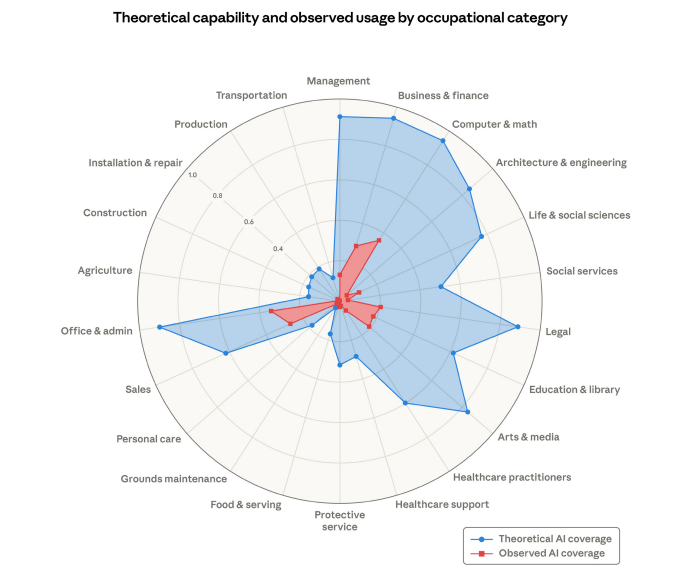
Arts and media fare little better. The sector shows meaningful theoretical exposure, as large language models can in principle handle the lion’s share of tasks, though observed usage still lags behind capability. The gap is narrowing, however, and the direction of travel is unambiguous.
Here is the sting in the tail. The workers most exposed to AI disruption are not, as popular mythology suggests, low-paid drudges. They are older, better educated, more likely to be women and considerably better paid, earning 47 per cent more per hour on average than their least-exposed counterparts. Graduate degree holders are nearly four times as prevalent in the high-exposure group. The creative professional, the senior analyst and the market researcher with an MBA are precisely the people who should be paying attention.
“We’re not talking about the checkout operator,” the paper implies. “We’re talking about the account planner.”
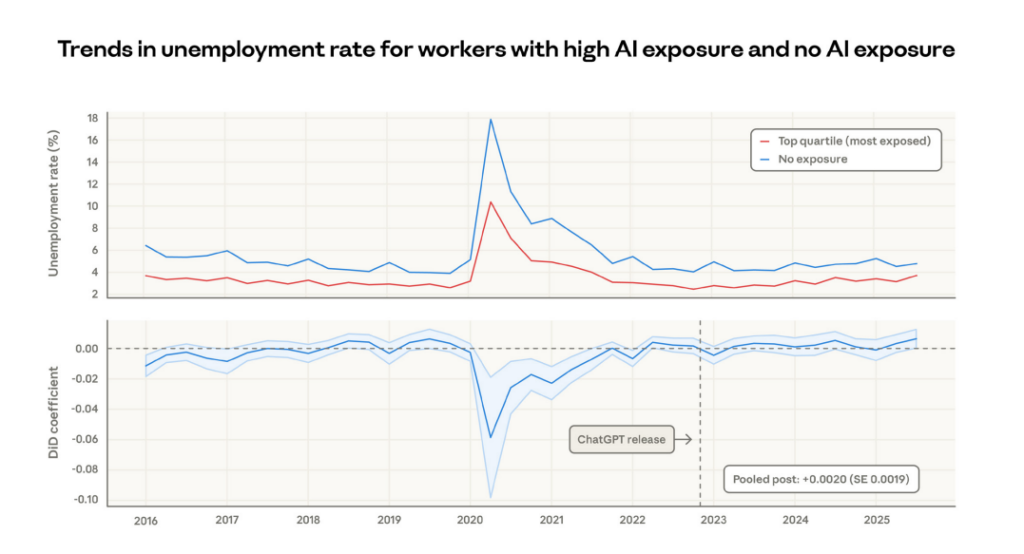
The most alarming signal in the data concerns not those already in jobs, but those trying to enter them. Among workers aged 22 to 25, hiring into highly exposed occupations has slowed measurably since the release of ChatGPT in late 2022. There has been a 14 per cent drop in the job-finding rate, a figure the authors describe as “just barely statistically significant.” Young people are, in effect, finding the door to exposed professions quietly closing. Whether they are staying in education, taking different jobs or simply giving up is not yet clear.
For a bright graduate eyeing a career in market research or media production, this is not merely an academic data point. It is a flashing amber light.
The paper is careful about what it does not find. Unemployment among highly exposed workers has not risen in any statistically meaningful way since the ChatGPT era began. The apocalypse has not arrived. Even in the Computer and Math category, the most theoretically exposed of all, Claude currently covers just 33 per cent of tasks in practice. The gap between what AI can do and what it actually does at scale in professional workflows remains vast.
Think of it less like a tsunami, the authors suggest, and more like a slowly rising tide. The internet did not destroy journalism overnight. It took 20 years and the collapse of a generation of classified advertising revenue. The China trade shock also took decades to fully register in unemployment statistics, and economists are still debating the numbers.
What does this mean for the luvvies, the admen and the pollsters? The honest answer is: not much yet, but watch this space. AI is already doing the grunt work, including data summaries, draft press releases and boilerplate creative briefs. The question is whether it stops there or continues climbing the value chain.
The authors are building a framework to track exactly that and promise to update it as new data arrives. If the tide does come in, they want to see it coming before the sandcastles are already gone.
For now, the creative industries can breathe, but perhaps not too deeply. The machine is not at the door. It is already at the desk.

Digital
Google partners with Adani and Airtel to build India’s largest AI data centre
The three-campus complex, built with Adani and Airtel, is India’s largest-ever technology infrastructure investment
Visakhapatnam: Google has broken ground on what it is billing as India’s largest-ever technology infrastructure project: a gigawatt-scale artificial intelligence hub in Visakhapatnam, Andhra Pradesh, built in partnership with AdaniConneX and Nxtra by Airtel. The ceremony at Tarluvada on 28th April marked the start of construction on a three-campus data centre complex that sits at the heart of a $15 billion investment Google has committed to deploying across India between 2026 and 2030.
The numbers are staggering by any measure. Nearly 1 gigawatt of compute capacity at a single location, three data centre campuses, a fibre-optic expansion under the America-India Connect initiative, and a long-term clean energy strategy designed to feed new renewable supply into the national grid. Google says the project will help India hit its target of 500 gigawatts of non-fossil fuel capacity by 2030 while delivering the high-performance, low-latency infrastructure that businesses need to build and scale AI-powered services.
The groundbreaking drew a formidable gathering of political and corporate India. Union minister for information technology Ashwini Vaishnaw, Andhra Pradesh chief minister N. Chandrababu Naidu and state IT minister Nara Lokesh attended alongside Google Cloud chief executive Thomas Kurian, Adani Group directors Karan Adani and Jeet Adani, and Bharti Enterprises vice chairman Rakesh Mittal.
Vaishnaw framed the project in terms of national ambition. “The India AI hub and three subsea cables landing in Visakhapatnam will become very important infrastructure for the country’s journey forward,” he said, adding his thanks to Google for its “continued trust in India.” Naidu was equally bullish, describing Andhra Pradesh as “India’s premier investment destination” and the Vizag hub as a cornerstone of the state’s technology corridor. “Our vision goes beyond attracting investment,” he said. “We want local talent, startups, and enterprises to become active partners in this technology-driven growth story.”
Kurian called the groundbreaking “a powerful realization of our shared vision with the Indian government, and an inflection point for the country’s AI-native future.” Jeet Adani was characteristically direct: “When energy becomes more affordable and increasingly powered by clean sources, intelligence becomes more accessible, and that is how India will lead the next phase of digital growth.” Gopal Vittal, executive vice chairman of Bharti Airtel, said the full stack of data centres, green power, pan-India fibre and a next-generation cable landing station would enable “large-scale, world-class AI infrastructure in Vizag.”
The project was first announced in October 2025. AdaniConneX and Nxtra by Airtel will lead construction of the data centre buildings and connecting infrastructure, with Google deploying its AI capabilities on top.
Beyond the hardware, Google has announced a substantial package of community programmes. On water, it is partnering with Sponge Collaborative on a watershed management plan linking coastal ecosystem restoration with clean drinking water systems, including reverse osmosis plants and Water ATMs, for local residents. On livelihoods, a tie-up with the Sambhav Foundation will equip more than 1,000 fisherfolk with GPS navigation, weather-forecasting tools, cold-chain management training and UPI-based financial literacy. The Google Udaan India Fund, run through ChangeX, will provide direct grants to local schools and social enterprises for AI skilling labs and digital literacy programmes. The NARI Shakti programme, developed with the Learning Links Foundation, will support more than 10,000 women entrepreneurs from low-income backgrounds in building micro-enterprises. The Skills Trade and Readiness programme will prepare more than 1,000 local workers for construction, welding and facility operations roles, while a parallel tie-up with ICT Academy will train more than 1,200 students and educators in cloud computing and generative AI.
The groundbreaking was accompanied by the Bharat AI Shakti Conclave, a conference organised with the Andhra Pradesh government and Nara Lokesh, bringing together suppliers, industry partners and infrastructure firms to map how Google’s anchor investment can be turned into a broader economic value chain for the region. The conclave’s central theme was building an AI industrial corridor, with a local-first procurement approach and the integration of regional small and medium enterprises into Google’s global operational frameworks.
Every major technology company in the world has been courting India. What sets Vizag apart is the sheer scale of the commitment and the deliberate effort to build an industrial ecosystem around it rather than simply plant servers in a field. Google is not just betting on India’s digital future; it is trying to build the factory floor on which that future gets made. Whether the $15 billion translates into genuine local opportunity, or merely into an impressive data centre humming quietly on the Andhra Pradesh coast, will depend on whether those community programmes prove as durable as the hardware. The groundbreaking, as ever, is the easy part.