Brands
Tech, traceability and AI take centre stage in textile waste revolution
Mumbai panel explores how innovation can turn discarded clothes into valuable resources

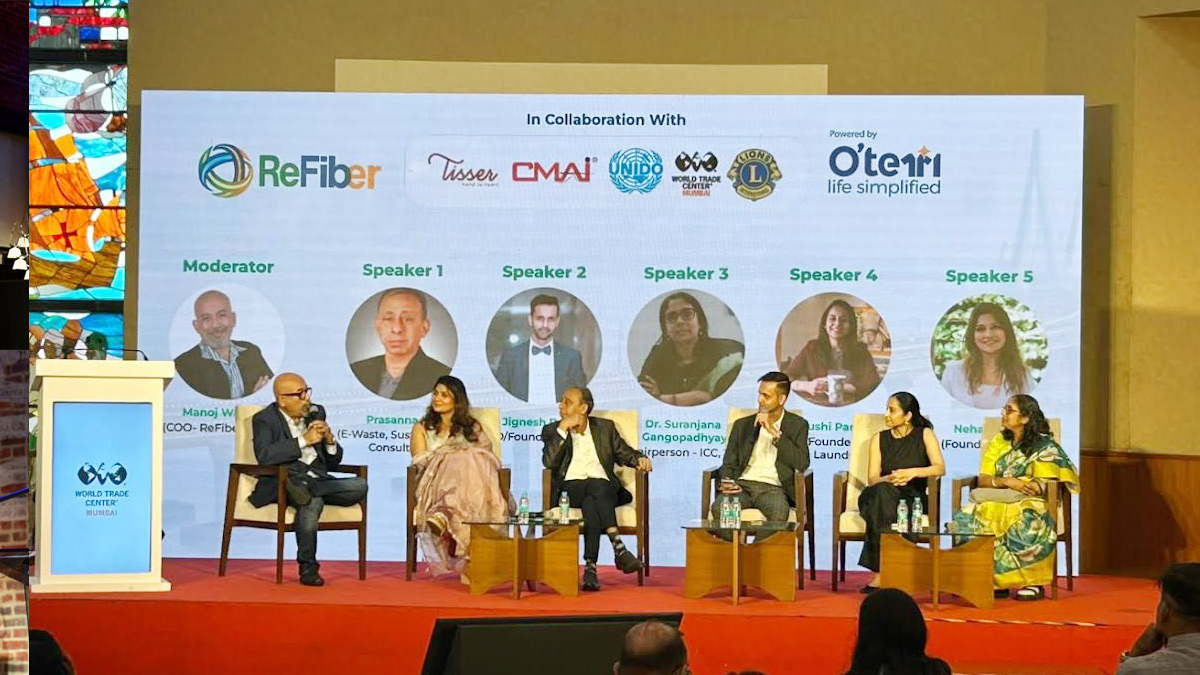
MUMBAI: One person’s old shirt could be another person’s new opportunity. That was the underlying message from a lively discussion on how technology, artificial intelligence and smarter consumer habits could help India stitch together a more circular textile economy.
The panel discussion, titled Click, Pick-up, Recycle: Using Tech to Turn Post-Consumer Textile Waste into New Resources, was held during the launch of Mumbai’s Mega Post-Consumer Textile Waste Collection & Upcycling Initiative by ReFiber, powered by OterRi, on World Environment Day.
Moderated by ReFiber and OterRi, chief operating officer, Manoj Wanvari, the session brought together sustainability consultant, Prasanna Hr; Myth.ai, chief executive officer and founder, Jignesh P Jain; VJTI, chairperson – Internal Complaints Committee, Suranjana Gangopadhyay; Ethiek and Laundromania, founder, Ayushi Pande; and IFBEC (International Fashion Business Exchange Council), founder, Neha Gupta.
The discussion highlighted how textile waste management is evolving from a recycling challenge into a technology-driven ecosystem built around traceability, data, design innovation and consumer engagement.
A major focus was the growing importance of digital tracking systems. As global regulations increasingly demand transparency throughout a product’s lifecycle, the industry is moving towards digital product passports that can track garments from raw material sourcing through manufacturing, consumer use and eventual recycling. Such systems are expected to play a critical role in helping brands measure environmental impact and demonstrate compliance with emerging sustainability standards.
Participants stressed that one of the biggest challenges lies not in recycling itself but in collection. While industrial textile waste has established recovery channels, post-consumer textile waste remains difficult to manage because garments are often made from blended fibres that require complex sorting and processing. Without efficient collection and segregation systems, large-scale circularity remains difficult to achieve.
Technology was repeatedly identified as a key enabler. Digital platforms can now help consumers understand the environmental impact of their actions by measuring carbon emissions avoided, water saved and landfill diversion achieved through textile recycling and reuse. Such tools have the potential to make sustainability more visible and tangible for consumers, encouraging greater participation.
Artificial intelligence emerged as another powerful force reshaping the industry. AI-driven design and sampling tools are helping fashion brands reduce material waste long before a garment reaches consumers. By enabling virtual product development, digital sampling and trend forecasting, companies can significantly cut down on physical samples, shipping requirements and production inefficiencies.
The conversation also explored how extending the life of garments remains one of the most effective ways to reduce waste. Better garment care, specialised cleaning solutions and improved maintenance practices can keep clothing in circulation for longer, reducing the need for replacement and lowering the environmental footprint of fashion consumption.
Consumer education was identified as a critical missing link. Many garments are discarded prematurely because of avoidable damage, improper washing methods or misconceptions about fabric care. Increasing awareness about how to maintain textiles could significantly extend product lifespans while reducing waste generation.
Another recurring theme was the need to rethink product design from the very beginning. Rather than addressing sustainability only at the end of a garment’s life, manufacturers are increasingly being encouraged to design products with recycling and recovery in mind. The use of mono-materials, recyclable fibres and simpler material compositions can make future recycling processes more efficient and commercially viable.
The role of educational institutions and material science also featured prominently. As new generations of textile engineers and designers enter the workforce, sustainability principles are increasingly being integrated into curriculum development. Future innovation, participants noted, will depend on designing products that balance performance, durability and recyclability.
Industry collaboration was highlighted as essential for success. Participants pointed out that circularity cannot be achieved by individual companies acting alone. Policymakers, manufacturers, technology firms, recyclers, startups, educators and consumers all have a role to play in creating an integrated value chain capable of recovering and reusing textile resources at scale.
The discussion also examined the economic opportunity associated with textile circularity. Rather than viewing discarded garments as waste, participants described them as valuable resources that can generate employment, support new businesses and reduce dependence on virgin materials. The challenge is creating the systems, infrastructure and incentives needed to unlock that value.
Throughout the session, examples from global markets demonstrated how successful textile recovery programmes depend on sustained collection efforts and strong consumer participation. The consensus was that India has the scale, entrepreneurial energy and technological capability to build similar models suited to local conditions.
As the conversation wrapped up, one message stood out: the future of fashion may depend less on producing more and more on making better use of what already exists. In a world increasingly focused on resource efficiency, turning wardrobes into circular ecosystems could be one of the textile industry’s most valuable innovations.






