MAM
TDSAT & Ad cap: TRAI almost done with its arguments

MUMBAI: The third day of the arguments presented by the Telecom Regulatory Authority of India (TRAI) saw several crucial points being touched upon and the TDSAT also noting down points that could be pondered upon for rumination.
The TRAI counsel Rakesh Dwivedi pointed out that if one reads section 7 (11) of the Cable TV Networks (CTN) Act then it must be read with the ad cap regulation because the regulator was using it only to enforce this section.
Section 7 (11) states that the authority has the power to ‘seize equipment used for operating the cable television network if it is found to be breaching its other sections’.

According to the TRAI, programmes and advertisements are different and the regulator is trying to prevent intermixing of these two and ensuring an increase in quality of service.
The regulator also gave its version regarding Article 19 (a) of the Constitution saying that airwaves and frequencies are a public property of the government and so there is no fundamental right that can apply to it. Electronic media and press are different and cannot be treated equally. Broadcasters are companies and not citizens so fundamental rights don’t apply to them, Dwivedi argued.
The point about misuse of clock hour was once again raised by Justice Aftab Alam to which the TRAI reverted by saying that the clock hour regulation instituted by the TRAI and the CTN Act are the same thing and they cannot be interpreted in any other way. Broadcasters are thinking of a bankable hour, that can be carried over within 24 hours but the TRAI says that a clock hour is fixed.
The bench questioned the TRAI that if it could have enforced the ad cap law under the CTN Act then it need not have made a separate regulation or a direction or use the TRAI act for it.
To this, counsel said that the CTN Act only applies to cable operators at this stage. And just because they have two powers that are coinciding they cannot take away one power. The point where broadcasters come into the picture of this Act, is for the advertising and programming code, which they have to adhere to by virtue of them having to apply for an uplinking and downlinking licence.
The TRAI counsel also requested that merely because it had framed a regulation or passed a direction the bench may not nullify it because it has passed it under the TRAI act and not the CTN act, although it has powers under both. He also requested that if the bench were to find anything wrong with the ad cap regulation, they may modify it. However, Alam said that it cannot be done since it was a delegated regulation. To this TRAI asked the bench to consider it as a direction and then modify it keeping in mind the best interest of the viewers.
One of the arguments, that the counsel raised, relates to Article 14 of the Indian Constitution that speaks about the fundamental right to equality. He stated that it would be in fair spirit if cable operators and broadcasters are not equated with each other at this juncture. The TRAI counsel presented data which clearly showed that broadcasters were airing TV commercials for an unbearable duration every day in between programmes and hence it had decided to apply the ad cap to them first. The limits on TV commercial time will be imposed on cable operators later by the TRAI, the counsel revealed. And the fact that cable ops will be made to comply later does not mean that broadcasters should be excluded from the ad cap now.
The counsel said he would be addressing the issue of clubbing channel genres together on Monday.
The bench asked the TRAI why it wasn’t willing to wait till digitization was completed to impose the ad cap regulation. The TRAI argued that by September 2014, nearly 50 per cent of the country will be digitized. Hence it was a good enough reason to bring in ad time limits rules now so that TV air time could be slowly modulated over the period. The TRAI counsel agreed the regulation may not be perfect in its current form, but that does not give the TDSAT a reason to strike it down.
Regarding FTA channels, Dwivedi said that the broadcasters had not given the TRAI any financial or commercials analysis of the minute by minute usage of ad time and data to support that ad revenues will indeed fall when the ad cap comes into effect. Hence, the regulator had made a general reccee of the channels and deduced what needed to be done and only then drawn up the ad cap regulation. It also stated that FTA channels don’t have too many ads so TRAI did not know why they were objecting to it.
At the end of the proceedings, an important observation was made by the TDSAT that if the ad cap regulation is struck down, no law can be contended except section 7 (11) of the CTN Act, because broadcasters have accepted this act. Articles 14 and 19 (1) (a) of the Constitution are against the imposition of the ad cap regulation and then the only thing that remains is the interpretation of the 7 (11) section of the CTN Act.
The TRAI will continue with its arguments on Monday and the broadcasters are scheduled to speak after that.





MAM
One Hand Clap acquires Agenseed to enter distribution space
Creative agency expands into full-stack services with strategic buyout.
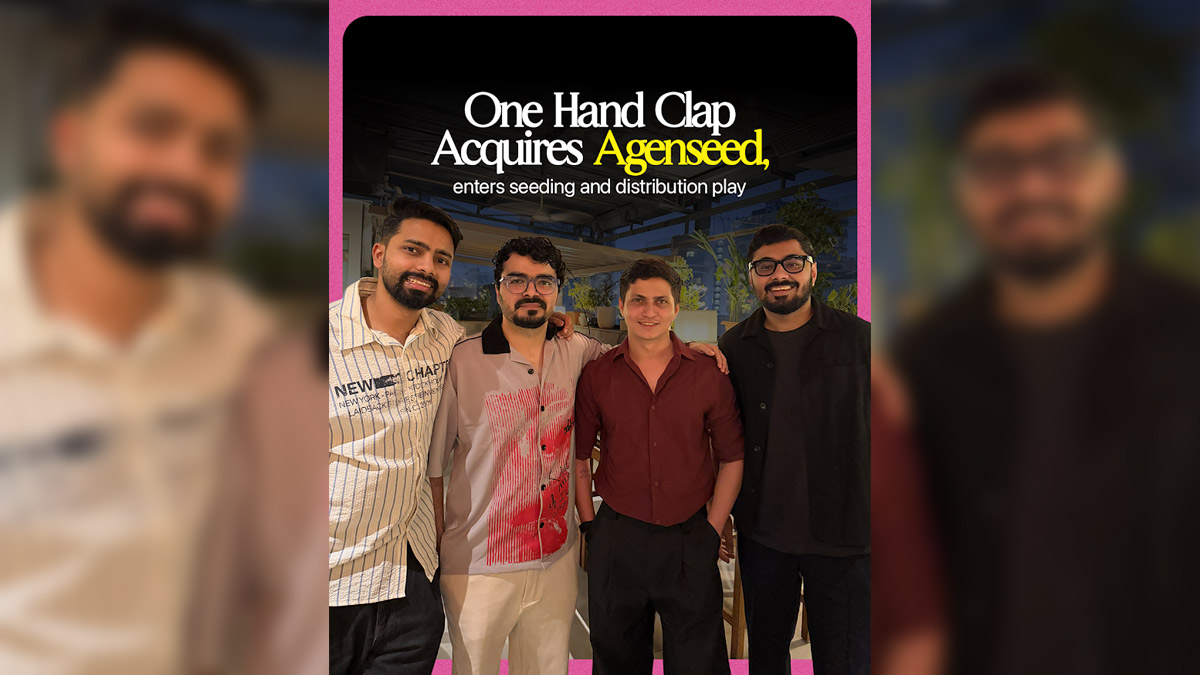
MUMBAI: One Hand Clap has decided to stop just clapping for great ideas now it wants to make sure they actually travel. The leading new-age creative agency and production house has acquired Agenseed, a seeding and distribution firm, marking its formal entry into the distribution segment. The move is aimed at expanding its role across the entire marketing value chain and unlocking new growth opportunities.
One Hand Clap expects the new distribution vertical to contribute up to 15 per cent of its overall revenues over the next 12–18 months, signalling a clear strategic shift beyond pure creative services.
Agenseed, founded by Monish Hardasani and Akram Malik, will function as the agency’s dedicated distribution arm. This acquisition strengthens One Hand Clap’s position as it aims to become a full-stack creative and distribution company in India’s rapidly growing digital advertising market.
With over 90 million posts shared daily on Instagram and brands allocating 25–35 per cent of their digital budgets to distribution and creator-led reach, amplification has become critical to campaign success. By integrating distribution early into the creative process, the agency hopes to help campaigns gain stronger cultural traction and momentum.
One Hand Clap founder Aakash Shah said, “The future of advertising is not just about executing great ideas, but about placing them intelligently. By owning both storytelling and distribution, we can drive greater impact for brands while opening up new revenue streams.”
Agenseed co-founder Monish Hardasani added, “The future belongs to ideas designed to travel. This partnership allows us to integrate distribution thinking at the source.”
Founded in 2019 by former AIB leaders Aakash Shah and Naveed Manakkodan, One Hand Clap has worked with major brands including Swiggy, Google, Netflix India, Crocs, Duolingo, CRED, Bumble, BGMI and Chetak. The agency also secured investment from Zerodha co-founder Nikhil Kamath last year.
In an increasingly fragmented attention economy, this acquisition reflects a broader industry shift where agencies are building end-to-end capabilities to stay competitive. One Hand Clap is clearly clapping louder and ensuring its ideas now reach much further.






