MAM
Smriti Irani releases ASCI’s guidelines on harmful gender stereotypes


Mumbai: Seeing gender stereotypes in advertising has become so common that now people take harmful gender differences as social norms. Unfortunately! The gender stereotypes are so deep-rooted in our minds that we hardly stop and think, why should an ideal family in any ad have an older boy and a younger girl, why not a family with two girls? Why should a typical Indian brand’s ad start with a man reading a newspaper and the woman making him a cup of tea? Why do terms like “men will be men” strike our minds?
Taking into consideration the deep-seated gender stereotypes in our minds, the Advertising Standards Council of India (ASCI) has launched a set of eight guidelines on harmful gender stereotypes. The new guidelines aim to focus not just on the bigger violations but on the ones that the audience might not even register, at once.
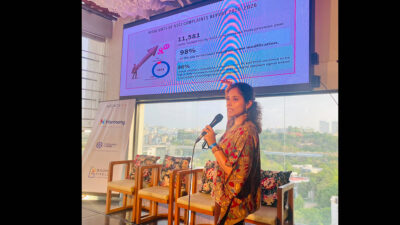
The guidelines come as a follow up for its GenderNext report released by ASCI and Futurebrands in October 2021. It was released by the minister for women and child development Smriti Irani at an event held in Delhi.
Just a few days after the Layer’r shot advertisements were taken down, the guidelines seem like a timely intervention from ASCI. The advertisements from the perfume brand didn’t go well with the audience and were accused of promoting rape culture in the country.
Sharing his thoughts on ASCI chairman Subhash Kamath added, “Advertising has the power to influence mindsets and decision making and bring about behavioural changes. Hence, we need to help shape the narrative. The recent controversy implies that there is a need for sensitisation, in terms of how we portray genders in advertising.”
Gender portrayal is a complex and nuanced issue and the guidelines provide an interpretation of ASCI’s Chapter III (related to harmful situations), which deals with ads that can cause harm to individuals or society. Gender stereotypes are harmful because they lock individuals in certain roles and perpetuate certain dynamics that are harmful to society. Advertising, through subtle and implicit depictions, reinforces certain harmful stereotypes and overlooks the aspirations of individuals and groups. A recent study by Kantar shows that 64 per cent of consumers believe that advertising reinforces rather than helps eradicate harmful gender stereotypes.
While the guidelines focus on women, they also provide guardrails for the depiction of other genders.
The guidelines, encourage advertisers and creators to deploy the SEA (Self-esteemed – Empowered – Allied) framework that guides stakeholders in imagining as well as evaluating portrayals of gender in their advertising by building empathy and aiding evaluation, as well as the 3S framework, which provides a checklist to guard against tropes and implicit stereotypes that creep into advertising.
These frameworks can prove to be extremely useful for marketing and advertising professionals to improve their advertising ROIs.
Speaking at the launch of the guidelines on harmful gender stereotypes, the minister for women and child development, Smriti Zubin Irani said, “While there are women who are happy with the incremental change that has been made in the advertising industry, women of my generation are a bit more impatient. It is time not only for the men but also for the women in the advertising industry to step up. This is a very important move, and I believe that there is a long journey to be undertaken to turn the thinking but it’s required now. Work in this area must move with more and more speed and organisations like ASCI should lead this, the action beginning with its member base”
She also pointed out how we just end up blaming and boycotting actors who are playing the sexiest roles instead of lashing out at each stakeholder included in the production of a particular advertisement. Irani feels that the real change will only come when each stakeholder will take the responsibility to bridge the gender gap.
ASCI chairman Subhash Kamath added, “The new guidelines were created after extensive consultation with many partners- both from industry, as well as civil society organisations, including the Unstereotype Alliance and UNICEF. These guidelines are a big step forward in strengthening ASCI’s agenda to shape a more responsible and progressive narrative. We are grateful to the government and Shrimati Smriti Irani for supporting these guidelines, and to the many partners who have been with us on this journey.”
Social activist and writer Ranjana Kumari reiterated that such guidelines are an attempt to start a discussion and debate around subtle messaging that may go unnoticed. “It is also important to push for laws that will appropriately penalise offenders,” she added.
ASCI’s Guidelines on harmful gender stereotypes in advertising are as follows:
1. ASCI will consider an ad’s likely impact when taken as a whole and in context.
2. ASCI will consider stereotypes from the perspective of the group of individuals being stereotyped.
3. The use of humour or banter is not likely to overcome the underlying issue of such harmful stereotypes.
4. The guidelines do not intend to prevent ads from featuring:
a. glamorous, attractive, successful, aspirational or healthy people or lifestyles;
b. one gender only, including in advertisements for products developed for and aimed at a particular gender;
c. gender stereotypes as a means to challenge their harmful effects.
Advertisements must not include gender stereotypes that are likely to cause harm or widespread offence.
1. While advertisements may feature people undertaking gender-stereotypical roles e.g., a woman cleaning the house or a man going to an office, or displaying gender-stereotypical characteristics, or for, e.g., a man being assertive or a woman being sensitive to others’ needs, they must not suggest that stereotypical roles or characteristics are:
- always uniquely associated with a particular gender;
- the only options available to a particular gender; or
- never carried out or displayed by another gender(s).
1.1 Advertisements that are aimed at / depict children may target and feature a specific gender but should not convey that a particular children’s product, pursuit, behaviour, or activity, including choice of play or career, is inappropriate for one or another gender(s). For example, ads suggesting that a boy’s stereotypical personality should be “daring” or that a girl’s stereotypical personality should be “caring”, or someone chiding a boy playing with dolls or girls from jumping around because it is not the typical activity associated with the gender, are likely to be problematic.
2. While advertisements may feature glamorous and attractive people, they must not suggest that an individual’s happiness or emotional wellbeing depends on conforming to these idealised gender-stereotypical body shapes or physical features.
3. Advertisements should not mock people for not conforming to gender stereotypes, their sexual orientation or gender identity, including in a context that is intended to be humorous, hyperbolic or exaggerated. For example, an ad may not belittle a man for carrying out stereotypically female roles or tasks or make fun of a same-sex relationship.
4. Advertisements should not reinforce unrealistic and undesirable gender ideals or expectations. For example, an advertisement must not depict a man with his feet up and family members creating a mess around a home, while a woman is solely responsible for cleaning up the mess, or a woman overly grateful for the man helping her in everyday chores. Similarly, a woman returning from work may not be shown as solely responsible for doing household duties while others around her are at leisure.
5. An advertisement may not suggest that a person fails to achieve a task specifically because of their gender e.g., a man’s inability to change nappies; or a woman’s inability to park a car. In categories that usually target a particular gender, care must be taken to not depict condescension towards any other gender or show them as incapable of understanding the product or unable to make decisions. This does not prevent the advertisement from showing these stereotypes as a means to challenge them.
6. Where an advertisement features a person with a physique or physical characteristics that do not match an ideal stereotype associated with their gender, the advertisement should not imply that their physique or physical characteristics are a significant reason for them not being successful, for example in their romantic, social or professional lives. For example, an ad may not suggest that a man who is short, a woman who is dark, or any individual who is overweight has difficulty finding a job or a partner due to this aspect of their physique.
7. Advertisements should not indulge in the sexual objectification of characters of any gender or depict people in a sexualised and objectified way for titillating viewers. This would include the use of language or visual treatments in contexts wholly irrelevant to the product. For example, an online takeaway service featuring an image of a woman wearing lingerie lying back in a provocative pose behind various fast-food items would be considered problematic. Even though the image may not be sexually explicit, by using a suggestive image of a woman that bears no relevance to the advertised product, the ad would be considered objectifying women by presenting them as sexual objects, and therefore is a gender stereotype that is likely to cause harm.
8. No gender should be encouraged to exert domination or authority over the other(s) by means of overt or implied threats, actual force or through the use of demeaning language or tone. Advertisements cannot provoke or trivialise violence (physical or emotional), unlawful or anti-social behaviour based on gender. Additionally, advertisements should not encourage or normalise voyeurism, eve-teasing, stalking, emotional or physical harassment or any similar offences. This does not prevent the advertisement from showing these depictions as a means to challenge them.