Brands
Smirnoff stirs up a flavour fiesta with Minty Jamun, Mirchi Mango and Zesty Lime


MUMBAI: Smirnoff Is raising the bar (and a few eyebrows) with the launch of three punchy new flavours — Minty Jamun, Mirchi Mango, and Zesty Lime — tailor-made for the bold, experimental tastes of India’s new-age drinkers.
Now hitting shelves across Karnataka, Uttar Pradesh, Haryana, and Maharashtra, this flavour-forward line-up is part of Smirnoff’s India-first playbook, as it courts the Gen Z and millennial crowd that prefers party nights on rooftops over banquets, and DIY cocktails over bar menus.
“We’re seeing a clear shift in how young Indians approach their favourite spirits — they want global brands to build a stronger local connect that is fresh and premium and yet playful. With Minty Jamun, Mirchi Mango,and Zesty Lime we’re not just offering new flavours, we’re creating moments of discovery that are vibrant, social, and rooted in today’s cultural codes,” said Diageo India (USL) CMO Ruchira Jaitly.

Each variant packs its own punch:
. Minty Jamun: A throwback to schoolyard summers, now with a stylish twist
. Mirchi Mango: A sweet-spicy bombshell, echoing India’s chilli-laced fruit obsession
. Zesty Lime: Bright, breezy and built for easy pours at pre-games and house parties
The launch is wrapped in Smirnoff’s new campaign “Flavour is a Vibe” — a cheeky nudge to embrace taste with spontaneity, style, and a generous splash of self-expression.
With India’s cocktail culture bubbling over and at-home mixology becoming the new norm, Smirnoff’s latest desi detour is likely to find itself clinking glasses at celebrations of every size. Because in 2025, it’s not just about what you’re drinking, it’s how you vibe with it.






Brands
Samsung certifies 1,000 Maharashtra students in AI and coding
The South Korean electronics giant marks its first large-scale skilling push in the state, with women making up nearly half the national programme’s enrolment
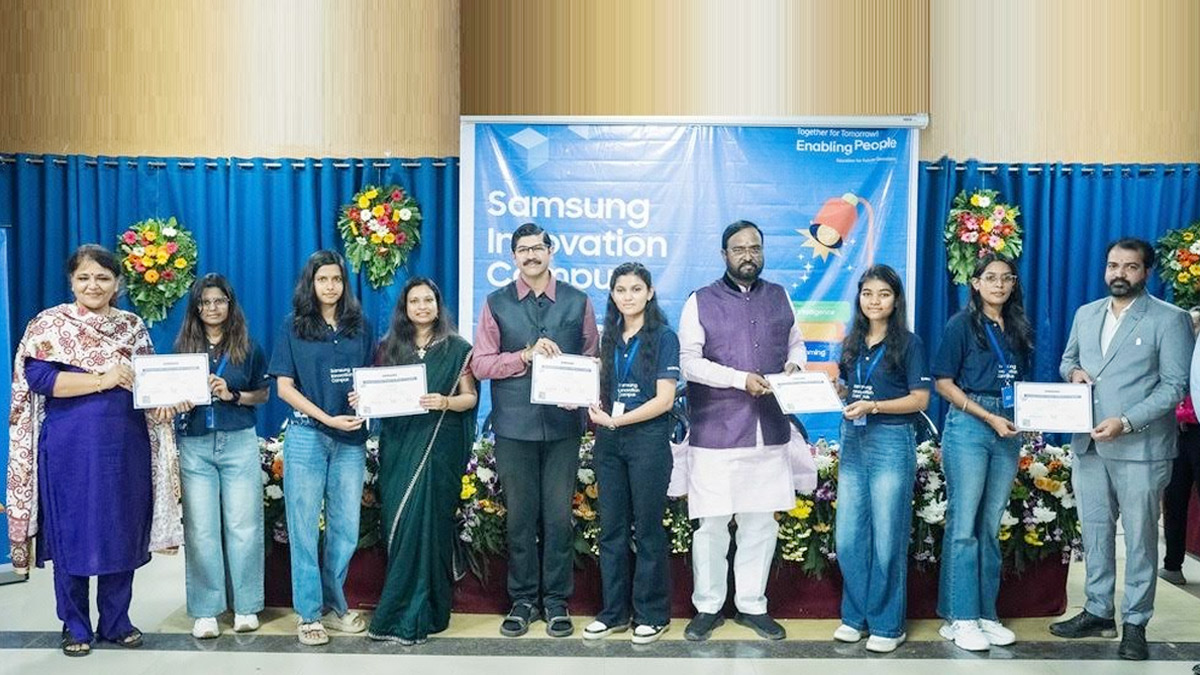
PUNE: Samsung has put 1,000 students in Maharashtra through a certified training programme in artificial intelligence and coding, the largest such drive the South Korean electronics company has run in the state and a signal that corporate India’s skilling ambitions are moving well beyond the boardroom brochure.
The certifications were awarded under Samsung Innovation Campus (SIC), the company’s flagship corporate social responsibility programme, which launched in India in 2022 with the stated aim of democratising access to future-technology education. The 1,000 graduates were drawn from four institutions: 127 from Savitribai Phule Pune University, 373 from Pimpri Chinchwad University, 250 from D.Y. Patil University’s Ramrao Adik Institute of Technology and 250 from Anjuman-I-Islam’s Kalsekar Technical Campus. All completed training in either AI or coding and programming, the two disciplines Samsung has identified as the critical pillars of the digital economy.
The programme does not stop at technical training. Soft-skills development and career-readiness modules are baked into the curriculum, a deliberate attempt to close the gap between what universities teach and what employers actually want.
“India’s digital growth story will ultimately be shaped by the quality of its talent pipeline,” said Shubham Mukherjee, head of CSR and corporate communications at Samsung Southwest Asia. “As technologies like AI move from the periphery to the core of industries, skilling must evolve from basic training to building real-world capability. This milestone in Maharashtra reflects how industry and academia can come together to create a future-ready workforce that is both globally competitive and locally relevant.”
The Maharashtra drive sits within a rapidly scaling national effort. Samsung Innovation Campus trained 20,000 young people across India in 2025, hitting its stated target for the year. Women account for 48 per cent of national enrolments, a figure the company cites as evidence of its push for an inclusive technology ecosystem. The programme is implemented in partnership with the Electronics Sector Skills Council of India and the Telecom Sector Skill Council.
Samsung, which is marking 30 years in India this year, runs SIC alongside two other initiatives, Samsung Solve for Tomorrow and Samsung DOST, as part of a broader effort to build what it calls a generation of innovators with both the technical depth and the problem-solving mindset to thrive in a fast-moving digital world.
A thousand certified students is a tidy headline. Whether they find jobs that match their new skills is the harder question, and the one that will ultimately determine whether corporate skilling programmes like this one are genuine pipelines or well-photographed gestures.






