MAM
‘Safer For Each Other 2.0’: Uber reassures riders of safety
NEW DELHI: Uber has launched the second-leg of its marketing campaign, ‘Safer For Each Other 2.0,’ to reassure riders of various precautionary measures it is undertaking for rider and driver safety, including in-car partitions and frequent disinfection of vehicles.
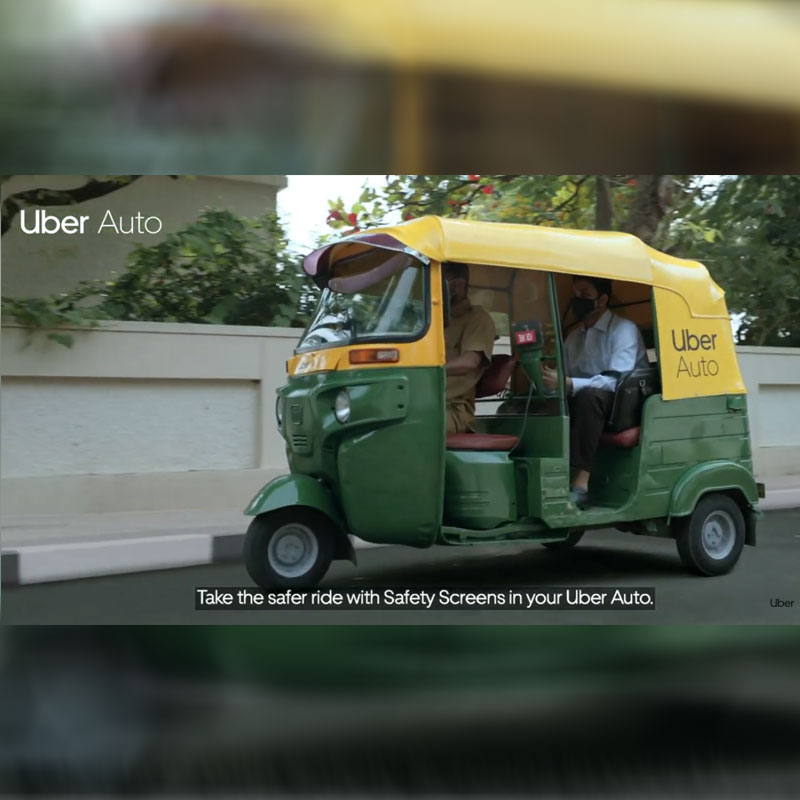
Uber has already installed safety screens in 81,000 autos across more than 20 cities and in 42,000 cars across seven cities. These high quality safety partitions are being installed just behind the driver’s seat and will act as an additional physical barrier between drivers and riders, facilitating social distancing while on a trip and help restrict contact.
Through ‘Safer For Each Other 2.0,’ Uber aims to make its partitions a tangible marker of safety in autos and cars. By sitting on the opposite sides of the safety screen, both riders and drivers are helping keep themselves #SaferForEachOther. The 360-degree campaign amplification plan will leverage print, radio, digital, social media, and other channels to ensure widespread awareness about Uber’s safety standards.
Uber marketing director, India SA & APAC rides brand marketing Sanjay Gupta, said, “At Uber, we are constantly defining transportation safety standards. The campaign salutes the human spirit & ability to move forward amidst crisis. As a brand that is reimagining how people move forward safely, the campaign highlights the importance of safety screens in maintaining physical distancing, while keeping riders & drivers connected on the common goal of keeping each other safer.”
Over the past few months, Uber has announced various features and policies to help riders and driver partners feel safer. It has launched a comprehensive set of safety measures such as the pre-trip mask verification selfies for drivers and riders, mandatory driver education around Covid2019 related safety protocols, and an updated cancellation policy.

Brands
Hyundai and TVS Motor partner to develop electric three wheelers
Joint development pact targets last mile mobility with localisation push
MUMBAI: Three wheels, one big ambition and a charge towards the future. Hyundai Motor Company and TVS Motor Company have signed a joint development agreement to co-create electric three-wheelers (E3Ws), aiming to crack India’s complex last-mile mobility puzzle. The collaboration moves beyond concept talk into execution mode, building on the E3W prototype first showcased at the Bharat Mobility Global Expo 2025. The goal now is clear, design, develop and commercialise a purpose-built vehicle tailored to Indian roads, riders and realities.
Under the agreement, Hyundai will lead design and co-development, bringing its global R&D muscle and human-centric engineering approach to the table. TVS Motor, meanwhile, will anchor the product on its electric platform, leveraging deep three-wheeler expertise and local market insight. It will also handle manufacturing and sales in India, with an eye on exports down the line.
The timing is strategic. India remains the world’s largest three-wheeler market, where affordability, durability and adaptability often outweigh sheer innovation. The upcoming E3W aims to strike that balance combining advanced technology with practical features such as adaptive ground clearance for monsoon-hit roads, improved thermal management for tropical climates, and flexible interiors suited for passengers, cargo or emergency use.
A key pillar of the partnership is localisation. Major components will be sourced and manufactured within India, a move expected to strengthen the domestic supply chain, create jobs, lower costs and improve after-sales support.
The shift from prototype to production will involve rigorous testing, certification and refinement to meet regulatory standards and consumer expectations. Dedicated cross-functional teams from both companies are already in place to accelerate timelines.
At a broader level, the tie-up reflects a growing trend in mobility, global players partnering with local specialists to navigate emerging markets. For Hyundai and TVS, the bet is that combining scale with street-level insight could unlock a new chapter in sustainable urban transport, one that runs not just on electricity, but on relevance.