MAM
Rise of zebra striping as drinkers mix spirits with sobriety

MUMBAI: Raise a glass and then a soda. The world’s latest drinking trend, dubbed “zebra striping”, is rewriting social rituals one sip at a time. According to new research by Euromonitor International, consumers are alternating between alcoholic and non-alcoholic beverages in a single evening, a mindful move that’s helping people balance indulgence with intention.
The global alcoholic drinks industry poured out 253 billion litres in 2024, but growth is showing signs of a hangover. Enter zebra striping, a trend spreading faster than happy-hour offers, especially among Gen Z and younger millennials who are redefining what it means to “go out for a drink.”
Euromonitor’s World Market for Alcoholic Drinks 2025 report finds that moderation is now mainstream. Only 17 per cent of consumers say they drink weekly in 2025, a sharp drop from 23 per cent in 2020 while 53 per cent are actively cutting back. The share of people who never drink at all has risen by 3 percentage points in just five years.
Behind the shift lies a mix of health goals and pragmatism: 87 per cent of respondents cited a desire to feel healthier and avoid long-term health risks; 30 per cent said saving money mattered, while 25 per cent credited better sleep as motivation. The “sober curious” movement is making abstinence aspirational and redefining nightlife as we know it.
Among those swapping cocktails for kombucha, Gen Z stands out with 36 per cent of legal-age respondents never having consumed alcohol at all. Hedonism, it seems, is being traded for hydration.
Yet, while traditional booze is flatlining, India is raising the bar. The country is projected to add 357 million litres to its alcoholic drinks consumption between 2024 and 2029, making it a standout growth market. With rising incomes and evolving social norms, India along with Brazil, Mexico, and South Africa is expected to outpour mature markets where spending power remains under strain.
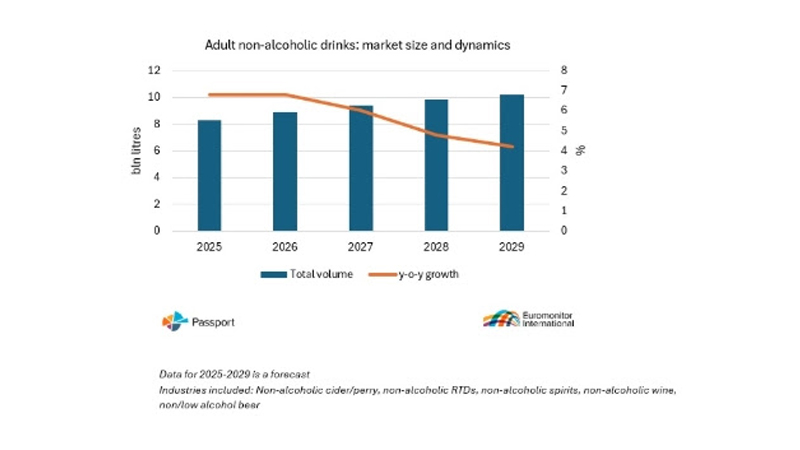
Globally, the adult non-alcoholic category is bubbling with momentum. In 2024, total alcoholic beverage volume grew a modest 0.6 per cent, reaching a 1.7 trillion dollars market, while the no/low segment soared: non-alcoholic spirits rose 17 per cent, RTDs 14 per cent, non/low beer 11 per cent, and non-alcoholic wine 7 per cent. Between 2025 and 2029, the adult non-alcoholic drinks market is expected to swell by 24 per cent, surpassing 10.2 billion litres by 2029.
As Euromonitor, global insight manager for alcoholic drinks Spiros Malandrakis put it: “Non-alcoholic alternatives are no longer niche, they’re becoming central to how people celebrate and connect.”
So, the next time someone says they’re going for a drink, don’t be surprised if it’s an alcohol-free G&T. After all, in today’s world, balance is the new buzz.