MAM
PVR announces results for quarter ended june 30, 2019


MUMBAI: PVR Limited today announced its unaudited standalone and consolidated financial results for the quarter ended 30th June, 2019.
The revenues for quarter ended June 2019 were Rs 887 crores as compared to Rs 701 crores during the corresponding period of last year, witnessing a growth of 27 per cent. Consolidated EBITDA for the quarter was Rs 285 crores as against Rs 141 crores in the same period last year, witnessing a growth of 102%. EBITDA margin for the quarter was 32.2%. Consolidated PAT for the quarter was Rs 18 crores as compared to Rs. 52 crores during the corresponding period of last year.
During the current quarter company transitioned to new accounting standard on leases – Ind AS 116. While this accounting standard has no economic impact on the business, there is a material change in the reported financials. Under this new standard company needs to capitalise all operating leases on the Balance Sheet as Right of Use and its corresponding liability as Lease Liabilities. On account of this transition the reported results of Q1 FY 2020 are not comparable to corresponding quarter last year. After adjusting for impact of this new accounting standard the Consolidated Revenue, EBITDA, EBITDA margin and PAT of the company would have been Rs 887 crores, Rs. 165 crores, 18.6% and Rs. 44 crores respectively. This would represent a revenue and EBITDA growth of 27% and 17% respectively.

The box office revenues for the quarter were up by 19% from Rs. 385 crores to Rs 457 crores led by a 19% growth in admits. F&B revenues were up by 29% from Rs 205 crores to Rs 263 crores. Advertising revenues witnessed robust growth of 28% increasing to Rs 92 crores, up from Rs. 72 crores in Q1 last year.
During the current financial year, company has aggressively expanded its presence adding 36 new screens till date across 6 properties and now operates a network of 794 screens spread over 168 properties in 67 cities across the country. The company intends to add a total of 80-100 screens in FY 2019-2020.
Commenting on the results and performance, Mr. Ajay Bijli, Chairman cum Managing Director, PVR Ltd said “We are extremely pleased with the performance of the business for Q1 FY 19-20 with strong all round performance of content at the box office despite two big cricketing events, IPL and World Cup, taking place during the same period. This truly reflects the strength of the cinema as a medium for entertainment, especially during a period when the consumer is spoilt for choice in terms of modes available to him to consume content. This give us conviction to continue with our growth plans and keep innovating to provide a better movie watching experience to our consumers.”




Brands
KKR sixes to power EV charger rollout under VIDA campaign
Cricket meets clean mobility as big hits spark India’s charging growth
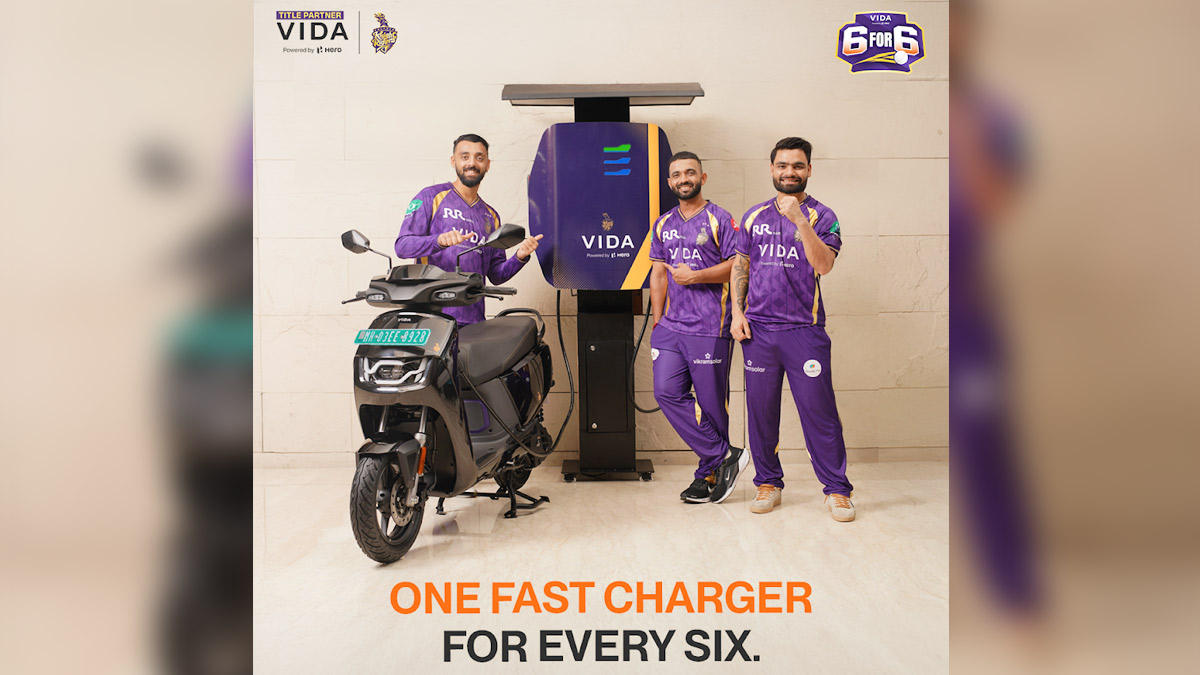
NEW DELHI: VIDA, the electric mobility arm of Hero MotoCorp, has teamed up with Kolkata Knight Riders to launch a campaign that turns cricketing flair into real-world impact.
Titled ‘6 for 6’, the initiative promises to install a 6kW fast EV charger for every six hit by KKR during the ongoing Indian Premier League season. The idea is simple but powerful, as each big hit on the field contributes directly to expanding India’s fast-charging infrastructure.
The campaign builds on VIDA’s growing network, which already spans over 5,300 fast-charging points across more than 430 cities. With EV adoption gaining pace, the brand is using cricket’s mass appeal to accelerate both awareness and infrastructure growth.
Explaining the thinking behind the move, Hero MotoCorp emerging mobility business unit chief business officer Kausalya Nandakumar said, “Cricket has an incredible ability to unite and inspire millions across the country. With the ‘6 for 6’ campaign, we are turning every big hit on the field into a step towards a cleaner and a more accessible mobility future.”
She added that VIDA’s expanding fast-charging network and removable battery technology are designed to make EV ownership more convenient and practical for everyday users.
From the franchise’s side, the campaign is also about giving on-field moments a larger purpose. Kolkata Knight Riders chief executive officer Venky Mysore said, “The ‘6 for 6’ campaign exemplifies the potential of sport as a platform for meaningful, real-world impact. By linking every six to the expansion of EV charging infrastructure, this partnership transforms fan excitement into tangible progress.”
As part of the rollout, VIDA has introduced co-branded charging stations in KKR’s signature colours, with a flagship installation unveiled alongside team players. The chargers are designed for quick top-ups, powering VIDA scooters from zero to 80 percent in about an hour, while also being positioned along key highways to support longer journeys.
The initiative also taps into VIDA’s removable battery system, which allows users to charge using standard household plug points, adding flexibility to the charging ecosystem.
By blending the thrill of cricket with the urgency of clean mobility, VIDA and KKR have found a neat way to make every six count twice, once on the scoreboard and again on India’s road to an electric future.








