
MAM
PBSHABD reaches 3,600 media organisations with free news service
Prasar Bharati platform offers multilingual news in five formats across nearly 50 categories


MUMBAI: News is getting a wider distribution net, with Prasar Bharati’s PBSHABD now reaching 3,600 media organisations, two years after the public broadcaster opened its news infrastructure to external users.
Launched in March 2024, PBSHABD was created by expanding the broadcaster’s earlier Prasar Bharati News Service (PBNS), which had operated as an internal news wire for Akashvani and Doordarshan. The platform now gives registered newspapers, television and radio broadcasters, digital publishers and content creators access to ready-to-use news content across multiple formats and languages.
The service remains free through March 2027 and provides round-the-clock news across nearly 50 categories and 15 Indian languages.
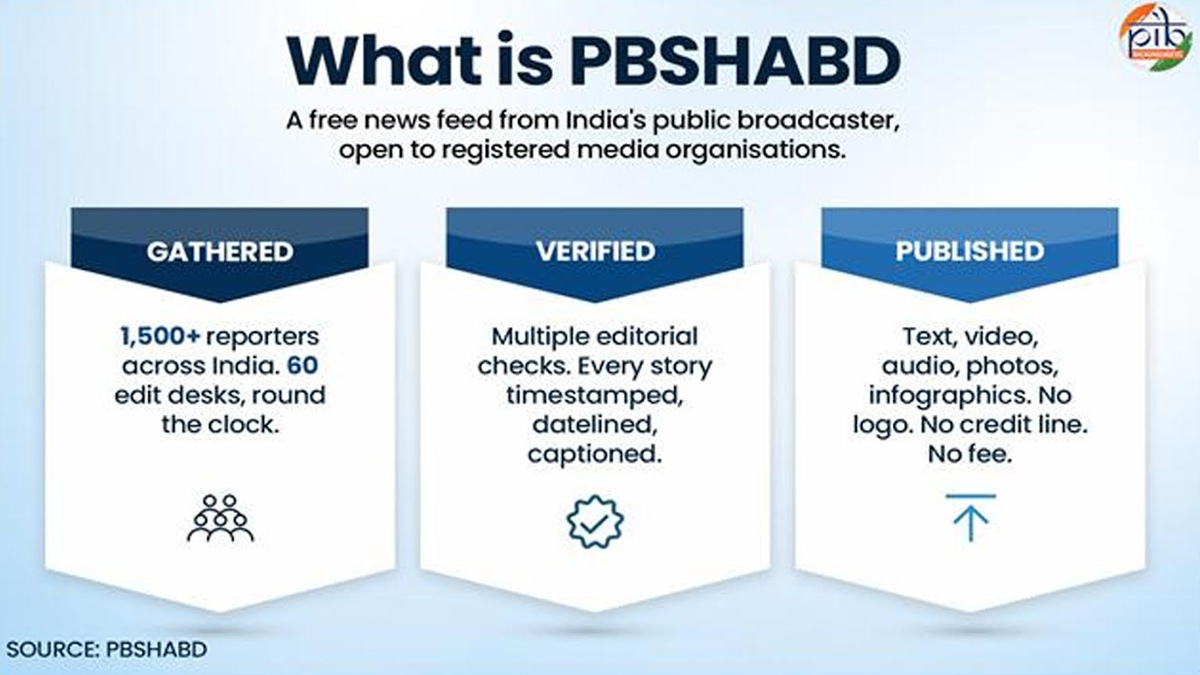
PBSHABD is built on Prasar Bharati’s existing news-gathering infrastructure rather than a newsroom created from scratch. More than 1,500 reporters, correspondents and stringers contribute to its news pipeline, supported by 60 dedicated editorial desks operating around the clock.
Akashvani and Doordarshan also have regional news units covering states and Union territories, giving PBSHABD a reporting network that stretches well beyond the broadcaster’s own platforms.
The service distributes content in five formats text, video, audio, photographs and infographics. This allows news organisations to use the same feed across television, print, websites, social media and other digital platforms.
One of PBSHABD’s notable features is its distribution model. Registered users do not pay a subscription fee for content downloaded from the platform, with free access currently assured until March 2027.
According to the backgrounder, the content carries no Prasar Bharati logo and does not require a credit line. For smaller publications, that means a national story can be published under their own masthead without the additional burden of maintaining a large reporting network.
The model could be particularly useful for regional and smaller news organisations that may not have correspondents in Delhi or outside India. Ready-to-use content across formats can also reduce production costs and shorten the journey from reporting to publication.
PBSHABD currently provides content in 15 Indian languages and nearly 50 categories, covering national, regional and local developments. Its user base spans newspapers, news television channels, digital publishers and content creators.
The wider Prasar Bharati network provides a substantial reporting and bulletin infrastructure behind the service. Akashvani operates 46 regional news units along with its headquarters operation, producing 607 bulletins a day in 92 languages and dialects.
Doordarshan News has 31 regional news units and a headquarters operation, producing more than 145 bulletins in over 22 languages and dialects.
PBSHABD says its content goes through multiple editorial checks before dissemination, with safeguards intended to prevent fake, morphed or manipulated material and caution around information sourced from unverified online platforms.
Stories are timestamped, datelined and captioned, giving users details on when and where an event took place. The verification layer is positioned as a response to an increasingly fragmented news environment spanning television, newspapers, websites, YouTube, social media and mobile applications.
Prasar Bharati is now preparing the next phase with PBSHABD 2.0, which is expected to introduce new product lines and improve content delivery.
The expansion takes the broadcaster’s news-gathering infrastructure beyond its own channels and places it in the hands of a much wider pool of media organisations. With 3,600 organisations already using the service, PBSHABD is steadily becoming a shared distribution layer connecting Prasar Bharati’s national reporting network with India’s multilingual and increasingly fragmented news ecosystem.






