MAM
Parrot Analytics launches Sports Demand to put rigour into soaring media rights market

LOS ANGELES: : Parrot Analytics, the media analytics firm known for pioneering streaming valuation, has launched Sports Demand, billed as the most advanced global sports analytics system. The tool is designed to arm leagues, teams, broadcasters, streamers and sponsors with data-driven insights to navigate the fast-inflating sports rights market.
Sports rights fees have surged in recent years, with Paramount’s $7.7 billion deal for UFC events, WWE’s $1.6 billion tie-up with ESPN, and the NFL’s equity-for-content swap with Disney underscoring the scale. Parrot says its system will allow buyers and sellers to measure fan engagement market by market, justify valuations, and extract stronger returns on investment.
“For the first time, decision-makers can weigh the impact of acquiring a sports league against investing in scripted series or films, within a single framework,” said Parrot Analytics chief executive Wared Seger. By integrating with the firm’s Demand360 platform, Sports Demand lets clients benchmark sports against TV shows, films and on-screen talent.

Capabilities include global fan mapping across 100 markets, integrated sports-entertainment benchmarking, empirical valuation models, content optimisation, and sponsor alignment analysis. Early adopters include leagues negotiating landmark streaming deals and operators launching direct-to-consumer sports services.
Seger argued that in an attention economy where sports compete directly with films and television for time and spend, “rigorous, standardised data is essential.”
Sports Demand is now available worldwide to Parrot Analytics’ enterprise clients, with dashboard and API access for seamless integration into rights, content and sponsorship strategies.





MAM
Lego brings Messi, Ronaldo, Mbappé, Vinicius together
Campaign clocks 314 million views ahead of FIFA World Cup 2026 buzz.
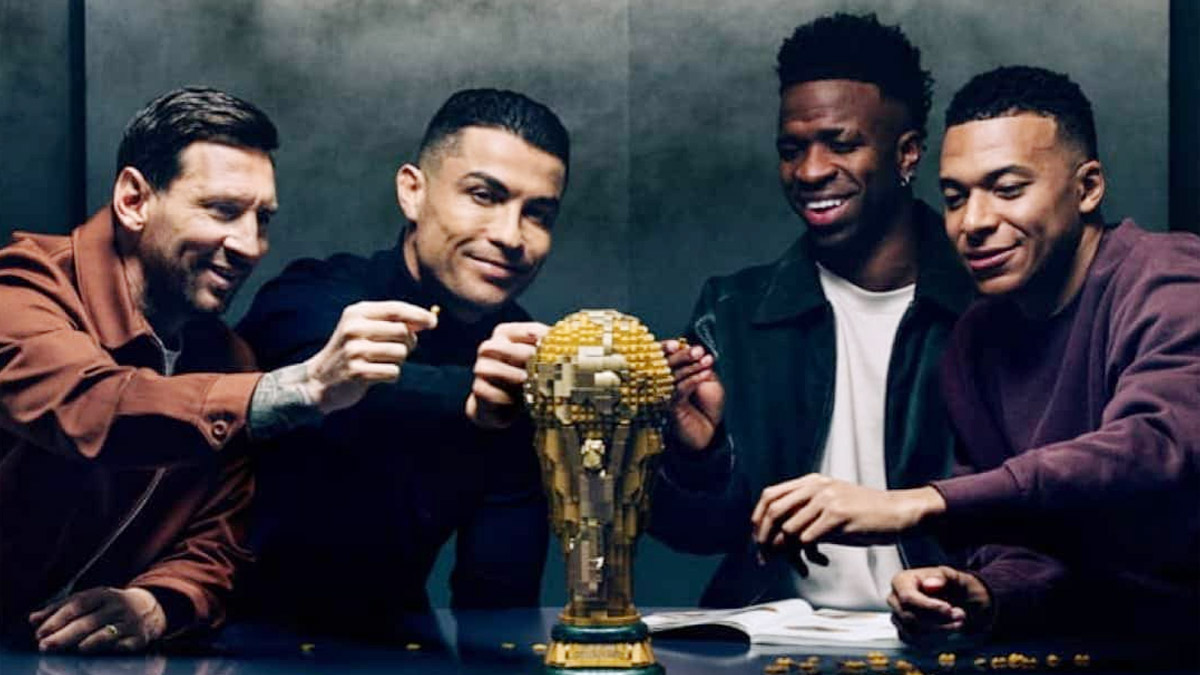
MUMBAI: Four legends, one frame and not a single tackle in sight. Lego has pulled off a crossover few thought possible, uniting Lionel Messi, Cristiano Ronaldo, Kylian Mbappé and Vinícius Júnior in a single campaign ahead of the FIFA World Cup 2026 only this time, they’re building dreams brick by brick.
Titled “Everyone wants a piece”, the campaign features the quartet assembling a Lego version of the World Cup trophy, before placing miniature versions of themselves atop it, a playful nod to football’s ultimate prize. Shared widely across social media, the ad carries a pointed disclaimer: it is not AI-generated, a subtle but telling signal in an era where even reality is often questioned.
The numbers tell their own story. The campaign has already crossed 314 million views on Instagram across the players’ accounts, with fans hailing it as a rare, almost nostalgic moment particularly for the reunion of Messi and Ronaldo, whose last shared campaign ahead of the 2022 World Cup became one of the platform’s most-liked posts.
Beyond the film, Lego is extending the play with exclusive, player-themed sets tied to each of the four stars, part of a broader football-led programme designed to ride the global momentum building towards 2026. The idea, as echoed by the players themselves, leans into the parallels between football and play experimentation, creativity, failure, and triumph.
Messi described the sets as a way to bring on-pitch moments into an imaginative, hands-on world, while Ronaldo called the transformation into a Lego figure a rare honour, blending sport with storytelling. Vinícius, meanwhile, struck a more personal note, recalling childhood moments of building with Lego and framing creativity as a universal language that transcends borders.
The timing is no accident. With the 2026 World Cup set to run from June 11 to July 19 across the United States, Canada and Mexico, and featuring an expanded 48-team format, global anticipation is already building. Argentina, led by Messi, will enter as defending champions, adding another layer of intrigue.
For Lego, the campaign does more than celebrate football, it taps into its mythology. Because when icons become figurines and rivalries turn into play, the beautiful game finds a new kind of pitch. one built, quite literally, by hand.






