MAM
Outdoor ad spends register 8% growth in H1 FY 2013


MUMBAI: Laqshya Media Group’s media research wing that caters to the OOH research and analysis has revealed the H1 fiscal analysis of 2013, while comparing it with the same period in 2012.
According to the report, despite the lingering economic uncertainty, OOH continues to grow – giving a positive sign to advertisers who plan to reach out to people with billboards, bus shelters, huge gantries, foot-over bridges, and any other outdoor vehicles.
According to Laqshya Media Research statistics on the outdoor advertising ad revenues, there has been a growth of 11 per cent for Q1 and 4 per cent growth during Q2 of 2013 over the same period in 2012, making it a total of 8 per cent growth for the H1 fiscal 2013 over 2012.

The sector-wise analysis reveals that real estate has upped its OOH investments most rapidly as compared to any other sector making it the most dynamic category for the first half of 2013. The sectors’ spends grew by 51 per cent as compared to H1 of 2012. The report states that the realty players from Mumbai and Delhi have been spending heavily in traditional OOH, whereas south based players are also actively visible in premium ambient media like airports.
The education sector with large focus on Q1 dominates the other category spends though their spends have reduced compared to H1 of 2012. In the media & entertainment category, TV channels particularly the GECs hold a substantial pie in the OOH share of spends. Jewellery brands like Tanishq has been spending heavily along with south based brands like Malabar and Kalyan on their store launch across various towns using OOH to create awareness. There has been a 28 per cent rise in their spends observed this year as compared to H1 2012.
Many other sectors slightly exceeded their spends in the first half this year as compared to last year making the overall OOH share of spends bigger and thus creating an 8 per cent growth as compared to 2012. Categories like banking, mobile handsets, airline operators, housing finance, life insurance, retail (particularly the innerwear segment) and healthcare saw greater growth as compared to last year’s first half.
Two-wheelers have emerged as one of the most active spenders in the first half of 2013 as compared to the same time in 2012, registering a growth of at least 50 per cent. Brands like Hero Motocorp, Bajaj and Honda have captured the roads with larger than life displays for their two-wheelers.
The first half of fiscal year 2013 also saw a decrease in spends by the top OOH spenders like automobiles (four wheelers) and mobile services.
Laqshya Media Group COO Atul Shrivastava said, “The overall OOH pie has grown 8 per cent this year as compared to same period last year. There has been a moderate growth in various other sectors but OOH that has traditionally thrived on automobiles and mobile services took a hit. Big players in the four- wheeler category like Hyundai and Tata Motors-owned Jaguar Land Rover have been successfully banking on OOH long term sites to create brand salience. The only spike observed in the category was during the brand launch of Honda Amaze and Chevrolet Sail.”






Brands
Samsung certifies 1,000 Maharashtra students in AI and coding
The South Korean electronics giant marks its first large-scale skilling push in the state, with women making up nearly half the national programme’s enrolment
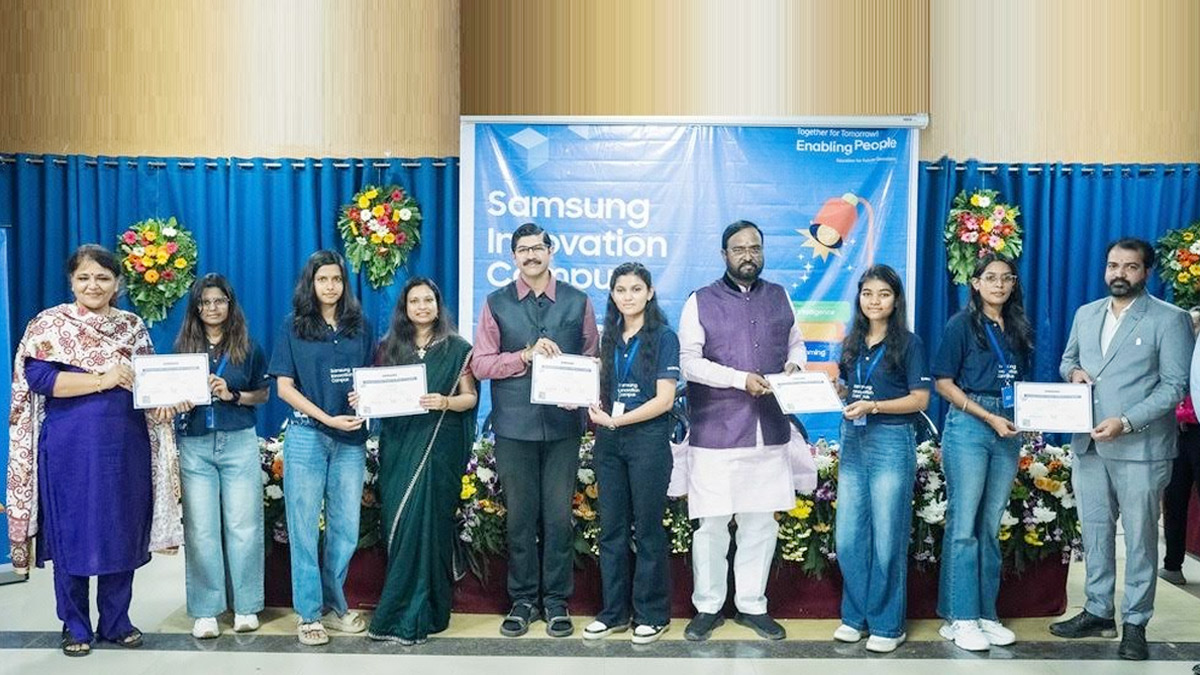
PUNE: Samsung has put 1,000 students in Maharashtra through a certified training programme in artificial intelligence and coding, the largest such drive the South Korean electronics company has run in the state and a signal that corporate India’s skilling ambitions are moving well beyond the boardroom brochure.
The certifications were awarded under Samsung Innovation Campus (SIC), the company’s flagship corporate social responsibility programme, which launched in India in 2022 with the stated aim of democratising access to future-technology education. The 1,000 graduates were drawn from four institutions: 127 from Savitribai Phule Pune University, 373 from Pimpri Chinchwad University, 250 from D.Y. Patil University’s Ramrao Adik Institute of Technology and 250 from Anjuman-I-Islam’s Kalsekar Technical Campus. All completed training in either AI or coding and programming, the two disciplines Samsung has identified as the critical pillars of the digital economy.
The programme does not stop at technical training. Soft-skills development and career-readiness modules are baked into the curriculum, a deliberate attempt to close the gap between what universities teach and what employers actually want.
“India’s digital growth story will ultimately be shaped by the quality of its talent pipeline,” said Shubham Mukherjee, head of CSR and corporate communications at Samsung Southwest Asia. “As technologies like AI move from the periphery to the core of industries, skilling must evolve from basic training to building real-world capability. This milestone in Maharashtra reflects how industry and academia can come together to create a future-ready workforce that is both globally competitive and locally relevant.”
The Maharashtra drive sits within a rapidly scaling national effort. Samsung Innovation Campus trained 20,000 young people across India in 2025, hitting its stated target for the year. Women account for 48 per cent of national enrolments, a figure the company cites as evidence of its push for an inclusive technology ecosystem. The programme is implemented in partnership with the Electronics Sector Skills Council of India and the Telecom Sector Skill Council.
Samsung, which is marking 30 years in India this year, runs SIC alongside two other initiatives, Samsung Solve for Tomorrow and Samsung DOST, as part of a broader effort to build what it calls a generation of innovators with both the technical depth and the problem-solving mindset to thrive in a fast-moving digital world.
A thousand certified students is a tidy headline. Whether they find jobs that match their new skills is the harder question, and the one that will ultimately determine whether corporate skilling programmes like this one are genuine pipelines or well-photographed gestures.






