MAM
Not the right time for brands to go dark; they must continue communication

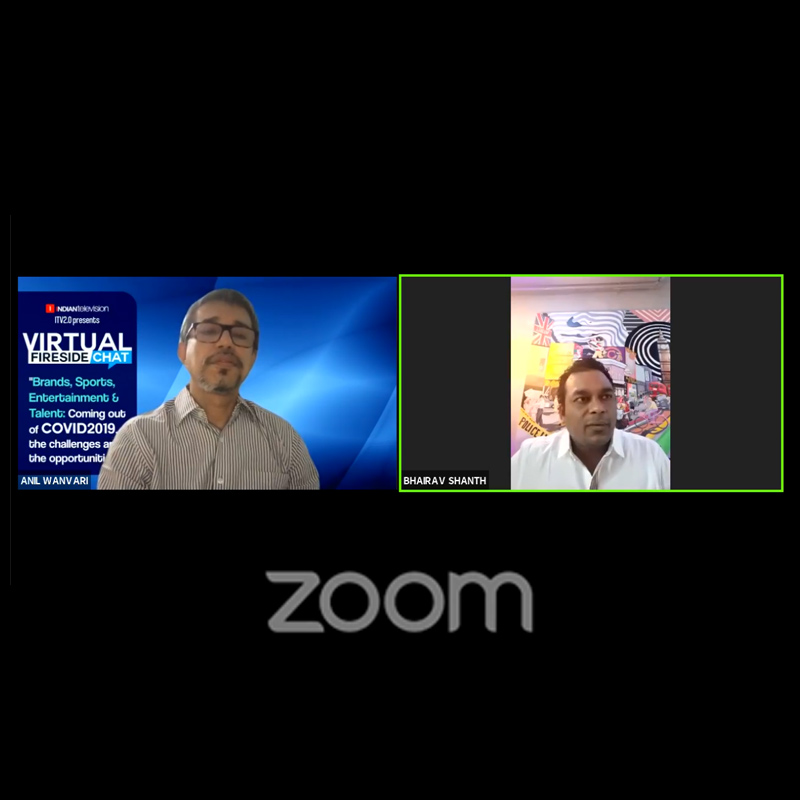
MUMBAI: Brands cannot go dark in these troubled times, says ITW Consulting managing director Bhairav Shanth during a virtual fireside chat with Indiantelevision.com founder, CEO and editor-in-chief Anil Wanvari. According to him, the brands should instead strive to remain relevant and active in these tough times.
He spoke about the future of the sports and live games and also how digital influencers have taken a centre stage, lately, to engage with masses on behalf of brands.
“We have introduced in excess of thousand plus brands into global cricket for the first time. We make an attempt to be involved and develop commerce for various cricket boards,” says Shanth.
The 12-year-old ITW Consulting seeks to fix the gap in the industry and do something different to give a single approach to every brand. With three verticals, Sports, Blitz and Playworx, the firm provides services such as sponsorship consulting, sports marketing, talent management among others.
Says Shanth, “In the last two months, digital influencers have been buzzing for creating engagement. Today, every brand ambassador has become an influencer by default.” The consulting firm has been actively working with the brands to identify the right digital influencer in the current scenario, at a time when everybody is sensitive.
During this testing time, not all brands want to sell their products through advertisement, but rather aim to create engagement and communication with consumers, believes Shanth. The firm has helped brands like Uber and Unacademy partner with the right digital influencers.
ITW Consulting is currently operational in all cricket-playing countries as well as across cities and districts in India, and the global presence has helped them grow a lot, points out Shanth. “Along with cricket, we are also doing a lot of work around Rugby, as it is a favourite sport in many countries. We are also trying to build interest in newer sports,” Shanth said.
Sports and events are the last priority of marketers while deciding media spends, which should not be the case. “Brands believe a traditional medium would deliver better, but we believe the hybrid model of sports with traditional medium would give more positive results,” says Shanth.
“We have brands that are showing enormous faith and belief in the sports ecosystem. If the brands are assertive that they want to invest in sports, agencies will fall in line," says Shanth. “It’s important for brands to do 360-degree activation and not just sponsorships.”
“Brands are cautious, but it is not all that bad. If the US can bounce back from the pandemic, so can other third-world countries,” points out Shanth. “Some brands are doing sports marketing right: BYJUS, Hero MotorCorp, etc. My favourite is Royal Stag; their sporting equipment contributed greatly to the sports ecosphere. Some new brands like Unacademy and Swiggy have shown great adaptability.”
Taking a cue from Bundesliga league that received record-breaking viewership in Germany, Shanth hopes that the live games, including cricket, are going to bounce back across the globe. He believes the absence of an in-stadia audience won’t impact the soul of the game.
“If people are thinking that sports in an empty stadium is not going to be exciting they are wrong. As television broadcast can create magical moments, it can adapt to the current requirement, and fill in with content, deep data and analytics that will keep the viewers engaged,” Shanth adds.
Over a period of time, technology has evolved, so is the reach and penetration of the internet in our lives. Going forward, this would increase the digital audience and may overpower television audiences, feels Shanth. According to him, with the changing scenario the e-sports category is picking up steam but can't replace live sports, as both need to co-exist, one cannot survive at the cost of the other.
Sports has acted as a band-aid every time the world has been under crisis and Covid2019 is no different than past situations, says Shanth. He cites an example of how sports helped the United States come out of the 9/11 shock. “Sport is a healer; people look at sports to create a sense of belonging and positivity. It is going to be back, and no one can take away the excitement of sports.”
Having been associated with many sports talents and personalities, Shanth says, “Athletes are anxious, want this crisis to end soon and be back on the field practising, playing games”. Sporting community altogether has come out with never-dying optimism during this stressful situation.
ITW Consulting is named after a favourite film Into The Wild. He says, “The company has seen enough changes for the past decade. And, we are getting better and by year and a half we will be stronger. We have never taken any situation for granted and will come up with a model.”
Like any other business, Covid2019 has impacted ITW Consulting too. Shanth says: “We have not taken any single downsizing move, have not fired anybody. For us, our employees are an investment and wish to stick with every talent we have, for the time to come.”
However, he admits that there have been substantial pay cuts in the company at the senior and mid-level management, but they all are aware that the reason for this is not profitability; rather it is a move to survive for the future if the situation worsens further.
The consulting firm is optimistic about the whole situation and hopes down the line, everything will normalise and “we together will find alternative solutions to the ongoing problem.”
“With Bundesliga about to start, we may see soccer leagues such as LaLiga, EPL to bounce back. The same would be the case with cricketing events,” Shanth said.