Brands
Mahindra revs up the XUV 7XO: tech-heavy trendsetter starts at Rs 13.66 lakh

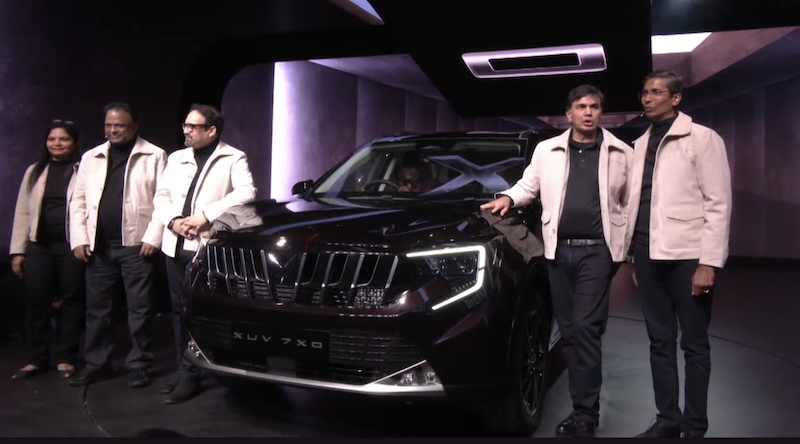
MUMBAI: Mahindra & Mahindra has unleashed the XUV 7XO, a tech-laden SUV that aims to outgun rivals with gadgetry galore and a starting price of Rs 13.66 lakh (ex-showroom). The vehicle, launched on 5 January in Jaisalmer, packs enough industry firsts to make competitors wince: coast-to-coast triple screens, integrated Dolby Atmos and Vision, Adas Level 2 with dynamic visualisation, and India’s first software-defined Ice vehicle.
But the real party trick? Mahindra’s global debut of its Davinci suspension system—valve-based damping tech that promises a smoother ride than a diplomat’s excuse. The company reckons this frequency-selective setup, paired with McPherson struts up front and multi-link independent rear suspension, will make potholes feel like poetry.
Mahindra chief design and creative officer Pratap Bose has given the XUV 7XO what he calls “authentic-SUV character”—which in this case means a full-width grille sporting piano-black finish with jewel-like talon accents, bi-LED projector headlamps with daytime running lights, and diamond-inspired clear lens LED tail lamps. The vehicle rides on 19-inch diamond-cut alloy wheels and features exposed ice-cube fog lamps with cornering lamps—a segment first that sounds like something from a cocktail bar but presumably helps you see round bends.
Electric smart door handles, a Skyroof panoramic sunroof, and premium piano-black cladding complete the exterior package. The design language screams “tough-premium”, which is marketing-speak for “we want it to look expensive without seeming delicate.”
Under the bonnet, buyers choose between Mahindra’s 2.0-litre mStallion TGDi petrol engine or the 2.2-litre mHawk turbo-diesel lump. Automotive business president R Velusamy promises the petrol manual variant will sprint from 0-60 km/h in under five seconds—quick enough to embarrass hot hatches at traffic lights. Both engines can be paired with six-speed manual or six-speed torque converter automatic gearboxes.
The diesel gets India’s first all-wheel drive system in its segment, with drive modes labeled Zip, Zap and Zoom. A custom mode lets drivers tailor their experience, presumably for those who find Zoom insufficiently zippy.
R Velusamy waxed lyrical about the Adrenox+ system, powered by Qualcomm’s Snapdragon SA8155P chipset—the first time this octa-core processor has appeared in an Indian Ice vehicle. “Exceptional computing speed and responsiveness,” he promises, which should mean the infotainment system doesn’t freeze when you’re trying to change radio stations.
Step inside and you’re confronted with 31.24cm coast-to-coast triple HD screens that stretch across the dashboard like a home cinema. The displays run on that Snapdragon chipset, with 49 pre-installed apps powered by something called Fun&Work—presumably to keep both bored passengers and road warriors entertained.
The audio setup comprises 16 Harman Kardon speakers engineered for “exceptional spectral balance,” paired with Dolby Atmos and Dolby Vision — making this India’s first vehicle with integrated Dolby technology. VenueScapes Live adds 3D surround sound, while a “bring-your-own-device” feature with theatre mode means rear passengers can plug in tablets or phones. GrooveMe, another segment first, does something musical that Mahindra is keeping delightfully vague about.
Seating deserves its own paragraph. The driver gets a six-way powered seat with memory and welcome retract functions. The co-driver seat offers six-way power adjustment with four-way electric “boss mode”—perfect for executives who want to recline whilst barking orders. Both front seats and rear seats get ventilation, whilst high-density foam with “first-in-segment plush pads” promises comfort worthy of a private jet. Six-seater variants are available in higher trims for those who prefer captains’ chairs over bench seating.
Climate control extends to dual-zone fully automatic temperature management with a “quiet mode”—handy when the boss in that powered co-driver seat needs a nap. An acoustic solar windscreen blocks noise and heat, whilst retractable rear sunshades keep the back seats from becoming a greenhouse. Multi-zone ambient lighting, soft-touch leatherette covering the instrument panel and seats, and an intelli command centre round out the luxury touches.
Wireless charging pads front and rear come with active cooling to prevent phones from overheating—because nothing says premium like not frying your iPhone whilst it charges. The vehicle also sports approach unlock and walk-away lock, plus memory outside rear-view mirrors that tilt automatically when reversing.
Mahindra claims over 120 safety features, with 75 standard across all variants—including six airbags, electronic stability programme with electronic brakeforce distribution, and hill descent control even on the base AX model. Higher trims get seven airbags with curtain airbags extending to the third row.
The Adas Level 2 system with Sense+ offers 17 functions, with segment-first dynamic visualisation showing what the cameras and sensors detect in real time. A 540-degree surround view camera system includes digital video recording—useful for insurance claims or capturing the moment some muppet cuts you up in traffic. Auto-booster headlamps with high beam assist automatically adjust lighting, whilst driver drowsiness alert nags you to pull over before you nod off.
Additional safety kit includes electronic parking brake with auto hold, frameless electrochromic (auto-dimming) interior rear-view mirror, tyre pressure monitoring with learning functionality, and what Mahindra calls “engineered for 5-star Bharat NCAP rating”—which is careful wording that means actual test results haven’t arrived yet.
Alexa built-in with ChatGPT integration means you can ask the vehicle’s AI assistant increasingly existential questions whilst stuck in traffic. The Adrenox connected car app offers 93 features, though Mahindra hasn’t specified whether any actually matter beyond remote start and vehicle tracking.
A carbon filter with LED display shows air quality index readings, presumably so Delhi residents can feel adequately depressed about their environment. Cruise control comes standard even on base variants, alongside push-button start/stop and wireless Android Auto and Apple CarPlay.
The range starts at Rs 13.66 lakh for the AX seven-seater petrol manual and tops out at Rs 24.11 lakh for the AX7L six-seater diesel automatic with all-wheel drive. Mahindra offers these as “introductory prices” for the first 40,000 customer deliveries, with terms and conditions that likely include caveats about availability and timing.
Automatic transmission adds Rs 1.45 lakh across the board. All-wheel drive diesel variants cost an additional Rs 2.45 lakh. The AX3 and AX5 variants slot in at Rs 16.02-16.49 lakh and Rs 17.52-17.99 lakh respectively for seven-seater configurations. The AX7 starts at Rs 18.48 lakh (petrol) or Rs 18.95 lakh (diesel) for seven-seaters, with six-seater and automatic options climbing the price ladder.
Premium AX7T and AX7L trims start at Rs 20.99 lakh and Rs 22.47 lakh respectively for diesel seven-seaters, with petrol automatics and six-seater configurations pushing prices above Rs 23 lakh.
Mahindra invested Rs 415 crore in the XUV 7XO, funded through internal accruals, and will build vehicles at its Chakan facility in Maharashtra, which has annual capacity of 120,000 units. The company positions this as a successor to the XUV 700, which has notched up over 300,000 customers since its 2021 launch.
Mahindra’s automotive division chief executive Nalinikanth Gollagunta promises the XUV 7XO will be “a trendsetter for the future of SUVs.” Bookings open 14 January, with deliveries starting the same day for pre-booked AX7, AX7T and AX7L customers. Lower-spec variants arrive from April 2026.
Whether the XUV 7XO becomes the benchmark it aspires to be, or merely another gadget-stuffed also-ran, depends on how India’s SUV-hungry buyers respond. With this much tech crammed into one vehicle, Mahindra is betting they’ll bite. Given the spec sheet reads like a CES exhibition catalogue, the company might just be right.