AD Agencies
Madison Avenue’s young guns storm the Hall of Achievement
NEW YORK: Nearly 500 guests packed Pier Sixty in New York on what organisers bill as “the most inspiring night in advertising.” They weren’t wrong. The American Advertising Federation rolled out the red carpet for eight fresh inductees into its Hall of Achievement, whilst supermodel and entrepreneur Ashley Graham scooped a special cultural force award.
For 33 years, the Hall of Achievement has set the gold standard for recognising advertising talent aged 40 and under. It’s a stamp of approval that matters in an industry obsessed with the next big thing. Content creator Eric Sedeño hosted the gala, which doubled as both celebration and validation for a cohort redefining how brands talk to consumers.
The selection process doesn’t mess about. Nominees who meet the criteria face scrutiny from a council of judges comprising Hall of Achievement alumni and top industry executives. Two rounds of voting separate the contenders from the chosen. The American Advertising Federation, which also runs the Advertising Hall of Fame, has turned the under-40 honour into a career-defining moment.
Graham’s cultural force award recognises her impact beyond the catwalk. The model has built a business empire whilst championing body positivity and reshaping beauty standards—the kind of cultural shift that makes advertising executives sit up and take notice.
At 33 years old, the Hall of Achievement shows no signs of losing its lustre. In an industry where youth drives innovation and disruption pays dividends, getting inducted before hitting 40 remains the ultimate flex.
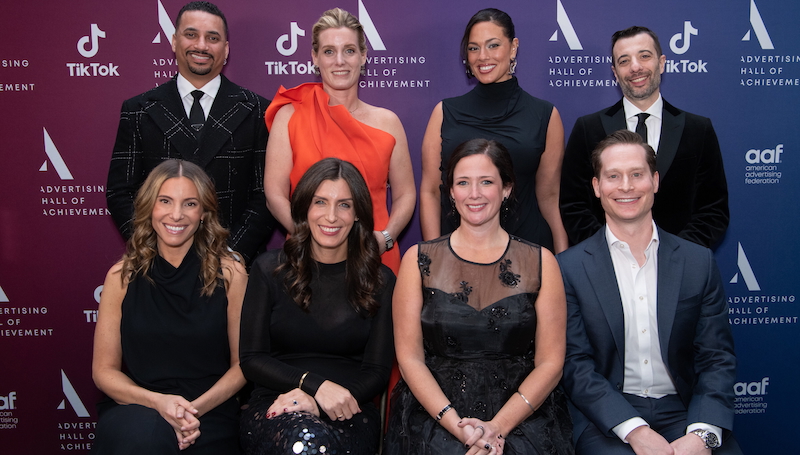
This year’s list of inductees cuts across industries, companies, business size and culture. From left to right:
Front row seated:
Alison Levin: NBCUniversal president, advertising & partnerships.
Abi Evans: Dentsu Creative chief growth officer. Abi was also honored with the Jack Avrett Volunteer Spirit Award in recognition of her service to the industry.
Amie Owen: IPG Mediabrands chief commerce officer.
Jason Schulweis: The Female Quotient former chief Commercial officer.
Back row standing:
Orlando Baeza: Chime VP of brand and creative.
Charlotte Tansill: Ogilvy North America president, PR, social & influence.
Ashley Graham: presented the AAF’s Special Cultural Force Award.
Paolo Provinciali: LinkedIn VP marketing – growth, performance & operations.

AD Agencies
Fevicol releases its last ad campaign by the late Piyush Pandey
The adhesive brand’s last campaign by the late advertising legend Piyush Pandey turns an everyday Indian obsession into a quietly powerful metaphor
MUMBAI: Fevicol has never needed much of a plot. A sticky bond, a wry observation, a truth that every Indian instantly recognises — that has always been enough. “Kursi Pe Nazar,” the brand’s latest television commercial, is no different. And yet it carries a weight that no previous Fevicol film has had to bear: it is the last one its creator, the advertising legend Piyush Pandey, will ever make.
The film, released on Tuesday by Pidilite Industries, fixes its gaze on the kursi — the chair — and what it means in Indian life. Not just as a piece of furniture, but as a currency of ambition, a vessel of authority, and a source of quiet social drama that plays out in every home, office and institution across the country. Who sits in the chair, who waits for it, and who eyes it hungrily from across the room: the film transforms this sharply observed cultural truth into a narrative that is, in the best Fevicol tradition, funny, warm and instantly familiar.
The campaign was Pandey’s idea. He discussed it in detail with the team before his death, but did not live to see it shot. Prasoon Pandey, director at Corcoise Films who helmed the commercial, said the team needed five months to find its footing before they felt ready to shoot. “This was the toughest film ever for all of us,” he said. “It was Piyush’s idea, magical as always.”
The emotional weight of that responsibility was not lost on the team at Ogilvy India, which created the campaign. Kainaz Karmakar and Harshad Rajadhyaksha, group chief creative officers at Ogilvy India, described the process as “a pilgrimage of sorts, on the path that Piyush created not just for Ogilvy, but for our entire profession.”
Sudhanshu Vats, managing director of Pidilite Industries, said the film was rooted in a distinctly Indian insight. “The ‘kursi’ symbolises aspiration, transition, and ambition,” he said. “Piyush Pandey had an extraordinary ability to elevate such everyday observations into iconic storytelling for Fevicol. This film carries that legacy forward.”
That legacy is considerable. Over several decades, Pandey’s partnership with Fevicol produced some of the most beloved advertising in Indian history, building the brand into something rare: a household name that people actively enjoy watching sell to them.
“Kursi Pe Nazar” does not try to be a tribute. It simply tries to be a great Fevicol film. By most measures, it succeeds — which is, in the end, the most fitting send-off of all.