Connect with us

MAM

Legrand India revolutionises customer experience with E-Shop launch

Published

on

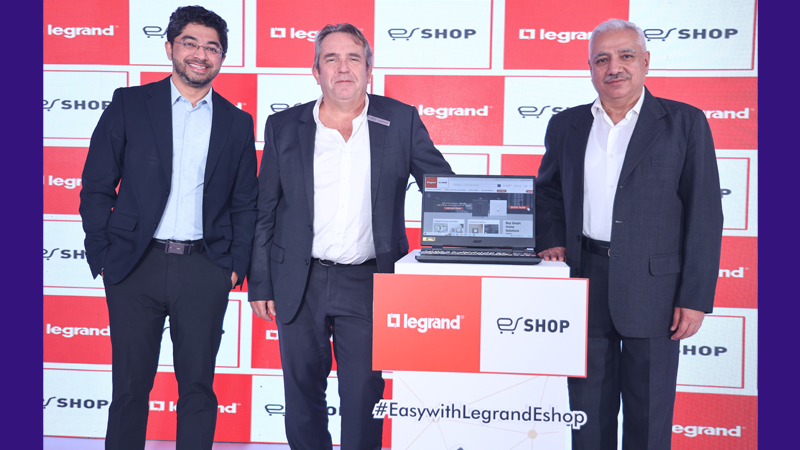
Mumbai: Today, Legrand India unveiled a groundbreaking digital strategy that promises to redefine the customer experience in the electrical and digital building infrastructure sector. Named “E-Shop,” this direct-to-customer (D2C) platform boasts a highly interactive website and a suite of digital channels. It is catering to a diverse clientele, including homeowners and remote electricians. As a market leader, Legrand is set to ensure seamless last-mile connectivity in India with free-of-cost deliveries.

This exciting new venture was formally inaugurated by  Legrand Group in India MD & CEO Tony Berland in a recently held event, accompanied by a fresh logo, innovative services, and a pioneering marketing campaign. The E-Shop’s success was validated through a rigorous five-month beta testing phase, serving over 200 customers monthly and seamlessly integrating with Legrand’s extensive ecosystem.

Legrand India director of sales Samir Kakkar stated, “In addition to our existing channels, such as projects, panel builders, system integrators, and retail counters, we recognised the burgeoning growth of e-commerce in India. To align with our ambitious goals, we have established a dedicated channel – digital business & emerging channel, which manages our e-commerce and omnichannel operations. Our sellers and fulfilment partners are our trusted distributors, fostering a robust nationwide distribution network.”

Advertisement

While D2C marks a promising journey for Legrand, it builds on a digital foundation established through previous initiatives. Legrand India has already achieved substantial business success worth Rs 230 million through digital platforms like Meta, Google, Indiamart, and Amazon. This favourable response paved the way for the creation of a dedicated E-Shop for Indian consumers, which is poised for further growth with targeted customer acquisition and content strategies.

Legrand India brand digital business and emerging channels Laxman Tari elucidated, “We are actively working on enhancing the customer experience through various projects aimed at simplifying the online purchasing journey. These initiatives will propel our product category into a prominent position on the online selling platform, with stages of implementation expected within the next six months.”

Legrand India’s head of director marketing Sameer Saxena, emphasised, “Legrand is renowned for its product innovation and disruptive marketing strategies. We have meticulously studied consumer behaviour, trends, and patterns to ensure unmatched customer satisfaction. Our introduction of modern trade concepts in the electrical industry has borne fruit, with 45 showrooms across India. We aim to replicate this success in the realm of e-commerce.”

Advertisement

Behind the seemingly simple concept of an E-Shop lies a web of innovation. To meet the critical demand for defined product availability, Legrand established a dedicated slot in its warehouse, swiftly accessible to sellers. The E-Shop is equipped with a dedicated call centre to promptly address customer queries and complaints. Additionally, Legrand has harnessed the power of machine learning with ‘Chatbot – LIVA,’ offering real-time transaction updates, product inquiries, and efficient complaint handling.

To bolster consumer confidence in shipping and logistics, Legrand has forged a pan-India partnership with ‘Delhivery.’

As the Internet of Things (IoT) drives demand for smart home products across India, Legrand’s E-Shop is poised to become the go-to destination for these offerings. Customers can now effortlessly embark on the journey to make their homes smarter. The E-Shop even offers the option to book an appointment with an expert for a personalized smart home experience.

Advertisement

With this groundbreaking E-Shop, Legrand reaffirms its commitment to pioneering innovation in the electrical and digital building infrastructure industry, setting new standards for customer satisfaction and convenience. For more information and to experience the future of electrical infrastructure, visit Legrand E-Shop.

Click to comment

Leave a Reply

Your email address will not be published. Required fields are marked *

AD Agencies

Omnicom posts $6.2 bn Q1 revenue, EBITDA margin rises to 14.8 per cent

AI push and cost synergies lift margins in first full quarter post-merger

Published

on

NEW YORK: Omnicom has reported a robust first quarter following its acquisition of Interpublic Group, signalling early gains from integration, cost efficiencies and a sharper focus on AI-led services.

The results mark the first full quarter with Interpublic’s operations included, offering a clearer view of how the combined entity is shaping up. Revenue from core operations stood at $5.6 billion, up $345 million year on year on a combined basis, while organic growth came in at 3.9 per cent. Adjusted EBITDA margin rose sharply by 240 basis points to 14.8 per cent, reflecting early synergy benefits.

“We’ve seen momentum and cohesive growth across the organisation,” said Omnicom chief executive officer John Wren. “Our results demonstrate the benefits of realigning our portfolio and moving decisively on integration.”

Advertisement

A key part of that realignment involves shedding underperforming assets. Omnicom has identified businesses worth roughly $3.2 billion in annual revenue for disposal, with about $1 billion already exited in the first quarter. The company expects to complete most of the remaining divestments over the coming quarters, sharpening its focus on higher-growth, higher-margin operations.

On the bottom line, adjusted earnings per share rose 11.8 per cent to $1.90, underlining the financial impact of cost discipline and integration. The company is targeting $900 million in cost synergies by 2026, rising to $1.5 billion by mid-2028.

“We are realising significant cost reduction synergies while continuing to invest for growth,” said Omnicom chief financial officer Philip Angelastro.

Advertisement

Beyond the numbers, the strategic pivot is becoming clearer. Omnicom has restructured its business around “core operations”, stripping out assets earmarked for sale to highlight the segments driving future growth. More than half of its revenue now comes from integrated media, which includes data, commerce, CRM and content automation, areas that are growing faster than traditional advertising.

Indeed, integrated media led growth in the quarter with high single-digit gains, while PR and experiential businesses delivered mid-single-digit growth. Healthcare posted modest gains, while traditional advertising lagged, reflecting a broader industry shift towards performance-driven and tech-enabled marketing.

Central to this transformation is Omni, the company’s AI-powered marketing and sales platform. Rolled out across the organisation during the quarter, the system connects data, talent and services while enabling AI-driven workflows.

Advertisement

The platform is already delivering tangible results, improving media performance, speeding up campaign execution and enhancing measurement capabilities. Integration with partners such as Adobe and Amazon is further expanding its reach.

“We’ve put the latest agentic AI tools in the hands of all our employees,” said Wren, highlighting the company’s push towards automation and data-led decision-making.

The shift is also reshaping client relationships. Omnicom reported new business wins with major brands including IBM, GSK and John Deere, while expanding engagements with existing clients such as Unilever and Exxon. Increasingly, clients are opting for consolidated partnerships, relying on a single provider for end-to-end marketing and sales services.

Advertisement

“There’s a clear trend of clients choosing one partner to manage most of their needs,” said John Wren. “Our integrated model makes that easier.”

Geographically, the US remains the largest market, contributing 61 per cent of revenue, followed by Europe and the UK at 21 per cent. Growth was strongest in the US, with other regions posting modest gains.

The balance sheet remains solid despite increased debt following the acquisition. Long-term debt stood at $10.2 billion at the end of the quarter, while liquidity was supported by $4.3 billion in cash and a $3.5 billion revolving credit facility. The company is also returning capital to shareholders, repurchasing $2.8 billion worth of shares in Q1 as part of a planned $5 billion buyback programme.

Advertisement

Looking ahead, Omnicom remains optimistic but cautious. While the company expects double-digit EPS growth for the year, it acknowledged ongoing geopolitical uncertainties, particularly in the Middle East, though the region accounts for less than 2.5 per cent of revenue.

The integration of Interpublic is still in its early stages, but the initial signs point to a business that is not just bigger, but structurally different. With AI at its core, a streamlined portfolio and a growing tilt towards integrated services, Omnicom is betting that scale, simplicity and smart technology will keep it ahead in an increasingly complex marketing landscape.

If the first quarter is anything to go by, that bet is already starting to pay off.

Advertisement
Continue Reading

Advertisement News18
Advertisement
Advertisement
Advertisement
Advertisement Whtasapp
Advertisement Year Enders

Indian Television Dot Com Pvt Ltd

Signup for news and special offers!

Copyright © 2026 Indian Television Dot Com PVT LTD