MAM
KWAN realigns its management team, readies itself for the next level of growth

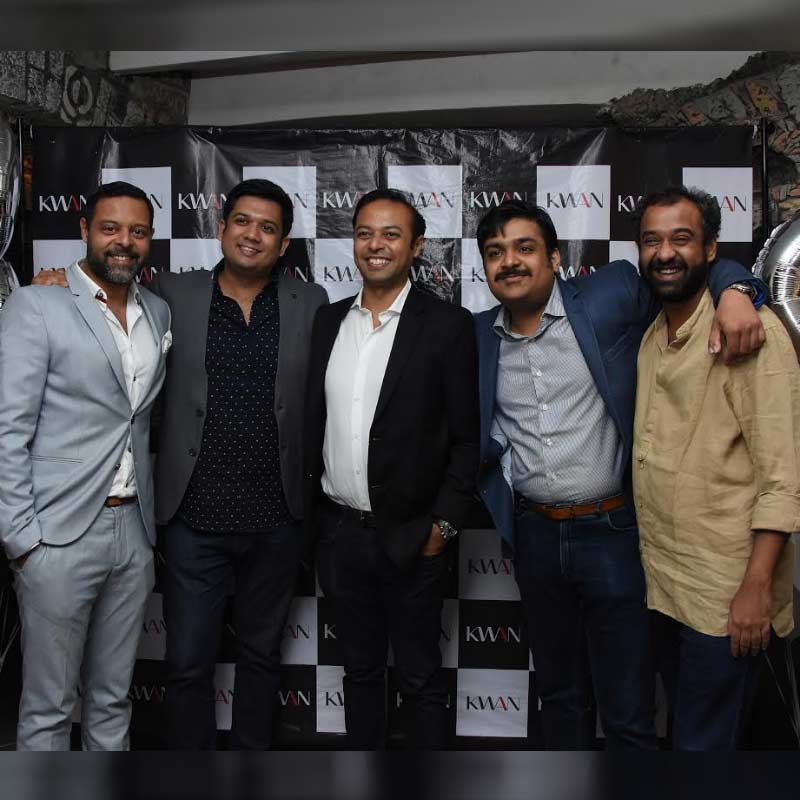
MUMBAI: In a major management reshuffle, KWAN Entertainment, India’s largest entertainment marketplace connecting investors, brands, and artists, has announced the appointment of its founding partners Indranil Das Blah and Vijay Subramaniam as its Co-CEOs. In the new role, the veteran duo will manage the day-to-day operations and the agency business at KWAN. The move is aimed at leveraging their combined extensive experience in the fields of entertainment, media, sports, and music to drive the company to the next level of its growth.
The latest development will also see KWAN’s Founder Anirban Das Blah take on a more evolved strategic role, in which he will guide the firm’s long-term vision, strategy, and growth as its promoter. The move will additionally give Anirban, a prominent name in the entertainment and media landscape, the opportunity to diversify his professional interests to other business ventures such as Mojostar (cofounded with Jiggy George) as an investor, promoter, and mentor.
Other members of the KWAN senior leadership team will continue in their current roles. Co-founder Madhu Mantena will continue to drive the evolution of KWAN into a diversified media and entertainment company, along with Anirban. Founding partner Dhruv Chitgopekar continues to spearhead its brand and consumer incubation initiatives.

Indranil Das Blah, Founding Partner and Co-CEO – KWAN Entertainment
Having started out as an Assistant Manager (Sales & Marketing) at sports marketing firm TSM in 2002, Indranil has since carved a name for himself in the fields of brand sales, celebrity endorsements, and sports marketing. He joined tennis ace Mahesh Bhupathi’s Globosport as the Head of its Delhi office in 2004 and worked closely with him on all sports-related initiatives for Globosport. By 2008, he had risen to the rank of Head of Sales and Sports at Globosport and, by 2015, had played an instrumental role in some of India’s biggest sporting events. This included getting sponsorships for 3WTA and 2 ATP tennis events, as well as initiatives aimed at the grassroots level, such as the Apollo Tyres Mission.
Indranil co-founded KWAN Entertainment in 2009. Under his leadership, the sports division at KWAN today manages many leading sports franchises in India, including Ranbir Kapoor-owned Mumbai City FC and Sanjay Dutt’s cricket franchise Leo Lions (part of the Masters’ Champions League in the UAE). The team manages multiple athletes and has been instrumental in securing over 200 sponsorship and endorsement deals in the last five years.
Vijay Subramaniam, Founding Partner and Co-CEO – KWAN Entertainment
A mechanical engineer by education, Vijay came to realise that his real passion was entertainment. As a result, he joined Globosport as an intern and swiftly rose up the ranks to head the company’s business in South India. During his tenure at Globosport, Vijay established the company’s LIVE touring business and spearheaded sales across brands and corporates in the southern region. He also successfully managed several big-ticket events, including the WTA Sunfeast Open in 2008, and the countrywide Royal Stag Saif Ali Khan Rock Tour.
As a co-founder and partner at KWAN, Vijay has been responsible for running various business verticals such as brand sales, live entertainment, television, music, and content. His in-depth knowledge of brands, live events, and films, coupled with an analytical business approach, have played a critical role in identifying several key growth and expansion opportunities for KWAN, and established Vijay as one of the experts in the entertainment industry. He also manages some of the country’s biggest and most talented Bollywood stars such as Deepika Padukone, Pritam, Shraddha Kapoor etc.
Speaking on the management rejig, Anirban Das Blah, Founder – KWAN Entertainment, said, “Having helmed KWAN for almost a decade now, I feel the time is right for me to hand over the reins of its day-to-day operations to Indranil and Vijay. They’re both extremely talented individuals who’ve been associated with KWAN from day one, and have proved their business management acumen time and again by driving exponential growth for their respective verticals. With them spearheading KWAN’s business operations as Co-CEOs, I have no doubt that the firm will continue to grow at a rapid pace, evolving and expanding in sync with the rapidly-changing entertainment and media ecosystem of the country.”
Indranil Das Blah added, “This is a big moment for me, personally and professionally. The KWAN family is extremely close to my heart and has been a big part of my professional endeavours over a large part of my career. I am eager to take on this new role and the responsibility that it brings, and uphold the faith that the team at KWAN has bestowed upon me.”
Vijay Subramaniam said, “For me, the KWAN journey has been nothing short of a dream fulfilled. I feel honoured and privileged to be able to continue the good work that we have achieved as a team over the years. I am confident that, with Anirban guiding the company’s strategic vision, Indranil and I will add more milestones to KWAN’s ongoing success story by leading the company into the next phase of its growth.”
Since its inception, KWAN has created an extensive popular culture universe in India comprising leading Bollywood and regional celebrities, native digital content creators, musicians, prominent fashion & lifestyle personalities, and specialist influencers. It works across multiple domains such as celebrity management, live entertainment, sports, TV, licensing, movie packaging, music, and regional cinema, and has also invested in and run various media-related businesses. KWAN is currently associated with several top Indian celebrities such as Ranbir Kapoor, Deepika Padukone, Hrithik Roshan, Sonam Kapoor, Tiger Shroff, Jacqueline Fernandez, Sania Mirza, Rana Dagubatti, Mahesh Babu, Pritam, Shraddha Kapoor, and Sushant Singh Rajput, to name a few.






Digital
Content India 2026 opens with a copro pitch, a spice evangelist and a £10,000 prize for Indian storytelling
Dish TV and C21Media’s three-day summit puts seven ambitious projects before an international jury, and two walk away with serious development money
MUMBAI: India’s content industry gathered in Mumbai this March for Content India 2026, a three-day summit organised by Dish TV in partnership with C21Media, and it wasted no time making a statement. The event opened with a Copro Pitch that put seven scripted and unscripted television concepts before an international panel of judges, and by the end of it, two projects had walked away with £10,000 each in marketing prize money from C21Media to support development and international promotion.
The jury, comprising Frank Spotnitz, Fiona Campbell, Rashmi Bajpai, Bal Samra and Rachel Glaister, evaluated a shortlist that ranged from a dark Mumbai comedy-drama about mental health (Dirty Minds, created by Sundar Aaron) to a Delhi coming-of-age mystery (Djinn Patrol, by Neha Sharma and Kilian Irwin), a techno-thriller about a teenage gaming prodigy (Kanpur X Satori, by Suchita Bhatia), an investigative crime drama blending mythology and modern thriller (The Age of Kali, by Shivani Bhatija), a documentary on India’s spice heritage (The Masala Quest, hosted by Sarina Kamini), a documentary on competitive gaming (Respawn: India’s Esports Revolution, by George Mangala Thomas and Sangram Mawari), and a reality-horror competition merging gaming and immersive fear (Scary Goose, by Samar Iqbal).
The session was hosted by Mayank Shekhar.
The two winners were Djinn Patrol, backed by Miura Kite, formerly of Participant Media and known for Chinatown and Keep Sweet: Pray & Obey, with Jaya Entertainment, producers of Real Kashmir Football Club, also attached; and The Masala Quest, created and hosted by Sarina Kamini, an Indian-Australian cook, author and self-described “spice evangelist.”
The summit also unveiled the Content India Trends Report, whose findings made for bracing reading. Daoud Jackson, senior analyst at OMDIA, set the tone: “By 2030, online video in India will nearly double the revenue of traditional TV, becoming the main driver of growth.” He noted that in 2025, India produced a quarter of all YouTube videos globally, overtaking the United States, while Indians collectively spend 117 years daily on YouTube and 72 years on Instagram. Traditional subscription TV is declining as free TV and connected TV gain ground, forcing broadcasters to innovate. “AI-generated content is just 2 per cent of engagement,” Jackson added, “highlighting the dominance of high-quality human content. The key for Indian media companies is scaling while monetising effectively from day one.”
Hannah Walsh, principal analyst at Ampere Analysis, added hard numbers to the picture. India produced over 24,000 titles in January 2026 alone, with 19,000 available internationally. The country now accounts for 12 per cent of Asia-Pacific content spend, up from 8 per cent in 2021, outpacing both Japan and China. Key exporters include JioStar, Zee Entertainment, Sony India, Amazon and Netflix, delivering over 7,500 Indian-produced titles abroad each year. The top importing markets are Saudi Arabia, the UAE, Egypt, the United States and the Philippines. Scripted content dominates globally at 88 per cent, with crime dramas and children’s and family titles performing particularly strongly.
Manoj Dobhal, chief executive and executive director of Dish TV India, framed the summit’s ambition squarely. “Stories don’t need translation. They need a platform, discovery, and reach, local or global,” he said. “India produces more movies than any country, our streaming platforms compete globally, and our tech and creators win international awards. Yet fragmentation slows growth. Producers, platforms, and tech move in different lanes. We need shared spaces, collaboration, and an ecosystem where ideas, technology, and people meet. That is why we built Content India.”
The data, the pitches and the prize money all pointed to the same conclusion: India is not waiting for the world to discover its stories. It is building the infrastructure to sell them.







