Brands
Javed Akhtar says AI cannot replicate creative writing without a subconscious mind
At Godrej Literature Live! Mumbai LitFest, the lyricist says human emotions remain key to art


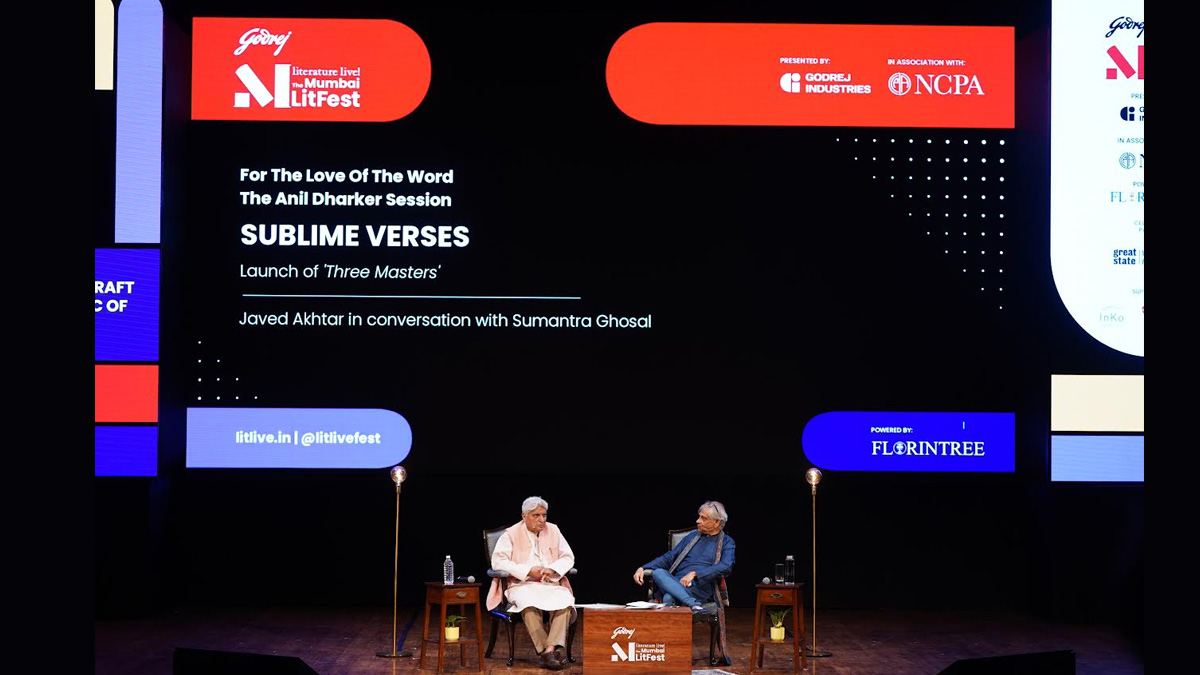
MUMBAI: Artificial intelligence may be a capable assistant, but it is no poet, according to lyricist and screenwriter Javed Akhtar. Speaking at the inaugural session of the 17th edition of Godrej Literature Live! The Mumbai LitFest, he argued that AI cannot replicate human creativity because it lacks access to the subconscious mind and the emotions that shape art.
The festival opened on 23 October at the National Centre for the Performing Arts (NCPA) in Mumbai with For The Love of the Word: The Anil Dharker Session, held in memory of the festival’s founder. The session featured the launch of Three Masters, Akhtar’s collection of dohas by three celebrated Indian philosopher-poets, Kabir, Rahim and Vrind.
In conversation with translator Sumantra Ghosal, who rendered the collection into English, Akhtar explored the enduring relevance of the poets’ verses and their insights into human nature.
Responding to an audience question on whether AI poses a threat to poetry, Akhtar drew a distinction between performing tasks and producing original art.
“AI can be a good secretary, an assistant, somebody who can do tasks like filing a complaint with BMC about water shortage,” he said. But when it comes to creative pursuits such as painting, composing a symphony or writing poetry, he believes the technology has a long way to go.
Akhtar argued that AI comes close to capturing the conscious human mind but cannot access the subconscious in the way people do. Human creativity, he suggested, draws on personal loss, deep-rooted emotions and experiences that shape how individuals interpret the world.
AI, he added, has neither experienced personal loss nor faces the same human accountability that informs lived experience. These differences, in his view, remain central to the creation of art.
His remarks put the spotlight on a question increasingly confronting writers, musicians and artists as generative AI tools become more capable: can a machine produce work that is technically accomplished but also rooted in the complexity of human experience?
The session also turned to the wisdom of Kabir, whose doha about the date palm formed a starting point for Akhtar’s reflections on greatness and social contribution.
The verse questions the value of height and stature when they offer little shade to a traveller and place their fruit beyond easy reach. Akhtar connected the metaphor to people who seek recognition without contributing meaningfully to society.
“What makes you a big person? Your contribution to the world. Your contribution towards society. What have you given?” he asked.
Describing life as an interval between nothingness and nothingness, Akhtar said people are remembered for what they give to others. Those who offer shade and fruit, rather than simply standing tall, leave a lasting impression.
The exchange brought the session’s two themes together: the value of human contribution and the role of experience in shaping expression. For Akhtar, poetry’s enduring power lies not merely in words or technique, but in the human understanding behind them.
As the Mumbai LitFest began its 17th edition, the message was clear: technology may help get the words on the page, but the human experience behind them remains the harder thing to reproduce.