MAM
IRS: Dainik Jagran & ToI maintain lead
MUMBAI: Dainik Jagran retains its stature as the most read publication even as readership for English news dailies is seeing a small fall.
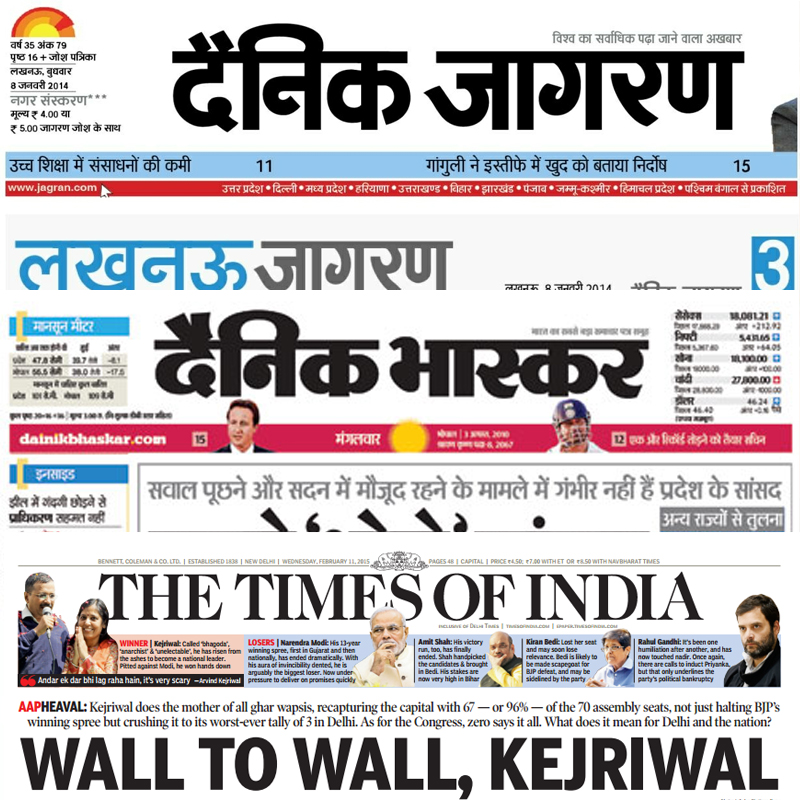
Among the Hindi dailies, Dainik Jagran has earned an average issue readership (AIR) of 15.95 million for the quarter, followed by Dainik Bhaskar (AIR of 13.49 million) and Hindustan (10.84 million), according to the third quarter IRS (Indian Readership Survey) report released by The Media Research Users Council (MRUC) today.
![]() |
The Times of India remains at the top among the English dailies and overall inched a rank up to the seventh spot.
The Times of India (ToI) has garnered a total AIR of 7.25 million, thereby topping the list by far. It is followed by Hindustan Times (AIR of 3.52 million) and The Hindu (AIR od 2.10 million).
![]() |
In the regional language dailies, Malayalam Manorama tops the chart with 9.93 million AIR, followed by Lokmat (Marathi) (AIR of 7.81 million) and Daily Thanthi (Tamil) with an AIR of 7.24 million.
![]() |
MAM
Xiaomi India launches Redmi Note 15 Special Edition campaign
OML film puts phone through chaos to showcase durability and camera
MUMBAI: If phones could sweat, this one would still keep its cool. In a market flooded with spec sheets and sameness, Xiaomi India has decided to turn up the heat quite literally. The brand’s latest campaign for the Redmi Note 15 Special Edition swaps predictable product demos for a full-blown kitchen meltdown, with celebrity chef Sanjeev Kapoor trading calm composure for controlled chaos.
Conceptualised and produced by OML, the campaign takes a sharply unconventional route. Instead of listing features, it throws the smartphone into a high-pressure dinner service, where Kapoor subjects it to a series of exaggerated, almost absurd stress tests chopping chillies on it, splashing water across its screen, and pushing it through a tense culinary gauntlet.
The message lands without spelling itself out. While the kitchen brigade falters under pressure, the phone does not. By the time a junior chef declares it “cooked”, the device emerges unscathed quietly reinforcing its durability, ultra-slim design, and 50 Master Pixel camera.
The approach reflects a broader shift in how brands are speaking to digital-first audiences. With Gen Z increasingly immune to traditional advertising formats, the campaign leans into storytelling, humour, and cultural familiarity to hold attention mid-scroll. The casting itself does part of the heavy lifting Kapoor, known for his composed persona, appears in an unexpectedly stern avatar, adding an element of surprise that fuels shareability.
For Xiaomi India, the idea was to move away from feature-led communication towards something more experiential. By embedding the product in chaotic, real-world scenarios, the campaign attempts to make performance feel demonstrated rather than declared.
The result is less of an advertisement and more of a content piece, one that understands the algorithm as much as the audience. Because in today’s attention economy, surviving the scroll might just be tougher than surviving a kitchen rush.