MAM
India’s book publishing market set to hit Rs 2 lakh crore by 2030-31
A landmark report from the Federation of Indian Publishers and NielsenIQ BookData charts a print market growing at nearly 11 per cent a year, with digital, journals and AI all fighting for a share of the shelf


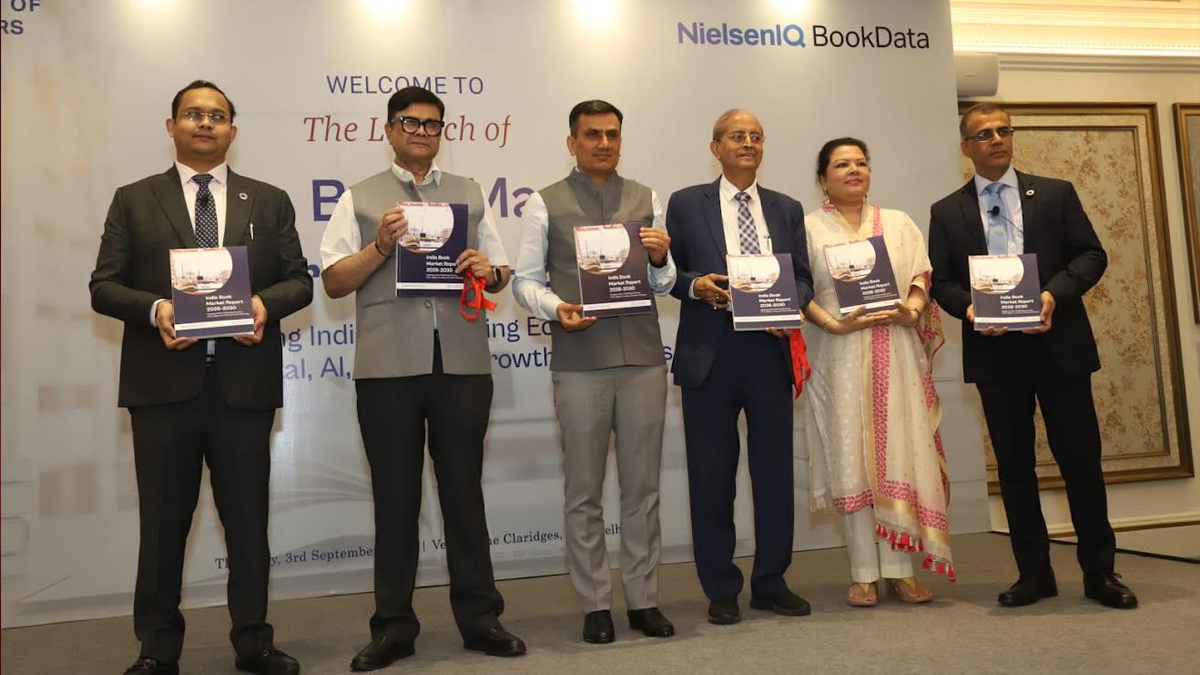
NEW DELHI: Forget the doom-mongering about screens killing books. India’s publishing industry, according to the India Book Market Report 2026-2030, nationally launched in New Delhi on 3 September 2026, is barrelling towards Rs 2 lakh crore in size by 2030-31, and the numbers behind that projection make for genuinely racy reading. The report, produced by NielsenIQ BookData for the Federation of Indian Publishers, is the first comprehensive stocktake of the sector since 2022, running to 168 pages across ten chapters covering print, digital publishing, scholarly journals, India’s education market, the business of books, economic contribution, artificial intelligence, legislation, a conclusion and recommendations. It arrives with the sort of granular detail that turns vague industry chatter into hard evidence.
The headline figures alone justify the fanfare. India’s print book market was estimated at Rs 95,816 crore in 2024-25, digital publishing at Rs 7,048 crore, and the scholarly journals market at Rs 5,150 crore. Print, far from being the sunset category sceptics love to predict, is growing at close to 11 per cent CAGR, a pace that would make most consumer sectors blush. Factor in the wider economic footprint, a Type-2 output of Rs 1,46,598 crore in 2025-26 and a multiplier effect of roughly 3.7 times, and books start looking less like a cultural nicety and more like serious industrial infrastructure. The sector employs an estimated 3,75,534 people in printing and publishing alone, and counts more than 26,000 publishers nationally.
What makes this report more than a numbers exercise is its refusal to treat print and digital as rivals. The report distils its argument into five core shifts. First, the market is broadening beyond its traditional education anchor into trade books, children’s content, professional learning, Indian-language publishing, research and lifelong learning. Second, print and digital are not in competition but reinforce each other, with digital capability strengthening discovery, accessibility, assessment and licensing around a still-important print core. Third, content itself is becoming reusable intellectual property, with a single book capable of generating value as a print edition, ebook, audiobook, translation, accessible format, learning tool or rights deal. Fourth, trust rather than raw capability will determine how much value AI actually adds, meaning quality, creator rights, privacy and human judgement have to stay central even as the technology speeds things up. And fifth, India’s opportunity extends well beyond exporting physical books, into intellectual property, translation, publishing technology, educational solutions, editorial services, manufacturing and international rights partnerships. As the report itself puts it, the strategic question is no longer whether publishing will change, but whether India can shape that change on its own terms.
Vikrant Mathur, executive director for India and GCC at NielsenIQ BookData, an operation that itself manages the ISBN and SAN agencies for the UK and Ireland, holds a database of more than 53 million book records and runs retail sales analysis across 17 territories, said the report combines market data with industry expertise to offer practical insight into trends, opportunities and challenges facing the industry. Pranav Gupta, vice president at the Federation of Indian Publishers, a body representing more than 80 per cent of India’s publishing industry and the country’s sole affiliate to the International Publishers Association in Geneva, called publishing fundamental to India’s intellectual, educational and cultural progress, and said the report should push the sector towards more evidence-led discussions and action.
The endorsements stacking up behind the report read like a who’s who of global publishing bodies. Sanjay Kumar, former secretary of education for the government of India, called the country the world’s third-largest publishing industry after China and America, with the potential to overtake both, and pushed the idea of India becoming a global printing hub in step with Make in India. Yuvraj Malik, director of the National Book Trust, pointed to India’s reader base, linguistic diversity and technological capability as the ingredients for a leading knowledge economy. José Borghino of the International Publishers Association, Caroline Sutton of the International Association of Scientific, Technical and Medical Publishers, Kevin Fitzgerald of the International Authors’ Forum and Anita Huss-Ekerhult of the International Federation of Reproduction Rights Organisations all weighed in, with a recurring theme, that India’s scale now needs to be matched by stronger copyright frameworks and rights infrastructure if authors and publishers are to capture the value they create.
Artificial intelligence gets a full chapter to itself, and the report’s tone here is neither breathless nor dismissive. It treats AI as a genuine lever for efficiency and accessibility across the publishing value chain, while insisting that quality, creator rights, privacy and human judgement stay central to how it is deployed. That balancing act, embracing the technology without letting it hollow out the industry’s credibility, runs as a thread through the report’s take on copyright and legislation too, where the Federation and its international partners are clearly angling for stronger enforcement and a functioning IRRO framework as the market scales up.
For an industry that has often struggled to get taken seriously in boardrooms and policy circles, this report is a deliberate bid for a seat at the table. Rs 2 lakh crore by 2030-31 is not a small number, and the fact that it comes wrapped in methodology, case studies and international endorsement rather than a press release quote gives it staying power. India’s publishers, in other words, have finally decided to stop guessing and start measuring, and the early data suggests they will like what they find.