Digital
IBM snaps up data streaming pioneer Confluent for $11bn in cash

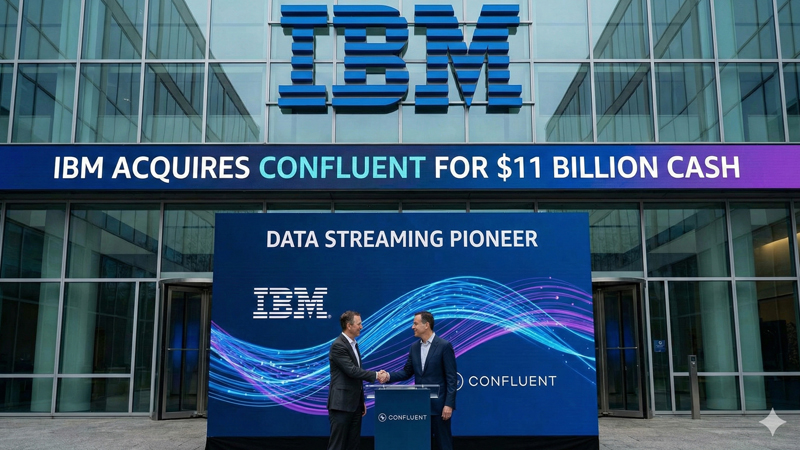
NEW YORK: IBM is paying $31 per share to acquire Confluent, the data streaming platform built on Apache Kafka, in an $11bn deal that underscores the technology industry’s frantic race to secure the infrastructure needed for artificial intelligence deployment. The acquisition, announced on 8th December, will give IBM control of a company that already serves more than 6,500 clients, including over 40 per cent of the Fortune 500.
Confluent’s platform connects, processes and governs data and events in real time across hybrid cloud environments. That capability has become increasingly critical as organisations grapple with data scattered across public and private clouds, datacentres and countless technology providers. IBM reckons Confluent’s technology will prove foundational for deploying generative and agentic AI at scale.
“IBM and Confluent together will enable enterprises to deploy generative and agentic AI better and faster by providing trusted communication and data flow between environments, applications and APIs,” said IBM’s chairman, president and chief executive, Arvind Krishna. “With the acquisition of Confluent, IBM will provide the smart data platform for enterprise IT, purpose-built for AI.”
The deal fits neatly into IBM’s hybrid cloud and AI strategy. IDC estimates that more than one billion new logical applications will emerge by 2028, reshaping technology architectures across industries. Global data volumes are expected to more than double by the same year. Those applications and the AI agents increasingly deployed alongside them need access to connected, trusted data delivered in real time.
Chief executive and co-founder of Confluent, Jay Kreps, struck an upbeat note. “Since its founding, Confluent has helped organisations unlock the full potential of their data, driving innovation in an increasingly complex IT landscape,” he said. “We are excited by the potential to join IBM and to accelerate our strategy with IBM’s go-to-market expertise, global scale and extensive portfolio.”
Confluent’s addressable market has doubled from $50bn to $100bn in just four years, according to the company. Its real-time data and event streaming capabilities will be combined with IBM’s AI infrastructure software and automation offerings. IBM expects the transaction to boost adjusted earnings before interest, tax, depreciation and amortisation within the first full year and free cash flow in year two.
The Mountain View, California-based company partners with technology leaders including Anthropic, Amazon Web Services, Google Cloud Platform, Microsoft and Snowflake. That open ecosystem approach aligns with IBM’s own strategy. The acquisition also extends IBM’s 25-year commitment to open-source innovation, following purchases of Red Hat and HashiCorp.
Confluent offers multiple deployment options: Confluent Cloud, a fully managed service with serverless Apache Kafka; Confluent Platform, a self-managed deployment; WarpStream, a hybrid bring-your-own-cloud model; and Confluent Private Cloud for on-premises and private cloud workloads. The platform includes data streaming, connectors, stream governance, stream processing, Tableflow, Confluent Intelligence and streaming agents.
Both boards have approved the transaction. Confluent’s largest shareholders and investors, holding approximately 62 per cent of voting power, have agreed to vote in favour. The deal requires Confluent shareholder approval, regulatory clearance and other customary conditions. IBM will fund the acquisition with cash on hand.
The transaction is expected to close by mid-2026. For IBM, it represents a significant bet that controlling the pipes through which data flows in real time will prove as valuable as the AI applications running on top. In an era of exploding data volumes and proliferating applications, that may prove a shrewd wager indeed.
NOTE: The cover image is AI-generated and is used for representational purposes only.