Brands
Hyundai powers ‘Atmanirbhar Bharat’ with localisation and EV breakthrough
MUMBAI: Hyundai Motor India Limited (HMIL) isn’t just making cars; it’s making waves. With a roaring 92 per cent localisation in manufacturing and a game-changing battery-pack assembly plant in Chennai, Hyundai is taking its ‘Make-in-India’ commitment to full throttle. If this isn’t a rev-up moment for India’s automotive landscape, we don’t know what is.
Let’s talk numbers—1,238 indigenised parts, 194 vendors, and a whopping $672 million in forex savings (over Rs 5,678 crore) since 2019. Hyundai’s localisation journey is no leisurely Sunday drive; it’s a turbocharged race to leverage India’s resources and engineering talent.
Hyundai’s whole-time director & chief manufacturing officer, Gopalakrishnan Chathapuram Sivaramakrishnan, put it perfectly, “Our indigenisation aligns seamlessly with India’s ‘Atmanirbhar Bharat’ vision. The launch of the battery-pack assembly plant is not just a milestone; it’s a testament to our commitment to delivering world-class technology made in India.”
Oh, and did we mention that Hyundai’s Creta Electric now boasts locally assembled battery packs? Talk about an electrifying debut!
Why is everyone talking about Chennai? Because Hyundai and Mobis India have launched a state-of-the-art battery-pack assembly plant, complete with an annual capacity of 75,000 packs in phase one. Whether it’s NMC (Nickel-Manganese-Cobalt Oxide) or LFP (Lithium-Iron-Phosphate) batteries, this facility has it all.
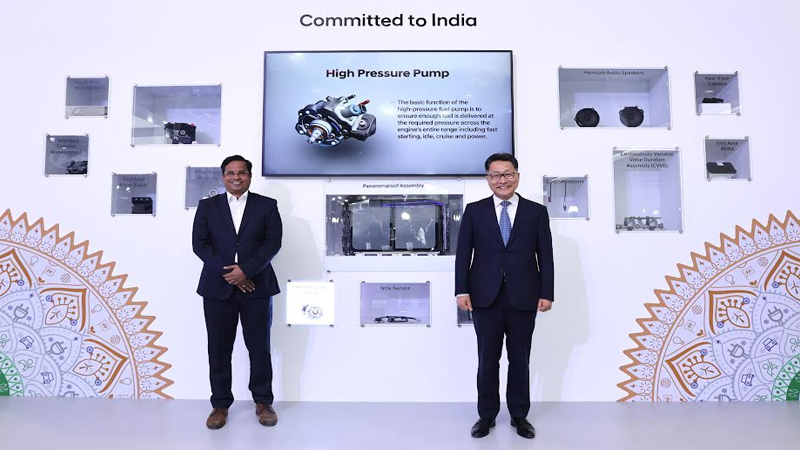
Hyundai isn’t just building cars; it’s building them with 100 per cent locally sourced components like alternators, alloy wheels, catalytic converters, and shark fin antennas. Fancy tech like tyre pressure monitoring systems and panoramic sunroofs? Yep, localised too.
The company is also looking ahead with plans to replicate this success at its Talegaon manufacturing plant in Maharashtra. Can we hear a round of applause for the future?
In its localisation journey, Hyundai isn’t just saving forex; it’s creating jobs—1,400 direct employment opportunities, to be exact. The company’s engineering prowess and strategic partnerships are redefining what it means to be ‘Atmanirbhar’.
In a world racing toward electric and sustainable solutions, Hyundai’s efforts are more than just industry milestones—they’re a blueprint for automotive evolution. The localisation strategy isn’t just a business move; it’s a bold statement. And with the Creta Electric leading the charge, Hyundai is proving that Indian manufacturing isn’t just capable; it’s competitive.

Brands
Wipro hires 7,500 freshers, withholds FY27 hiring outlook
Profit rises to Rs 3,522 crore, Rs 15,000 crore buyback announced.
MUMBAI- Hiring may be on, but visibility is off, Wipro is adding talent even as it pauses the crystal ball. The company hired 7,500 freshers in FY26 but stopped short of offering any hiring outlook for FY27, underscoring the uncertainty gripping the IT services sector as it pivots towards an AI-led operating model.
The disclosure came alongside its fourth-quarter earnings, where management flagged volatile demand conditions and refrained from committing to future workforce expansion. Chief human resources officer Saurabh Govil noted that over 3,000 of the total hires were onboarded in the March quarter alone, signalling continued intake despite a lack of clarity on deployment pipelines.
This divergence active hiring without forward guidance reflects a broader industry pattern where talent acquisition continues even as deal conversions remain uneven and client spending cycles stretch. Wipro expects its IT services revenue for the June quarter to range between a decline of 2 per cent and flat growth sequentially in constant currency terms, reinforcing near-term caution.
Chief executive officer Srini Pallia pointed to artificial intelligence as both a disruptor and an opportunity. He said evolving client priorities are pushing the company towards outcome-driven engagements, with Wipro increasingly focusing on a services-as-software model through its AI Native Business and Platforms unit. The shift marks a structural change from traditional headcount-led growth to AI-enabled delivery frameworks.
The company has already committed over $1 billion to its AI ecosystem, with investors closely watching how these investments translate into revenue. For now, the numbers present a mixed picture. Net profit rose sequentially to Rs 3,522 crore, while revenue grew 3 per cent to Rs 24,236 crore. However, core IT services performance remained under pressure, with full-year revenue declining 0.3 per cent in dollar terms and 1.6 per cent in constant currency.
Large deal bookings offered a counterpoint, rising 45.4 per cent year-on-year to $7.8 billion, highlighting a widening gap between deal wins and actual revenue realisation. On a quarterly basis, IT services revenue slipped 1.2 per cent sequentially, signalling continued softness in execution.
Margins, however, told a more optimistic story. Operating margins expanded to 17.3 per cent in the fourth quarter, up from 14.8 per cent in the previous quarter, reflecting improved cost discipline. That said, the company cautioned that upcoming wage hikes and the ramp-up of large deals could exert pressure going forward.
Attrition stood at 13.8 per cent in the March quarter, indicating stabilisation after periods of elevated churn. Alongside its earnings, Wipro also announced a Rs 15,000 crore share buyback, reinforcing its focus on shareholder returns, with a payout ratio of 88 per cent over the past three years.
Taken together, the numbers capture a company in transition investing in AI, maintaining hiring momentum, but navigating a demand environment where growth is uneven and visibility remains limited.