MAM
Hybe sets up India subsidiary, aims to localise K-pop in subcontinent


MUMBAI: Hybe Corp, the entertainment powerhouse behind global K-pop acts including BTS, Seventeen and Txt, has announced the formation of Hybe India, a whollyowned subsidiary set to begin operations later this year.
The company announced on 30 June that this initiative is part of chairman Bang Si-hyuk’s“multi-home, multi-genre” strategy, aiming to export Hybe’s artist development blueprint to non-Korean markets. HybeIndia is expected to launch between September and October,following market research and corporate set-up.
With a population of 1.4 billion, a median age of around 28 years, and one of the world’s fastest growing entertainment markets (estimated to grow at 8.3 per cent annually to Rs 3.45 trillion by 2028), India presents a significant opportunity for Hybe global ambitions. The plan is to replicate the K-pop model—training, storytelling, fan engagement—in local contexts. This mirrors earlier expansions in Latin America and the US, where Hybe America’s Katseye entered the Billboard Hot 100 within a year of debut.

Hybe has great ambitions for India’s young populace. It says that it will get into:
Localised music production: Hybe India will blend Indian languages and aesthetics with the K-pop system.
● Talent discovery and development: Audition-based programmes, mentorships and training camps are expected, possibly in partnership with Indian broadcasters.
● Live events and fan engagement: The expansion may lead to concerts by acts such as BTS and Seventeen in India.
● Cultural adaptation: Hybe’s production model must adapt to India’s musical landscape—from Bollywood to indie. Bang Si-hyuk previously said K-pop should be seen as a methodology, not merely a genre.
● Market infrastructure: India’s growing event infrastructure, seen in shows like Coldplay Live positions it well for large-scale performances.
Hybe’s India entry follows its expansion into Latin America and China, adding to earlier success in Japan and the United States. The company tailors its approach—from talent sourcing to IP management—based on local needs.
With Hybe India set to launch in September or October, the road ahead could feature BTS/Seventeen concerts, homegrown idol groups and Indian-language K-pop acts. While details are still emerging, Hybe’s focus on immersive fan experiences and localisation may transform India’s music scene.
In essence, this is more than corporate expansion. It’s a step toward co-creating a next- generation Indian pop identity, rooted in the precision of K-pop and coloured with local culture.




MAM
Lego brings Messi, Ronaldo, Mbappé, Vinicius together
Campaign clocks 314 million views ahead of FIFA World Cup 2026 buzz.
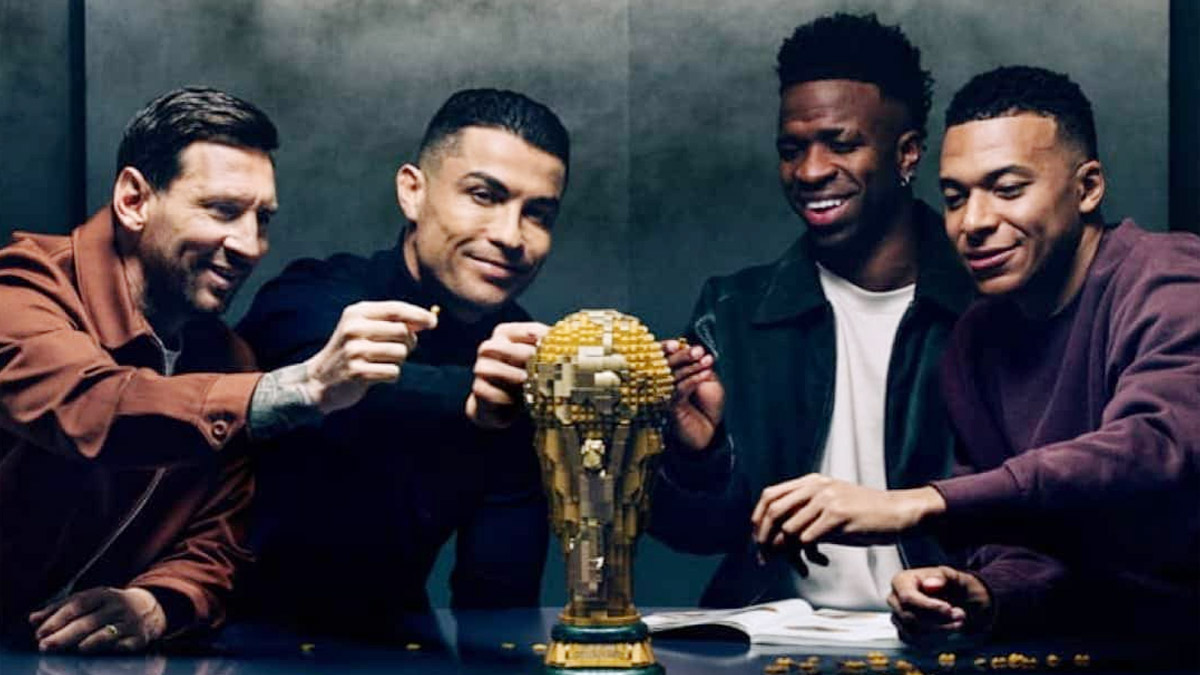
MUMBAI: Four legends, one frame and not a single tackle in sight. Lego has pulled off a crossover few thought possible, uniting Lionel Messi, Cristiano Ronaldo, Kylian Mbappé and Vinícius Júnior in a single campaign ahead of the FIFA World Cup 2026 only this time, they’re building dreams brick by brick.
Titled “Everyone wants a piece”, the campaign features the quartet assembling a Lego version of the World Cup trophy, before placing miniature versions of themselves atop it, a playful nod to football’s ultimate prize. Shared widely across social media, the ad carries a pointed disclaimer: it is not AI-generated, a subtle but telling signal in an era where even reality is often questioned.
The numbers tell their own story. The campaign has already crossed 314 million views on Instagram across the players’ accounts, with fans hailing it as a rare, almost nostalgic moment particularly for the reunion of Messi and Ronaldo, whose last shared campaign ahead of the 2022 World Cup became one of the platform’s most-liked posts.
Beyond the film, Lego is extending the play with exclusive, player-themed sets tied to each of the four stars, part of a broader football-led programme designed to ride the global momentum building towards 2026. The idea, as echoed by the players themselves, leans into the parallels between football and play experimentation, creativity, failure, and triumph.
Messi described the sets as a way to bring on-pitch moments into an imaginative, hands-on world, while Ronaldo called the transformation into a Lego figure a rare honour, blending sport with storytelling. Vinícius, meanwhile, struck a more personal note, recalling childhood moments of building with Lego and framing creativity as a universal language that transcends borders.
The timing is no accident. With the 2026 World Cup set to run from June 11 to July 19 across the United States, Canada and Mexico, and featuring an expanded 48-team format, global anticipation is already building. Argentina, led by Messi, will enter as defending champions, adding another layer of intrigue.
For Lego, the campaign does more than celebrate football, it taps into its mythology. Because when icons become figurines and rivalries turn into play, the beautiful game finds a new kind of pitch. one built, quite literally, by hand.






