MAM
How Broadcoasters’ LED screens are lighting up the Mumbai coastline

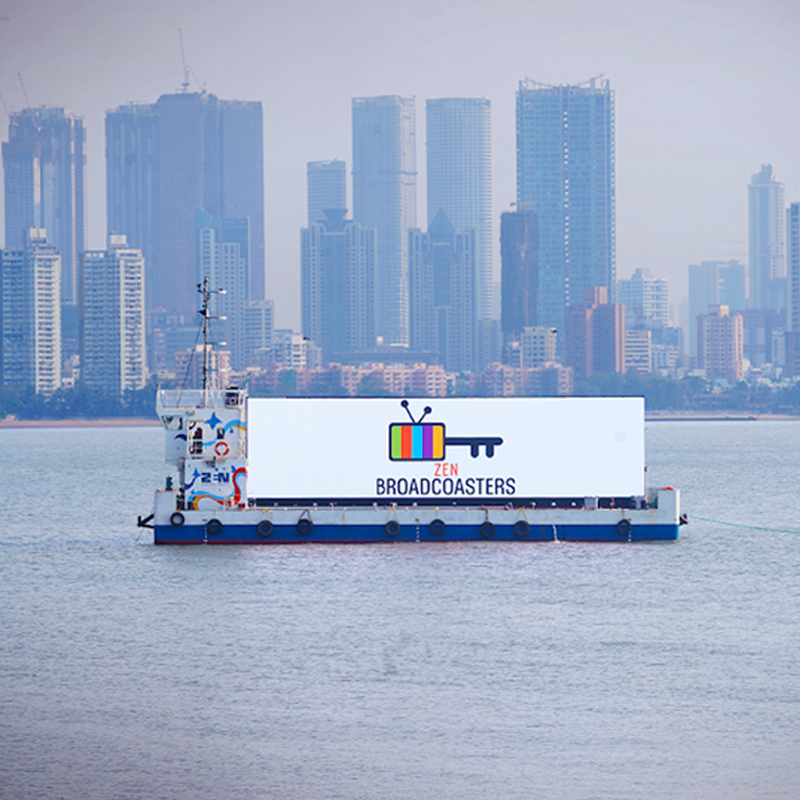
MUMBAI: What started as a seed of an idea to explore India’s vast coastline as a marketing medium led to a whole new and unique concept of having LED hoardings over water. Launched in 2017, Zen Digital Media is an Indian start-up co-founded by Sanjay Raval and Payal Raval and Broadcoasters is one of its first products to go live this month.
The novel OOH set-up uses a customised, self-propelled vessel to carry high resolution LED screens with auto-brightness sensors along India’s coastal areas as an advertising platform, showcasing various formats of eye-catching static and video content.
While the start-up had the first-mover advantage in the segment, it did bring its fair share of challenges too. Right from designing the vessel according to the specifications mandated by the Indian Register of Shipping and customising it to support the weight of huge LED screens, combining high-tech tools with mobility while taking into account the wind pressure – the team had the whole thing planned down to a tee.
“A lot of effort has gone into creating this kind of infrastructure. What we have done is make a platform that is very future tech-ready in terms of new technologies like VR, AR at our back end and infrastructure. So tomorrow if any gaming or tech companies want to take over the platform to screen gaming finales or have people interact with the screen, we will be ready for that too,” Zen Digital Media head of marketing Varun Ramrakhyani told Indiantelevision.com.
Though capital-intensive and cost-heavy, Ramrakhyani believes the platform is different enough to warrant a new category in itself, and not be compared to other out-of-home (OOH) advertising media. “We are essentially broadcasters who can relay anything we want on our space, in addition to operating on the coast, hence the name Broadcoasters,” he quipped.
The first Broadcoaster vessel was launched and anchored at Mumbai’s Bandra Worli Sealink promenade on 15 March. The next launch is scheduled across the beautiful coastline of Juhu-Versova Beach this month. It is a cyclical industry which can only operate in the ocean for eight months – between October and May – in a year, as they have to be out of the waters during the monsoon.
“While there have been a few global precedents of having LEDs on water, we have opened up the platform to a lot of participants in a lot of different ways,” said Ramrakhyani. “It is new-age storytelling where brands can flex their creative muscles, play around with light, animation, VFX special effects, and long-form videos. The Brihanmumbai Municipal Corporation (BMC), Mumbai police and ASCI (Advertising Standards Council of India) are already participating and using the platform to educate people and relay their messages very creatively.”
For the Juhu launch, the team has selected a five-kilometre stretch wherein the vessel will keep plying to and fro. The second vessel is accordingly designed to carry dual screens while moving from point A to point B and back, all while using heavy animation, VFX, and full-length videos.
Zen Digital also plans to use the screens to highlight important events and achievements, such as an Olympics victory for India or an ISRO launch. “So, the entire idea is to engage, entice, educate and excite the audience in a way that has never been done before,” he remarked.
Several brands such as Amul, MG Hector, Skoda, Tata Motors, Volvo, Mercedes, Kotak, HSBC, Amazon Prime, and non-government bodies such as ASCI are already on board. The start-up has also tied up with five-star properties along Juhu beach to conduct full-scale events.
Its second initiative, ‘Beach and You’ is modelled along the lines of “Equal Streets” of Bombay, wherein it will showcase content which people coming to the beach can make use of, like Zumba or yoga. This will be executed with the help of tie-ups with health and fitness companies to air fitness sessions.
But what of the profitability and feasibility aspects of this hitherto unexplored segment in India?
“No capital-intensive business can be profitable from day one. We believe it will take its own sweet time to give returns. The traditional industry is very RoI-centric, and everything has to be measured. But creativity is very subjective and cannot be measured. Brands that want to test the market with creativity come to us,” summed up Ramrakhyani.