MAM
Healthcare products lead in ASCI norms breach, 143 complaints upheld

MUMBAI: Healthcare products, followed by education category, led in breaching various norms set by Advertising Standards Council of India (ASCI) on advertisements and getting hauled up for the same in the month of January this year, according to an official statement from the advertising self-regulatory body.
ASCI yesterday noted that its Consumer Complaints Council (CCC) upheld complaints against 143 out of 191 advertisements. Out of 143 advertisements against which complaints were upheld, 102 belonged to the healthcare category, 20 to the education category, followed by seven in personal care category, six in the food & beverages category and eight ads from other categories.
Some of the big companies and products pulled up by ASCI include Apple, Amul, Qi Lifecare Pvt. Ltd, Nivea India, HUL, Standard Chartered Bank and Coca-Cola India.

HEALTHCARE
The CCC found the following claims of 102 advertisements in healthcare products or services to be either misleading or false or not adequately/scientifically substantiated and violating ASCI’s norms. Some of the healthcare products or services advertisements also contravened provisions of the Drug & Magic Remedies Act and Chapter 1.1 and III.4 of the ASCI code.
Complaints against the following advertisements, amongst others, were upheld:
1. Proyurveda Lifescience Pvt. Ltd. (Max ARTHO Capsules, Oil and Gel): The advertisement’s claims that it “helps in protecting joint cartilage by reducing degeneration” and “helps in treating the root cause of joint pain” were inadequately substantiated and are misleading by implication.
2. Nurture Health Care (Medora Capsules): The advertisement’s claim (in Marathi) as translated into English — “Medora capsules deliver weight reduction without any lifestyle changes” — was not substantiated with evidence of product efficacy and is misleading by exaggeration.
3. Qi Lifecare Pvt. Ltd. (Qi Spine Clinic): The advertisement’s claim, “new treatment approach helps 50-year-old achieve complete recovery from 12 years of chronic back pain”, was inadequately substantiated. It was considered that the testimonials did not constitute reliable objective evidence and did not entitle the advertiser to make very broad claims made in the advertisement regarding surgery-free recovery.
Consumers were likely to understand that the testimonial was genuine representation of complete recovery from chronic back pain by the advertised treatment alone and was representative of the results that could be generally achieved by taking the treatment. Also, since the physiotherapy treatment approach is well established, calling it “new” was considered to be misleading. Further, the claim, “India’s first back pain specialist”, was not substantiated with comparative data versus other similar clinics providing similar treatment to prove this claim. Also, the claims are misleading by exaggeration.
4. Shree Maruti Herbal (Stay On Power Capsules): The advertisement’s claim — “clinically 99.99 per cent efficacy proven power capsules” — was not substantiated with clinical evidence of product efficacy. Also, the claim when read in conjunction with the text in the body copy of the advertisement and product visual is misleading by implication that the product, which as per pack declaration is “herbal supplement for men”, is for improvement in their capacity for sexual pleasure.
It was noted that this medical product is being presented as an “amazing gift”, which people could exchange for Diwali among friends, and considered to be misleading by ambiguity and a manifestation for a disregard for safety while consumption of the product could encourage negligence. It was further concluded that the advertisement gives a false impression regarding the true character of the medicine and is in breach of the law as it violated the Drugs & Magic Remedies Act (DMR Act).
EDUCATION:
The CCC found claims in the advertisements by 20 different advertisers were not substantiated and, thus, violated ASCI guidelines for advertising of educational institutions. Hence, complaints against these advertisements were upheld. Some of the upheld cases are the following:
1. Vidyamandir Classes: The advertisement’s claim — “cash reward worth (Rs) 2 crore (Rs 20 million)” — was not substantiated with supporting evidence of students who have received cash worth Rs. 2 crore. Also, the claim (“scholarship up to 100 per cent”) was not substantiated with authentic supporting data such as evidence of 100 per cent scholarships availed by students. The claims were found to be misleading by exaggeration.
2. Cadd Centre India Private Ltd. (Cadd Centre-Ce): The advertisement’s claims (“First Time Ever In India! 1000 Jobs In 100 Days For Cadd Quest Participants” and “Job Guarantee For 1000 Students”) were not substantiated with verifiable support data such as detailed list of students who have been placed through its institute, contact details of students for independent verification, enrolment forms and appointment letters received by the students, nor any independent audit or verification certificate. The claims are likely to mislead students into believing that the institute is providing permanent jobs.
PERSONAL CARE
1. Nivea India P. Ltd. (Nivea Protect & Care Deodorant): The print advertisement has visual of Nivea crème super-imposed on the deodorant can image and claims were considered to be misleading by ambiguity and implication that several other major ingredients (and not only fragrance) of Nivea Crème were added to the deodorant product. The front of the pack claim (“with Nivea Crème ingredients”) accompanied by a visual of cream, and back of pack claim of “with precious Nivea Crème ingredients” is likely to mislead the consumers that Nivea Protect & Care Deodorant has several major skincare ingredients of Nivea Crème. The pre-dominant common element of both the products is the Nivea fragrance. These claims are misleading by ambiguity.
2. Richfeel Health & Beauty Pvt. Ltd.: The advertisement showcases pictures of results of both pre and post treatment. It was noted that the advertiser did not provide its response specific to the claims/visuals objected to, nor did it provide photographic evidence to prove that the pictures shown in the advertisement (pre and post treatment) are demonstrating the real benefit achieved through the treatment. It was concluded that the efficacy being depicted via images of before and after the treatment are false and misleading by gross exaggeration. Without this evidence, addition of any disclaimers was not considered acceptable.
3. Hindustan Unilever Limited (Rin Antibac): The advertisement’s claim (“Presenting new Rin Antibac with Ayurvedic extracts removes germs”), accompanied by visuals implying sterile clothes, was not substantiated and is misleading by implication and exaggeration as the advertised product does not have the property to provide germ protection in wear conditions. As clothes will be exposed to different environments, they would be contaminated and would carry germs. Both the claims, that is germ inhibition/sterile clothing in wear conditions and provided only by the advertised product (i.e. other detergent not providing similar benefit), were not substantiated.
FOOD & BEVERAGES
1. S.V.Fruit (Go Green Frozen Fruits): It was concluded that while the advertised product may be carbide free, claiming it to “protect from cancer” is misleading by exaggeration.
2. Gujarat Co-Operative Milk Marketing Federation Ltd. (Amul Butter): The advertisement refers to butter being a rich source of Vitamin A and further states that “eat milk with every meal and live every day, worry-free”. It was considered the latter part of the statement was misleading by implication and encouraging excessive consumption of butter, which may not be advisable from a health point of view.
3. Coca-Cola India Pvt. Ltd. (Thums Up): The advertisement showcases a rider performing a wheelie on normal streets and traffic conditions amongst a few people. This is contradictory to the disclaimer made in the advertisement — “the actions are for representational purposes alone and must not be copied by viewers”. It was concluded that though the overall advertisement is not objectionable, regardless of the disclaimer, the specific visual showing the stunt performed by the rider (wheelie) in normal traffic and/or in presence of bystanders and public encourages dangerous practices and encourages a disregard for safety and negligence.
OTHERS
1. Standard Chartered Bank (Standard Chartered credit card): The advertisement claims that “get up to 10 per cent extra cash back on all spends with your Standard Chartered credit card”. It was considered to be false and misleading by ambiguity as the cash back being offered is limited to Rs.10, 000.
2. Apple India Private Limited (Apple): The advertisement’s text states that “the amazing iPhone 7 is here”, but shows an image of iPhone 7 Plus variant, which is misleading by ambiguity and implication. While the advertiser may have a logo/trademark with “iPhone7”, by omission of any reference to the word “series” in the advertisement text and in absence of any visual of iPhone 7 variant, it was concluded that the advertisement is likely to mislead consumers about the product advertised and its corresponding features.
3. Opera Software Asa (Opera Mini): The advertisement’s claim — “saves data cost up to 90 per cent while browsing” — was not substantiated with supporting data and is misleading by exaggeration.
ASCI is a self-regulatory organization for the advertising industry to promote, maintain, monitor and uphold fair, sound, ethical and healthy principles and practices of advertising for the protection of interest of consumers and the general public. Established in 1985, ASCI’s role has been acclaimed by various government agencies like the Department of Consumer Affairs (DoCA), Food Safety and Standards Authority of India (FSSAI) and Ministry of AYUSH.
ASCI and its Consumer Complaints Council (CCC) deal with complaints received from consumers and industry against advertisements that are considered as false, misleading, indecent, illegal, leading to unsafe practices, or unfair to competition and in contravention of the ASCI code for self-regulation in advertising.
The full list of companies/adverts hauled up by ASCI for breach of norms could be found here.







Brands
Jubilant FoodWorks faces Rs 47.5 crore GST demand, plans appeal
Tax authorities flag alleged misclassification of restaurant services
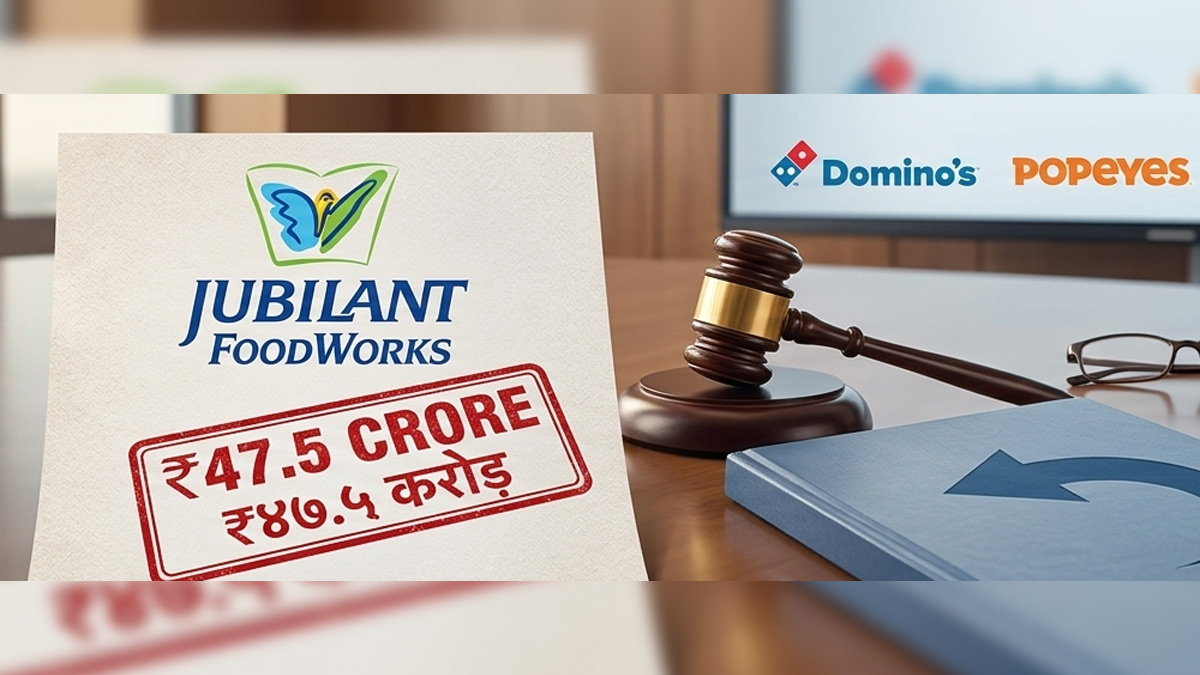
MUMBAI: Jubilant FoodWorks Limited has landed in a tax tussle after receiving a GST demand of Rs 47.5 crore from the office of the additional commissioner of CGST and central excise in Thane, Maharashtra.
The order, issued under the provisions of the Central Goods and Services Tax Act, 2017, relates to an alleged incorrect classification of certain services under the category of restaurant services. According to the tax authorities, this classification resulted in a short payment of goods and services tax for the period between the financial years 2019-20 and 2021-22.
The demand includes Rs 47.5 crore in GST along with an equal amount as penalty, in addition to applicable interest. The order was received by the company on March 13, 2026.
In a regulatory filing to the BSE Limited and the National Stock Exchange of India Limited, the company said it disagrees with the order and believes its arguments were not adequately considered.
The company is preparing to challenge the decision and plans to file an appeal. It added that once the redressal process is complete, the demand is likely to be dropped.
Despite the sizeable figure attached to the notice, the company said it does not expect any material impact on its financials, operations or other activities.
The disclosure was signed by Suman Hegde, EVP and chief financial officer, who confirmed that the company received the order at 19:06 IST on March 13 and has already initiated steps to contest it.
The development places the quick service restaurant major in the middle of a tax debate that could hinge on how certain restaurant-linked services are classified under GST rules. For now, the company appears ready to take the matter from the tax office to the appeals desk.