MAM
Goafest’13: How to make client-agency relationships work

VARCA,GOA: When Arvind Sharma was asked to kick off the Advertising Conclave at Goafest 2012, he said one line, which turned out to be more prophetic than he would have imagined. He started his speech saying “Some of the most meaningful conversations one has, are the ones he avoids the most.” He was referring to this year’s theme at the Advertising Conclave which was ‘Time to Listen’.
The first day of the annual ad fest in Goa on 4 April witnessed advertisers across categories address an audience filled with the cr?me de la cr?me of the advertising world. They frankly shared their perceptions of the shortcoming of ad and media agencies and where the latter were not living up to their expectations.
HUL MD Nitin Paranjpe delivered an insightful narration where he pointed out what in his experience are the kinks in the client and agency relationship. He started off admitting that it is not just the agency that should be held responsible; the entire marketing environment that needs to be looked at hard to find some answers.

According to him, the biggest challenge today is the abundance of choice. There is an abundance of options for each product in the market and brands are vying for the TG’s attention in a heated environment. On the other hand, media itself is facing the tyranny of abundant choice where the audience is becoming increasingly fragmented and engaging it is very tough. “What we have is scenario where choice is abundant, but there is very little to choose between each,” Paranjpe explained.
 This has led to an urgent need for brands to differentiate themselves which in turn possibly leads to desperate measures. Tata Sky MD and CEO Harit Nagpal‘s view in this regard was that “in order to be different, it is necessary to actually be different rather than just standing different.” He supported this this statement with a picture of five zebras where the one in the middle had its rear facing the camera.
Another point that was unanimously pointed out by all the advertisers was that the 30 second television commercial is becoming redundant and agencies need to strategise innovatively to factor in this change. The rise of social media also needs to be accounted for when planning in today’s environment.Amul MD RS Sodhi spoke from his experience with agencies – DaCunha Communications (outdoor), Draftfcb Ulka (creative) and Lodestar (media). He expressed that for any marketing strategy to work, there needs to be a long-standing relationship between the agency and the client. This builds the basis for trust and understanding that is required in any marketing relationship. It also offers consistency, which is paramount to maintaining a brand’s identity among the TG.
“According to me, what agencies need to remember today, is that the goal of advertising is to sell the product and not the creator of the campaign. What the product stands for, what the audiences relate to with the product and the brand should be the first consideration,” he elucidated. “Accolades for the creator should not be the reason behind creating any campaign.”
He also added that the whole concept of advertising awards should either be discontinued or be revisited and reworked upon. “These awards look at and honour work that is created by the industry and judge by the industry. What is the point? Either discontinue them or ask the clients and the audience to rate the ads,” he suggested. His suggestion was met with a thunderous applause fom the audience.
SBI Capital Markets MD & CEO Arundhati Bhattacharya spoke about the importance of research. “It is important to understand both the brand personality and the TG profile in order to come up with a relevant campaign,” she said. She also feels that advertising should be done in order to further the business and it should be kept simple and short. It is the consumer whose minsdset has to be appealed to,she further said.
 Arunabh Das Gupta of BCCL feels that the death of planning as a practice in the industry has led to a lot of complications. Today one sees a gap in the marketing research done by agencies and this leads to a shortfall of breakthrough creatives. He also offered that creative agencies need to look at talent retention seriously since their employess are the touch points that the clients deal with and form the basis of building a relationship between the two.
Tata Sky‘s Nagpal begged to differ from the rest on a couple of points. While most of the speakers felt that the fragmentation of the advertising agency into media, creative and account planning has led to a decrease in efficiency of client servicing, Nagpal feels that hiring specialised personnel for specialized work is the order of the day and if need be, this talent should be imported.
He added that there should be clarity regarding wha the agency and the client expect from each other in order to have an efficient and fulfiiling working rapport. Suresh Bandi from Panasonic pointed out that what matters to a clients is the value that an agency gives them for a given price. “The way I see it, when an agency increases its fees, the value the agency brings to me decreases,” he said.
Nagpal on the contrary feels that clients should not look at cost-cutting every time. Specialized work comes at a certain cost and while agencies in a bid to compete and win clients may lower their rates, it may lead to a lowering of quality. It is the basic princliple of “Itne mein sirf itna hi milega.”
Another grievance recorded by each advertiser was that while the pitch process is spearheaded by a known senior agency executive/professional, once the pitch is won, the clients end up dealing with newbies who are not trained enough to handle the account or have no clue of the pitch in the first place. This creates a disjunct and gap in the dynamics and is often the reason why most client-agency relationships fail.
In conclusion, the panel agreed that while agencies and clients needs to introsopect and make some changes, the key takeaway was that the relationship between the agency and the client is what decides the effecniency of a campaign. An integrated team will function much better than a fragemented one and a team that knows each other is the one that will take the brand all the way.







MAM
India’s financial sector spent less on TV ads in 2025 but flooded the internet
Banks, insurers and lenders cut tv ads as digital jumps, LIC and Muthoot lead tv and Axis Bank tops online
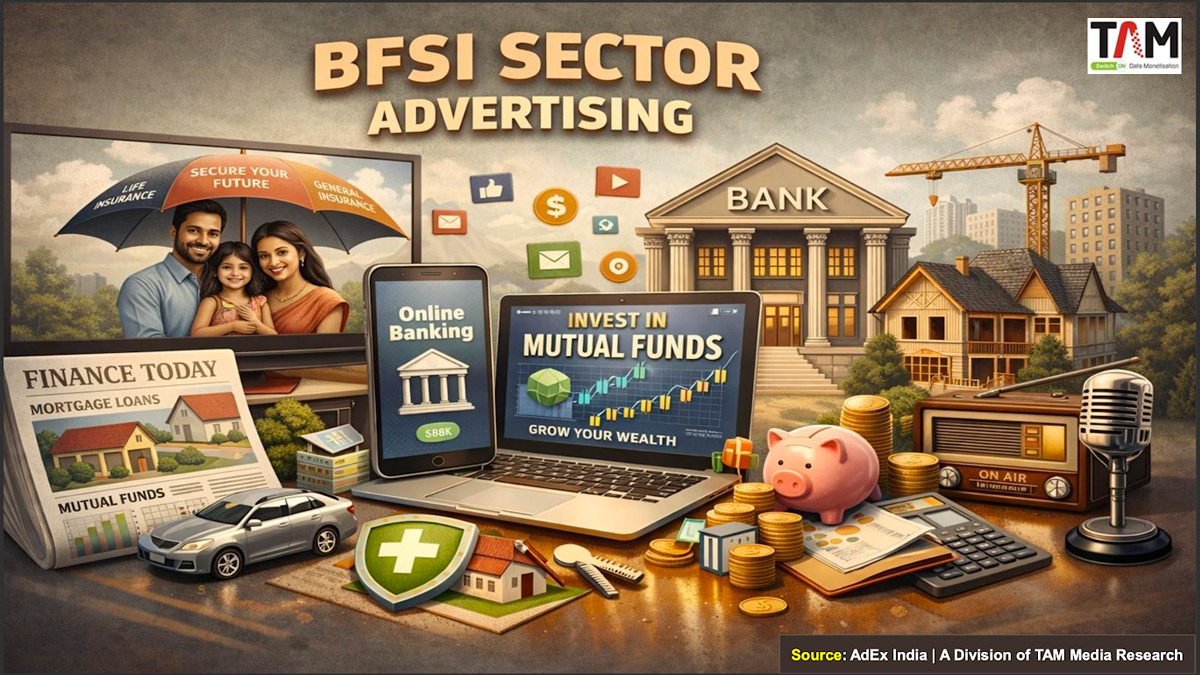
MUMBAI: India’s banking, financial services and insurance sector, one of the most prolific advertisers in the country, delivered a split verdict on media in 2025. It spent less on television, held its nerve in print, turned up the volume on radio and deluged the internet with a ferocity that left every other medium looking pedestrian. The picture that emerges from TAM AdEx’s cross-media report for the BFSI sector is of an industry in transition, still wedded to the news bulletin but increasingly seduced by the algorithm.
Television: a retreat with caveats
TV ad volumes for the BFSI sector fell 16 per cent in 2025 compared with 2024, a sharp reversal after two years of consistent growth that had pushed volumes 16 per cent above 2021 levels by 2023 and a further 7 per cent higher by 2024. Within 2025 itself, the drop was concentrated in the middle of the year: the second and third quarters saw ad volumes slide 35 per cent each against the first quarter, with a partial recovery of 13 per cent in the fourth.
The retreat did not reshuffle the deck. Life insurance retained first place among TV categories with 19 per cent of ad volumes, mortgage loans held second with 16 per cent, and the top ten categories together accounted for 82 per cent of all BFSI television advertising. The dominance of news channels was equally pronounced: news claimed 68 per cent of ad volumes, general entertainment channels a distant 14 per cent and movies 12 per cent. Together, news and GEC captured 82 per cent of the sector’s television spend. News bulletins alone took 48 per cent of programme-genre volumes, with feature films second at 12 per cent. Prime time, between 6pm and 11pm, drew 34 per cent of ad volumes, followed by afternoon at 22 per cent and morning at 20 per cent. A full 82 per cent of all ads ran between 20 and 40 seconds.
Life Insurance Corporation of India was the sector’s biggest TV spender with 11 per cent of ad volumes. Muthoot Financial Enterprises came second with 9 per cent, followed by National Payments Corporation of India at 6 per cent, Tata AIG General Insurance at 5 per cent and State Bank of India at 5 per cent. The top ten advertisers together accounted for 51 per cent of total TV volumes. Three names were new to the top ten in 2025: Tata AIG General Insurance, IIFL Finance and Tata Capital. At brand level, Muthoot Finance Loan Against Gold led with 9 per cent share, Tata AIG Health Insurance entered the top ten for the first time, and the top ten brands together contributed 35 per cent of ad volumes.
Print: the long climb continues
Print told a different story. Ad space for the BFSI sector has grown every year since 2021, rising 16 per cent in 2022, 30 per cent in 2023, 51 per cent in 2024 and 64 per cent in 2025, all measured against a 2021 baseline. Within 2025, ad space was flat in the second quarter but surged 46 per cent in the third and 33 per cent in the fourth compared with the first. Life insurance led print categories with 21 per cent of ad space, followed by mutual funds and banking services and products at 13 per cent each, and corporate financial institutes at 11 per cent. The top ten categories together took 82 per cent of print ad space. LIC led print advertisers with 6 per cent share, and the top ten together covered just 19 per cent of ad space, a reflection of how fragmented print spending remains. Three new entrants joined the top ten in 2025, with Billion Brains Garage Ventures the only exclusive presence not seen in 2024’s list. In the top ten brands, LIC dominated with a 2 per cent share, while Nippon India Mutual Fund rose to third position from fourth in 2024. English accounted for 62 per cent of print ad space, Hindi for 20 per cent. Business and finance publications took 59 per cent of the genre split. The south zone led regional spending with 33 per cent of print ad space, Bangalore topping that zone, while New Delhi and Mumbai were the leading cities nationally.
Radio: louder than ever
Radio ad volumes for the BFSI sector have climbed steadily, rising 12 per cent above 2021 levels in 2023, 36 per cent in 2024 and 45 per cent in 2025. The quarterly pattern within 2025 was volatile: a sharp drop of 43 per cent in the second quarter and 42 per cent in the third, followed by a near-full recovery in the fourth. Life insurance led radio categories with 22 per cent of volumes, banking services and products second at 14 per cent and corporate NBFCs third at 11 per cent. LIC of India held its position as the leading radio advertiser with 20 per cent of ad volumes; the top ten radio advertisers together covered 69 per cent. Muthoot Financial Enterprises led radio brands with 10 per cent share, five of the top ten brands belonged to LIC alone, and SBI Mutual Fund made a remarkable leap to fifth position from 272nd in 2024. Evening and morning time-bands together captured 84 per cent of radio ad volumes, with evenings at 44 per cent and mornings at 40 per cent. Maharashtra was the leading state for radio BFSI advertising with 18 per cent share; Maharashtra, Gujarat and Uttar Pradesh together accounted for 43 per cent.
Digital: the five-times surge
If one number defines the 2025 BFSI advertising story, it is five. Digital ad impressions for the sector multiplied fivefold between 2021 and 2025, having already doubled in 2023 and doubled again in 2024 before the 2025 leap. Within the year, impressions dipped 19 per cent in the second quarter and 12 per cent in the third before recovering 8 per cent above the first quarter by the fourth. Banking services and products led digital categories with 27 per cent of impressions, life insurance and credit cards tied at 19 per cent each, and securities and sharebroking organisations fell from first place in 2024 to fourth in 2025. Axis Bank was the runaway leader among digital advertisers with 12 per cent of impressions, followed by ICICI Bank at 9 per cent, IDFC First Bank at 7 per cent and Kotak Mahindra Bank at 6 per cent. The top ten digital advertisers covered 59 per cent of impressions, and seven of them were new entrants compared with 2024, signalling rapid churn in the digital spending hierarchy. At brand level, Axis Bank led with 9 per cent, ICICI HPCL Super Saver Credit Card vaulted to third place from 921st in 2024, and six of the top ten digital brands were new to the list. Programmatic buying accounted for 91 per cent of all digital BFSI transactions; combined with ad networks, it captured 96 per cent.
The data from TAM AdEx paints the portrait of a sector that still believes in the power of the television news bulletin to sell insurance to the masses, but increasingly knows that the next generation of borrowers, investors and cardholders is scrolling, not watching. The race is now on to reach them before the algorithm serves up someone else’s loan offer first.






