MAM
Global e-commerce to make up 19% of retail sales in 2022, to grow upto 25% by 2027: GroupM report


Mumbai: Today, e-commerce, after a surge of investment and adoption during the pandemic, is finding its place in a world where in-person activities are resuming. GroupM has released its e-commerce and retail media forecast that details the socioeconomic factors contributing to the state of this space. According to the study, the e-commerce industry will generate $101 billion in annual revenue this year, a 15 per cent increase over 2021. This, even as pandemic-related lockdowns in China and supply chain bottlenecks there and in war-torn Ukraine have contributed to a drag on growth in the first half of 2022.
The report has been penned down by GroupM’s global director of business intelligence Kate Scott-Dawkins. The study estimates global e-commerce to make up 19 per cent of global retail sales in 2022, growing to 25 per cent by 2027. Global retail media is likely to reach $101 billion in 2022 and will surpass $160 billion in annual revenue in five years’ time. In 2021, retail media ad revenue represented 18 per cent of global digital advertising revenue and 11 per cent of total global ad revenue.
According to the report, 20 of the top global e-commerce companies accounted for 67 per cent of e-commerce sales in 2021. Global e-commerce sales of $5.4 trillion are estimated for this year. Of this figure, China and the US alone is expected to make up 52 per cent. Nearly 61 per cent of the total, $3.3 trillion, can be attributed to only seven markets: the US, China, Japan, Germany, the UK, Canada and Australia.

The top countries’ e-commerce figures are China – with an estimated e-commerce market growth in 2022 of 5.6 per cent, slower than last year’s growth of 10 per cent; and the US, with an estimated e-commerce market growth in 2022 of 25 per cent. Among the major global markets highlighted in this report, only three are forecast to see 10 per cent or lower e-commerce penetration in 2022: Australia, Japan, and Canada.
By 2027, the report estimates e-commerce sales will reach $9.1 trillion. This figure includes sales of autos and auto-parts, as well as gasoline, but excludes food services or catering sales to produce like-for-like comparisons across all tracked markets.
There is no doubt that the pandemic lifted the fortunes of any e-commerce retailer already established or ready to invest in becoming established during the first year of the pandemic. Unsurprisingly, Chinese retailers make up three of the top five retailers by global e-commerce gross merchandise value (GMV), with Amazon and eBay rounding out the other two spots (though Shopify would replace eBay at number five if included). Alibaba is the undisputed leader, with more than double the e-commerce GMV of Amazon. Alibaba has dominated the mobile commerce and payments ecosystem with Alipay (along with Tencent competitor WeChat), and certainly benefited from heavy adoption of mobile shopping during the COVID-19 outbreaks in China in 2020 and the spring of 2022.
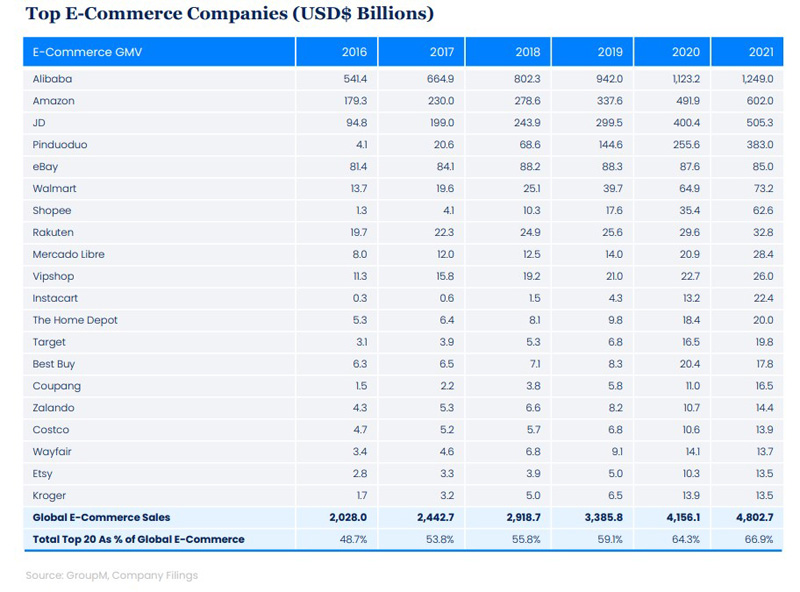
Concurrently, global advertising revenue increased by 24 per cent in 2021, which is even more remarkable given that the figure in 2020 was only a two per cent decrease.
Read the full report here.







AD Agencies
Publicis acquires AdgeAI to sharpen predictive measurement in advertising
Deal integrates AI-driven content intelligence with Publicis production platform

MUMBAI: Publicis Groupe is doubling down on data-led creativity with the acquisition of measurement and content intelligence firm AdgeAI, a move aimed at helping brands understand what truly works in their campaigns.
Announced on March 12 in Paris, the deal brings AdgeAI’s analytics technology into Publicis’ AI-driven production ecosystem, allowing brands to measure and predict creative performance in real time. The company said the integration will help marketers move beyond guesswork and focus on content that delivers measurable business outcomes.
AdgeAI’s platform analyses engagement and conversion data across video and digital campaigns to pinpoint which creative elements resonate most with audiences. By identifying patterns that drive results, the system provides insights that guide content strategy and improve returns on marketing investment.
The acquisition comes at a time when brands are producing more content than ever before. While the tools to create campaigns have become faster and cheaper, many marketers still struggle to determine which messages actually drive sales.
Publicis Groupe chairman and CEO Arthur Sadoun, said brands today need clarity rather than just volume. “In the AI era, brands do not simply need more content. They need to know what works, and why, so they can scale their messaging across audiences, markets and platforms,” he said. He added that the acquisition turns creative measurement from a backward-looking report into a forward-looking capability that predicts outcomes.
Publicis production chief executive officer Deepti Velury, said embedding predictive intelligence into the production process will allow brands to create fewer but more effective assets. According to her, AdgeAI’s technology can analyse creative components at a granular level and identify patterns directly linked to campaign performance.
AdgeAI co-founder and CEO Eyal Ben Shalom, described the deal as a shift in how the industry approaches creative intelligence. By plugging its technology into Publicis’ broader platform, he said brands will be able to move at the speed of digital algorithms without losing the spark of strong creative ideas.
With the addition of AdgeAI, Publicis is positioning itself to close the gap between creativity and data, giving brands a clearer view of what clicks with audiences and what drives the bottom line.