Brands
FY-2015: Titan revenue up 9%, ad spends down 5.5%

BENGALURU: Titan Company Limited reported nine per cent increase in Total Income from Operations (TIO, revenue) in FY-2015 to Rs 11913.41 crore as compared to the Rs 10927.39 crore in FY-2014. The company’s profit after tax (PAT) for the year increased 11.1 per cent to Rs 816.26 crore from Rs 734.94 crore in the previous year.
The company spent 5.5 per cent lower amount at Rs 382.13 crore (3.21 per cent of TIO) towards advertising in FY-2015 as compared to the Rs 404.43 crore in FY-2014.
Note: 100,00,000 = 100 lakh = 10 million = 1 crore

Businesses and Brands
Titan has three revenue segments – watches comprising brands namely Titan, Xylus, Nebula, Sonata and Fastrack and Zoop; Jewellery with Tanishq, Zoya, Gold Plus from Tata, Mia and Fq teen diamonds; and ‘Other’ such as eyewear under the Titan EYE+ brand, apparel and eyewear also under Fastrack brand and precision engineering among others.
During the current quarter, sales value of World of Titan grew 11 per cent; Tansihq sales value declined 21 per cent, Goldplus declined 4 per cent, Helios declined 3 per cent, Fastrack grew 1 per cent, LFS and Titan Eye+ grew 10 and 14 per cent respectively.
Watches
The watch segment saw an increment of two per cent in volumes in FY-2015 as compared to FY-2014. Net sales for the segment grew 7.3 per cent to Rs 1921 crore in the current year from Rs 1791 crore in FY-2014.
Though Q4-2015 saw a fall of six per cent in volume as compared to Q4-2014, revenue increased 1.8 per cent to Rs 511 crore from Rs 502 crore in the corresponding year ago quarter on the back of increment of prices.
Jewellery
Titan’s jewellery distribution brands are Tanishq and Goldplus from Tata. Jewellery contributes about 80 per cent to Titan’s TIO. The segment’s sales grew eight per cent (excluding coins) in volumes in FY-2015 as compared to FY-2014. Sales revenue grew 9.2 per cent to Rs 9240 crore in FY-2015 from Rs 8632 crore in FY-2014. During the year the company witnessed a grammage growth of eight per cent, (including coins) and six per cent excluding coins. Also, the share of studded jewellery increased to 32 per cent from 30 per cent in FY-2015. The company says that it saw a customer growth of 13 per cent in the jewellery segment during the year.
Q4-2014 was a quarter of falls for Titan’s jewellery segment. For Q4-2015, volumes witnessed a fall of 16 per cent as compared to Q4-2014, while sales of jewellery fell 15.3 per cent to RS 1828 crore from Rs 2157 crore in Q4-2014. Customers declined seven per cent in the quarter. While studded jewellery witnessed an 18 per cent decline during the quarter, it retained the same share of 37 per cent as last year.
Others
The ‘Others’ segment reported 12.9 per cent revenue growth to Rs 565 crore in FY-2015 from Rs 500 crore in Q4-2014. Eyeware witnessed a growth of 24 per cent and returned an operating profit of Rs 4 crore. For Q4-2015, the segment reported 12.8 per cent increase in revenue to Rs 165 crore from Rs 146 crore in Q4-2014.
Trends
Titan’s ASP declined 8.1 per cent in Q4-2015 to Rs 80.30 crore (3.22 per cent of TIO) from Rs 87.37 crore (3.12 per cent of TIO) in Q4-2014 and was 17 per cent lower than the Rs 96.75 crore (3.31 per cent of TIO) in Q3-2015. Please refer Fig A below. During a 13 quarter period starting Q4-2012, Titan’s ASP was highest in terms of absolute rupees in Q3-2014 at Rs 118.04 crore (4.41 per cent of TIO). It was highest in terms of per centage of TIO in Q1-2013 at 4.69 per cent of TIO (Rs 103.44 crore).
Though ASP shows a declining trend both in terms absolute rupees and in terms of per centage of TIO, on calculation, the brown trend line actually indicates ASP as 3.15 per cent of TIO, while the actual amount spent by the company was 0.07 per cent more as mentioned above for Q4-2015. On calculation, the blue trend line indicates ASP in absolute rupees as Rs 96.48 crore as opposed to the actual Rs 80.30 crore spent by the company in Q4-2015.

TIO and PAT
Please refer to Figure B below. The company’s TIO in Q4-2015 fell 11 per cent to Rs 2496.19 crore from Rs 2803.38 crore in Q4-2014 and was 14.6 per cent lower than the Rs 2922.51 crore in the immediate trailing quarter. During the thirteen quarter period under consideration in this report, TIO shows a linear increasing trend.
PAT in Q4-2015 at Rs 215.09 crore (9.6 per cent of TIO) was 4.3 per cent more than the Rs 190.73 crore (7.4 per cent of TIO) in Q4-2014 and was 12.8 per cent more than the Rs 190.73 crore (7.1 per cent of TIO) in Q3-2015. PAT shows a linear increasing trend during the 13 month period under consideration.

Company speak
Titan managing director Bhaskar Bhat said, “The economic outlook for the year 2014-15 was quite good but improvement in consumer demand has been quite lukewarm. Our jewellery business was also adversely impacted due to regulatory changes and termination of the consumer friendly Golden Harvest Scheme. All our brands witnessed good growth during the first half but post Diwali season we have seen tapering of growths. The Company will however continue to invest in strategic initiatives taking into account our long term and sustainable growth plans.”







Brands
Samsung certifies 1,000 Maharashtra students in AI and coding
The South Korean electronics giant marks its first large-scale skilling push in the state, with women making up nearly half the national programme’s enrolment
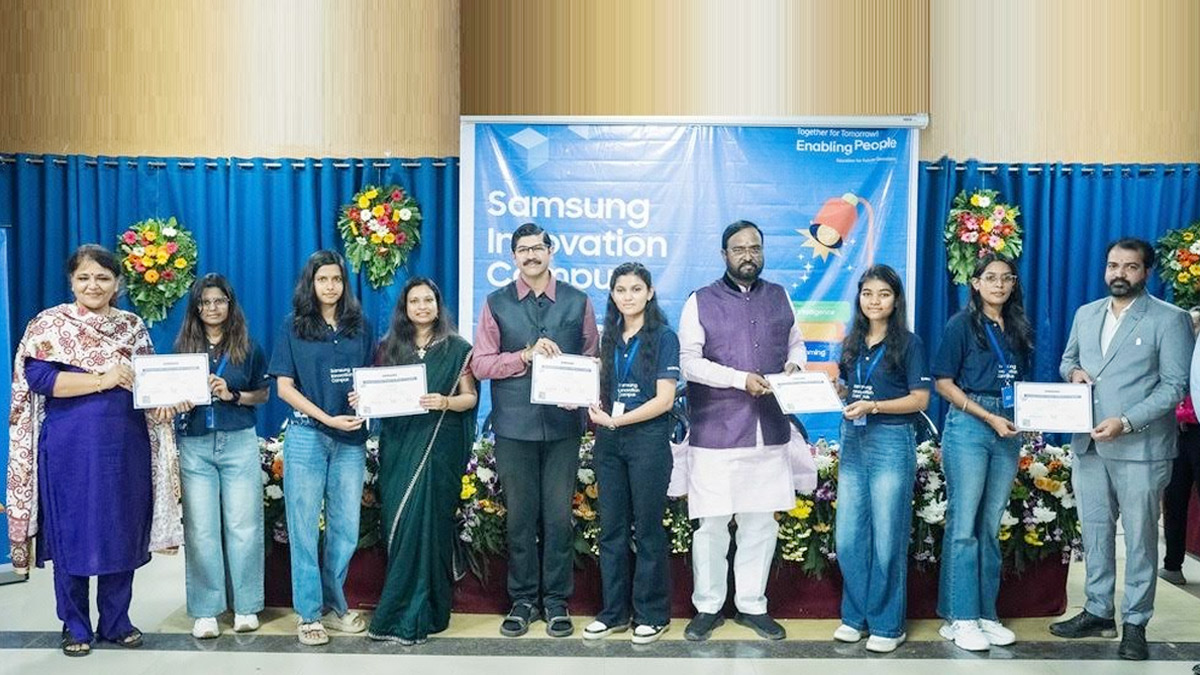
PUNE: Samsung has put 1,000 students in Maharashtra through a certified training programme in artificial intelligence and coding, the largest such drive the South Korean electronics company has run in the state and a signal that corporate India’s skilling ambitions are moving well beyond the boardroom brochure.
The certifications were awarded under Samsung Innovation Campus (SIC), the company’s flagship corporate social responsibility programme, which launched in India in 2022 with the stated aim of democratising access to future-technology education. The 1,000 graduates were drawn from four institutions: 127 from Savitribai Phule Pune University, 373 from Pimpri Chinchwad University, 250 from D.Y. Patil University’s Ramrao Adik Institute of Technology and 250 from Anjuman-I-Islam’s Kalsekar Technical Campus. All completed training in either AI or coding and programming, the two disciplines Samsung has identified as the critical pillars of the digital economy.
The programme does not stop at technical training. Soft-skills development and career-readiness modules are baked into the curriculum, a deliberate attempt to close the gap between what universities teach and what employers actually want.
“India’s digital growth story will ultimately be shaped by the quality of its talent pipeline,” said Shubham Mukherjee, head of CSR and corporate communications at Samsung Southwest Asia. “As technologies like AI move from the periphery to the core of industries, skilling must evolve from basic training to building real-world capability. This milestone in Maharashtra reflects how industry and academia can come together to create a future-ready workforce that is both globally competitive and locally relevant.”
The Maharashtra drive sits within a rapidly scaling national effort. Samsung Innovation Campus trained 20,000 young people across India in 2025, hitting its stated target for the year. Women account for 48 per cent of national enrolments, a figure the company cites as evidence of its push for an inclusive technology ecosystem. The programme is implemented in partnership with the Electronics Sector Skills Council of India and the Telecom Sector Skill Council.
Samsung, which is marking 30 years in India this year, runs SIC alongside two other initiatives, Samsung Solve for Tomorrow and Samsung DOST, as part of a broader effort to build what it calls a generation of innovators with both the technical depth and the problem-solving mindset to thrive in a fast-moving digital world.
A thousand certified students is a tidy headline. Whether they find jobs that match their new skills is the harder question, and the one that will ultimately determine whether corporate skilling programmes like this one are genuine pipelines or well-photographed gestures.






