Brands
Fujifilm launches hybrid instant camera instax mini Evo Cinema in India at Rs 47,999

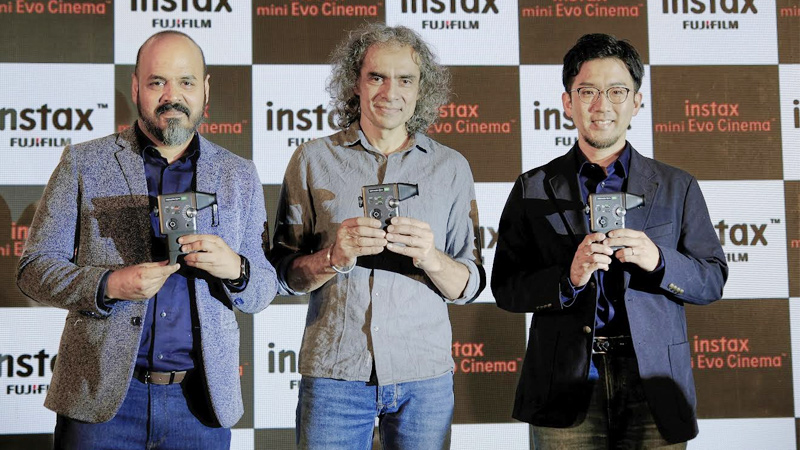
MUMBAI: Against the backdrop of an old-school Hollywood setup at The Westin Mumbai Garden City, where vintage cameras and decades of filmmaking evolution lined the walls, Fujifilm launched its latest love letter to analogue nostalgia. The instax mini Evo Cinema, a hybrid instant camera that marries moving images with tangible prints, made its debut with filmmaking mogul Imtiaz Ali bearing witness.

Priced at Rs 47,999, the instax mini Evo Cinema premium edition will be sold in India as a combo box with two packs of instax mini glossy film. Pre-bookings run from 21 to 27 January on instax.in, with buyers receiving two additional designer film packs as an incentive. Sales and dispatches begin on 28 January.

The camera allows users to shoot stills and videos of up to 15 seconds, convert a selected video frame into an instax print, and embed the clip in a QR code. Scanning the print plays the video on a smartphone, turning a photograph into a physical gateway to moving memories.
Speaking to Indian Television Dot Com, Fujifilm India instax and optical devices business associate director and head of electronic imaging Arun Babu said the instax mini evo cinema is not positioned as a conventional filmmaking tool, but as the creation of an entirely new category within instant photography.
“Fujifilm already has a wide portfolio of professional, cinema, vlogging and wedding cameras in its digital imaging business,” Babu explained. “But within instax, we had never introduced video capability before. This is the first instant camera that allows users to record a 15-second video, convert a frame into a physical print, and embed the full video and audio within a QR code.”
He added that the product does not compete with existing camera categories. “It creates a category of its own. It’s meant for people who want a unique way of creating content: gadget enthusiasts, social media creators and anyone who enjoys experimenting with new forms of storytelling.”
Addressing whether the camera’s retro appeal limits it to novelty use, Babu said its nostalgia-driven design could also find selective applications in serious filmmaking. “As filmmaker Imtiaz Ali mentioned on the panel, when a project requires a specific era-driven aesthetic—like the periods depicted in Chamkila or Rockstar—this camera could be used as a creative format. However, its strongest appeal will be among Gen Z and millennials who are deeply engaged in social media-led content creation.”
Fujifilm India managing director Koji Wada, said the product reflects the company’s aim of “giving our world more smiles” by pairing cinematic creativity with the emotional pull of instant prints.
A headline feature is the new Eras Dial, offering 10 effects inspired by different decades, from 1940s colour film to 2010s smartphone aesthetics. Each effect has 10 adjustable levels, delivering 100 visual and audio expressions, complete with period-style noise and nostalgic sounds.

Design cues lean heavily on Fujifilm’s past. The vertical grip echoes the Fujica Single-8 8mm camera from 1965, while tactile dials and a print lever mimic analogue film handling. A detachable viewfinder and grip attachment aim to enhance immersion and stability.
A companion app for Android and iOS enables video editing, clip stitching, poster-style print templates and direct printing from smartphones. With Bluetooth and Wi-Fi support, the device doubles as a smartphone printer, positioning it as a three-in-one camera.
Fujifilm says the instax mini Evo Cinema will be promoted under the tagline “One camera, decades of possibilities”, as it seeks to extend the appeal of instant photography in an increasingly digital age.