MAM
FMCG advertisers hogged TV eyeballs in Jan ’17


BENGALURU: Thirteen advertisers shared places in list of top ten television advertisers in terms of number of insertions (or spots) across the first 4 weeks of 2017. The total number of insertions in the first four weeks of 2017 by the top ten television advertisers was 12,51,529.As is the norm, FMCG Brands grabbed the bulk of the spots – 93.56 percent or 11,70,874 insertions during weeks 1, 2, 3, and 4 (Saturday, 31 December 2016 to Friday, 27th January 2017) as per Broadcast Audience Research Council (BARC) data for top 10 advertisers Across Genre: All India (U+R): 4+ Individuals.
Of these 13, 11 were FMCG advertisers, with Amazon Online India Pvt Ltd (online) and Super Cassettes Industries (Music) being the sole exceptions. Both these non-FMCG advertisers were among the top ten television advertisers in two of the four weeks. Amazon ranked eighth in week 2 and fifth in week 3, while Super Cassettes ranked ninth and eighth in weeks 2 and 4 respectively in terms of number of television insertions per week.
Eight of the 13 advertisers were present in the top 10 list of advertisers in terms of television insertions in all the four weeks. Three were present in in the list during two of the four weeks and two were present in the list in only one week (week 1 of 2017).

Please refer to Fig A below:

The total number of television insertions by the top 10 advertisers per week increased from 2,68,323 in week 1 to 3,47,695 in week 3 before petering off by 9.81 percent to 3,13,579 in week 4. As is obvious, Hindustan Lever Limited (Lever) has been the top advertiser in the four weeks with 31.28 percent of total insertions by the top ten advertisers in terms of insertions.
Baba Ramdev’s Patanjali Ayurved Limited which had stood third in the first three weeks of 2017 behind Reckiyy Benckiser (India) Limited climbed to the second spot in week 4 of 2017, pushing Reckit down to third spot. While Reckitt had cut down its ad insertions in week 4 by a massive 41.96 percent to 35,481 from 61,127 in week 3, Patanjali had increased its insertions by 20.5 percent in week 4 to 38,886 from 32,270 in week 3. Super Cassettes was the sole non-FMCG brand in the list of top 10 television advertisers in terms of ad insertions in week 4.
Fig B below gives the breakup of the top 10 advertisers in terms of number of insertions for individual weeks:







MAM
Lego brings Messi, Ronaldo, Mbappé, Vinicius together
Campaign clocks 314 million views ahead of FIFA World Cup 2026 buzz.
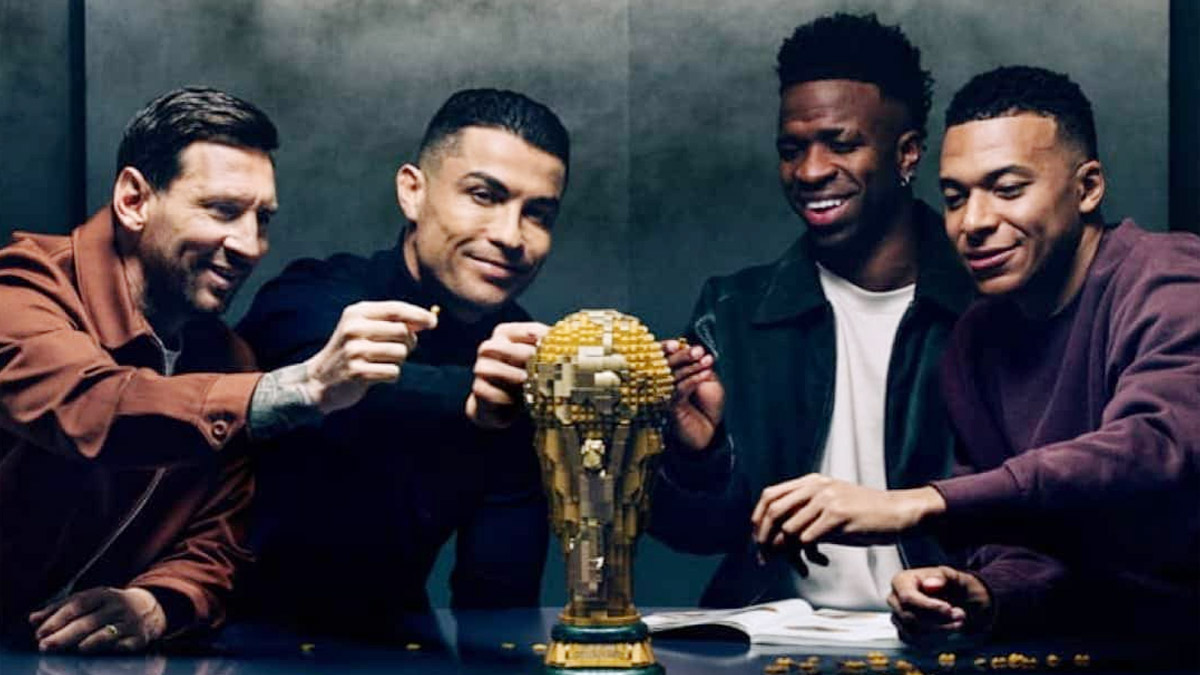
MUMBAI: Four legends, one frame and not a single tackle in sight. Lego has pulled off a crossover few thought possible, uniting Lionel Messi, Cristiano Ronaldo, Kylian Mbappé and Vinícius Júnior in a single campaign ahead of the FIFA World Cup 2026 only this time, they’re building dreams brick by brick.
Titled “Everyone wants a piece”, the campaign features the quartet assembling a Lego version of the World Cup trophy, before placing miniature versions of themselves atop it, a playful nod to football’s ultimate prize. Shared widely across social media, the ad carries a pointed disclaimer: it is not AI-generated, a subtle but telling signal in an era where even reality is often questioned.
The numbers tell their own story. The campaign has already crossed 314 million views on Instagram across the players’ accounts, with fans hailing it as a rare, almost nostalgic moment particularly for the reunion of Messi and Ronaldo, whose last shared campaign ahead of the 2022 World Cup became one of the platform’s most-liked posts.
Beyond the film, Lego is extending the play with exclusive, player-themed sets tied to each of the four stars, part of a broader football-led programme designed to ride the global momentum building towards 2026. The idea, as echoed by the players themselves, leans into the parallels between football and play experimentation, creativity, failure, and triumph.
Messi described the sets as a way to bring on-pitch moments into an imaginative, hands-on world, while Ronaldo called the transformation into a Lego figure a rare honour, blending sport with storytelling. Vinícius, meanwhile, struck a more personal note, recalling childhood moments of building with Lego and framing creativity as a universal language that transcends borders.
The timing is no accident. With the 2026 World Cup set to run from June 11 to July 19 across the United States, Canada and Mexico, and featuring an expanded 48-team format, global anticipation is already building. Argentina, led by Messi, will enter as defending champions, adding another layer of intrigue.
For Lego, the campaign does more than celebrate football, it taps into its mythology. Because when icons become figurines and rivalries turn into play, the beautiful game finds a new kind of pitch. one built, quite literally, by hand.






