MAM
Facebook & GroupM launch Media Playbook to help brands reimagine media strategies & unlock growth


Mumbai: GroupM and Facebook have come together to launch an industry-first media playbook for advertisers and marketers to adapt to the dramatic change in consumer behaviour as a result of COVID-19. The ‘Turn The Tide’ Media Playbook offers a perspective on the evolving consumer and media landscape, and recommends media strategies that businesses can deploy to drive efficient outcomes.
A recent consumer behaviour study by Facebook and Boston Consulting Group (BCG) identified three key consumer shifts since the pandemic began; Reversal of past trends such as bringing outside experiences in-home through digital as well as the increasing value-consciousness amongst people; Acceleration of ongoing trends such as the significantly increased mobile and digital influence in every aspect of life; And lastly, formation of new habits such as do-it-yourself (DIY) as well as greater focus on health and hygiene. Of these, the acceleration in digital adoption will be the most structural and long-lasting.

The Media Playbook is built to cater to these key consumer behaviour shifts, and calls out four pillars for businesses to deliver efficient business outcomes in the new normal:
1) Embracing the full spectrum of consumer segmentation that is pivoted to business outcomes such as hyperlocal strategies.
2) Mastering the full funnel of performance marketing especially with the increasing direct-to-consumer penetration.
3) Integrating innovations with business outcomes and building virtual experiences to simulate product touch-and-feel, for instance through Augmented Reality (AR) and interactive ads.
4) Delivering on the right media mix by realigning media mix models based on the current reality of digital acceleration.
GroupM south Asia president growth and transformation Tushar Vyas said, “Over the years while working with the Facebook team we have realised the need to constantly help and educate brands and marketers on how to navigate various tricky situations when advertising. We are very proud to have partnered with Facebook and to introduce a robust playbook that will help brands and businesses rethink efficient ways to connect and strengthen the relationship with customers in the new normal. The pandemic has seen consumers switch their actions right from the way they shop, socialize and work, causing brands and businesses to repurpose their strategies. In such times, brands need to cautiously redesign their business models and with the new playbook we wish to help them take advantage of performance marketing and focus on hyper-localization to drive sales.”
Facebook India director and head global markeitng solutions Sandeep Bhushan said, “With the drastic alteration in media consumption, businesses need to understand truly incremental outcomes by platform as well as cross-platform efficiency. Irrespective of whether they operate online or offline, businesses need to bring alive digital experiences to connect with customers in their context. A significant digital acceleration has happened on the back of social media, and with 400M+ Indians connected on the Facebook family of apps in India, we play a consequential role in the consumer journey. Continuing our commitment to enabling growth for businesses both large and small, the Media Playbook outlines the opportunities that businesses need to embrace in order to deliver efficient outcomes in the new normal.”
Key media strategies to help businesses deliver efficient outcomes based on the four pillars:
Embracing the full spectrum of consumer segmentation: The changing consumer landscape has shown that hyperlocal strategies for targeting and communication have become critical. With the evolution of smart shoppers and a value-conscious mindset, robust consumer segmentation has become crucial for business impact. There is a need for brands to identify audience segments relevant to their business. Facebook helps businesses connect with consumers where they are, and build an advanced hyperlocal journey resulting in more effective campaigns.
Mastering the full funnel of performance marketing: Businesses are increasingly moving from offline to online. According to the Facebook-BCG study, e-commerce adoption has accelerated by 2-3 years and there is an urgent need to embrace performance marketing strategies to make the online adoption efficient and effective. In times of physical distancing, it’s essential to stay in touch with the customer and continuously eliminate friction in the path-to-purchase. Consequently, conversational marketing digital solutions driven by WhatsApp, Facebook Messenger, and digital CRM tools can prove to be very effective to engage the consumer with a value-driven outreach.
Integrating innovations with business outcomes: As consumer experiences shift from offline to online, businesses need to also build engaging virtual experiences that are interactive, immersive, and involving, and simulate the product touch-and-feel elements. Interactive ad formats such as Playable Ads and augmented reality (AR) ads can increase favorability and conversion rates. Influencers can also play a key role in these times because of the constraints of physical, in-person, content creation. They also lend an authentic voice to the brand. With Branded content ads on Facebook and Instagram, businesses have the ability to promote creators' organic branded content posts as feed and stories ads, thereby reaching new audiences and leading to measurable impact.
Realigning media mix models: The Facebook-BCG report also revealed that digital influence in urban consumers has risen significantly, up to ~70% for some categories. Irrespective of whether consumers are making the final purchase offline or online, they are now engaging with brands on their smartphones. This makes it imperative for businesses to relook at media mix models to drive growth. It underlines the immediate need for industry-leading digital measurement standards such as custom mix modelling (CMM) developed by Nielsen, as well as other cross media and brand lift studies.
The GroupM-Facebook partnership will also include webinars to help scale media practitioners, enabling them to build for the new normal and turn the tide.







MAM
Madison World to launch AI platform M BrAIn for media planning
Agency group invests about $1 million as it shifts to AI driven growth planning.
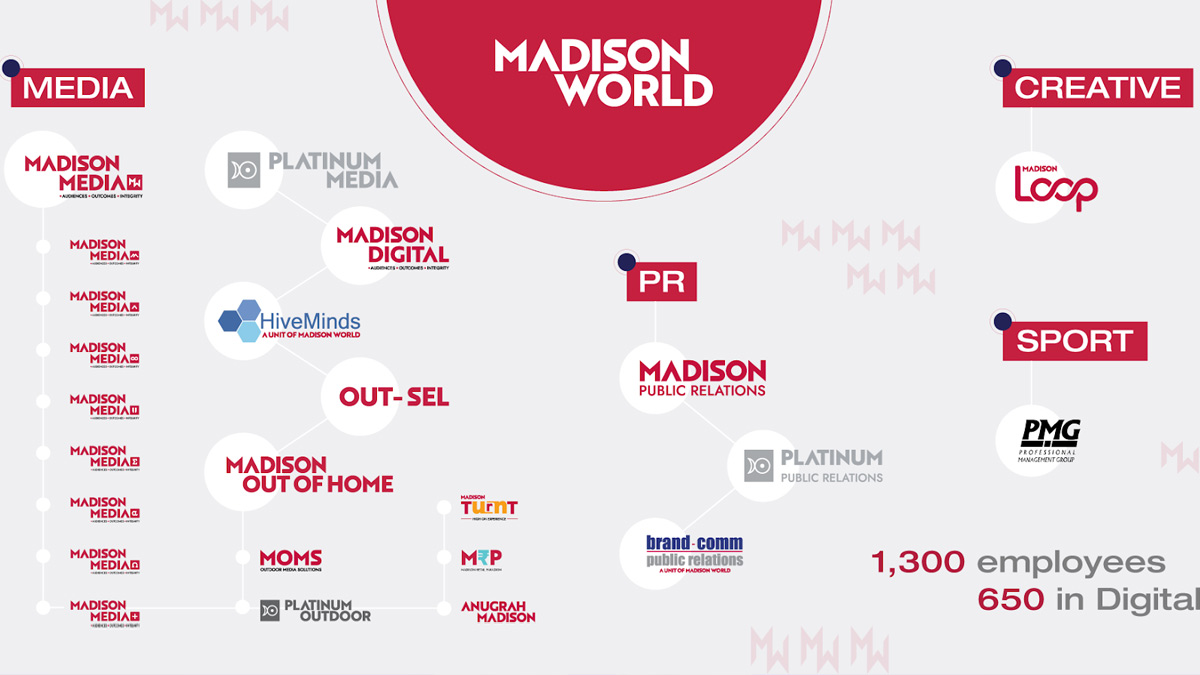
MUMBAI: If media planning once ran on spreadsheets and gut instinct, the next chapter may run on algorithms and curiosity. Madison World is preparing to roll out the first version of its proprietary artificial intelligence platform Madison M BrAIn in early April, as the independent agency group accelerates its transition toward AI driven planning and product led media services.
The platform, expected to involve an investment of around $1 million, is designed to reshape how the agency approaches strategy by combining internal knowledge, external data sources and advanced AI models into a single intelligence ecosystem.
According to Madison Media, OOH and Hiveminds partner and group CEO Ajit Varghese the initiative forms part of a larger structural rethink within the organisation. “Traditionally agencies built frameworks around media planning and allocation. We are redesigning that structure into what we call a Growth Planning System (GPS),” Varghese said.
The shift reflects a growing belief that effective media strategy must begin earlier in the decision making process. Instead of jumping directly to channel allocation, planners must first decode the market itself identifying consumer barriers, purchase triggers and the core challenges facing a brand.
Once those insights are mapped, agencies can build clearer growth agendas for clients and design media strategies that connect more closely with business outcomes.
To support that approach, Madison has built Madison M BrAIn as what it describes as a human AI cognitive ecosystem. Acting as a central intelligence hub, the platform aggregates proprietary insights alongside external data sources and large language models, enabling planners to access deeper market intelligence before building campaign strategies.
Varghese said one of the core objectives is to democratise knowledge across the organisation. “In the past, this level of understanding was largely available to senior leaders or experienced strategists. With Madison M BrAIn, even a junior planner should be able to access the same intelligence and approach clients with a far more informed perspective,” he said.
The agency has already implemented the new planning philosophy internally and completed three months of testing for the AI platform, with early trials showing encouraging results in terms of learning capability and system performance.
While the first version relied on global large language models, Madison is now developing its own proprietary Small Language Model (SLM) to serve as the core of the M BrAIn ecosystem.
“The SLM will be able to read global LLMs, but the LLMs cannot read the SLM,” Varghese explained. “That ensures all the intelligence we build remains within the Madison ecosystem and strengthens our proprietary knowledge base.”
The first version of Madison M BrAIn is expected to go live in early April, with a more refined version targeted by the end of June. Over time, the platform will integrate additional external data streams and APIs including consumer insight platforms, social listening tools and client datasets.
These integrations are expected to enhance the system’s learning capability and enable it to generate increasingly sophisticated strategic recommendations.
Although the platform is currently being deployed for internal use, Madison sees potential for it to evolve into a licensable product in the future.
“At the moment, our focus is to stabilise and strengthen M BrAIn internally. But over time there is potential for this to become a product that could be licensed externally,” Varghese said.
The AI platform is also part of a wider technology transformation underway at the agency group. Alongside M BrAIn, Madison is building a broader digital infrastructure called the Catalyst operating system, which aims to integrate operational processes, data and product platforms into a unified ecosystem.
This broader technology stack could require an additional $1 million to $1.5 million investment over time, though spending will be phased and reviewed regularly.
“We are evaluating progress every three months and prioritising the most critical capabilities first,” Varghese said.
Madison expects the full AI and operating ecosystem to be fully functional within 12 to 18 months, positioning the agency to combine human strategy with machine intelligence as the advertising industry enters its next data driven phase.







