Brands
Exelmoto shifts gears from vanity to utility
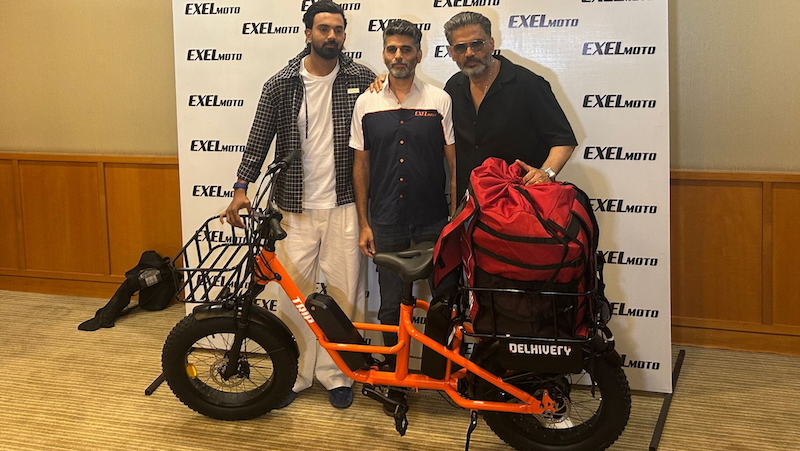
MUMBAI: Forget the flowery talk about clean air and conscious commuting. Exelmoto, the electric cycle venture backed by actor Suniel Shetty, cricketer KL Rahul and actor Ahan Shetty, is done playing the aspirational mobility game. It’s now chasing something far more lucrative: last-mile logistics.
The company has signed up Delhivery, one of India’s largest delivery networks, for a phased rollout of 200 electric bikes purpose-built for hauling parcels through congested urban streets. The deal, which began as a pilot in June, validates founder Akshai Varde’s bet that sturdy frames and fat tyres built for Indian roads could handle real-world commercial pounding.
“Delhivery validated what we built under real-world conditions,” said Varde, a designer with over two decades in motorcycles. “It showed that our design and engineering hold up even in demanding daily use.”
The pivot marks a sharp turn for a brand that launched with lifestyle credentials in June 2025 —lightweight electric cycles that need no registration or licence, aimed at students, office workers and the elderly. But whilst the personal mobility pitch has its charms, the margins and scale lie in B2B contracts.
“Our commercial pivot creates clear paths to profitability,” said Rahul, who joined Shetty and Ahan as co-investor earlier this year. “This isn’t just about personal mobility anymore; it’s about building last-mile infrastructure for India.”
The company hasn’t abandoned retail entirely. Exelmoto recently launched Scoot, an electric cycle with a step-through frame and bench seat designed for women and older riders. It offers 45 kilometres of range with pedal-assist, keeping it licence-free whilst targeting comfort over speed.
“When my generation can confidently adopt electric mobility, the revolution is truly underway,” said Shetty, who came aboard after seeing Varde’s prototype.
With 68 outlets opening, Amazon and Flipkart listings set for November, and manufacturing capacity targeted at 50,000 bikes by 2026, Exelmoto is scaling fast. The company holds two granted patents and four pending, covering frame architecture and component packaging. Exports to southeast Asia and west Asia are in the works.
Ahan, the youngest investor, summed up the shift: “My generation’s looking for brands that evolve with us, not just talk to us. Exelmoto began with style, and now it’s about substance and infrastructure.”
Whether India’s clogged streets need another electric two-wheeler is debatable. Whether they need one that can turn a profit delivering packages is a far more interesting question. Varde and his celebrity backers are betting the answer is yes.

Brands
Wipro hires 7,500 freshers, withholds FY27 hiring outlook
Profit rises to Rs 3,522 crore, Rs 15,000 crore buyback announced.
MUMBAI- Hiring may be on, but visibility is off, Wipro is adding talent even as it pauses the crystal ball. The company hired 7,500 freshers in FY26 but stopped short of offering any hiring outlook for FY27, underscoring the uncertainty gripping the IT services sector as it pivots towards an AI-led operating model.
The disclosure came alongside its fourth-quarter earnings, where management flagged volatile demand conditions and refrained from committing to future workforce expansion. Chief human resources officer Saurabh Govil noted that over 3,000 of the total hires were onboarded in the March quarter alone, signalling continued intake despite a lack of clarity on deployment pipelines.
This divergence active hiring without forward guidance reflects a broader industry pattern where talent acquisition continues even as deal conversions remain uneven and client spending cycles stretch. Wipro expects its IT services revenue for the June quarter to range between a decline of 2 per cent and flat growth sequentially in constant currency terms, reinforcing near-term caution.
Chief executive officer Srini Pallia pointed to artificial intelligence as both a disruptor and an opportunity. He said evolving client priorities are pushing the company towards outcome-driven engagements, with Wipro increasingly focusing on a services-as-software model through its AI Native Business and Platforms unit. The shift marks a structural change from traditional headcount-led growth to AI-enabled delivery frameworks.
The company has already committed over $1 billion to its AI ecosystem, with investors closely watching how these investments translate into revenue. For now, the numbers present a mixed picture. Net profit rose sequentially to Rs 3,522 crore, while revenue grew 3 per cent to Rs 24,236 crore. However, core IT services performance remained under pressure, with full-year revenue declining 0.3 per cent in dollar terms and 1.6 per cent in constant currency.
Large deal bookings offered a counterpoint, rising 45.4 per cent year-on-year to $7.8 billion, highlighting a widening gap between deal wins and actual revenue realisation. On a quarterly basis, IT services revenue slipped 1.2 per cent sequentially, signalling continued softness in execution.
Margins, however, told a more optimistic story. Operating margins expanded to 17.3 per cent in the fourth quarter, up from 14.8 per cent in the previous quarter, reflecting improved cost discipline. That said, the company cautioned that upcoming wage hikes and the ramp-up of large deals could exert pressure going forward.
Attrition stood at 13.8 per cent in the March quarter, indicating stabilisation after periods of elevated churn. Alongside its earnings, Wipro also announced a Rs 15,000 crore share buyback, reinforcing its focus on shareholder returns, with a payout ratio of 88 per cent over the past three years.
Taken together, the numbers capture a company in transition investing in AI, maintaining hiring momentum, but navigating a demand environment where growth is uneven and visibility remains limited.