Brands
Emerging technology an integral part of sports consumption by fans: Capgemini

MUMBAI– Capgemini, the official Global Innovation Partner of the Men’s and Women’s HSBC World Rugby Sevens Series since January 2018, has launched a new report, ‘Emerging technologies in sports: reimagining the fan experience’. The study, using responses from over 10,000 fans around the globe who regularly watch and follow top sports, has been produced by the Capgemini Research Institute.
The study shows that for 69 per cent of fans, the use of emerging technologies, such as virtual reality (VR), artificial intelligence (AI) and augmented reality (AR), has enhanced their overall viewing experience both inside and outside the stadium; a positive experience with technologies also enhances overall fan engagement. Of respondents who liked their technology experiences, 56 per cent said they would actually go to more physical matches at their team’s stadium as a result, and 60 per cent said they would stream more matches online.
49 per cent of fans have often increased their spending on team merchandise following a good experience and 42 per cent have increased this spend a few times, while 92 per cent said they increased their spend on online subscriptions for watching matches (either often or a few times). The report also shows that fans who have experienced emerging technologies during a recent visit to a stadium are more satisfied with their experience overall, highlighting a 25-point NPS® (Net Promoter Score) difference between fans who have experienced emerging technologies and those who have not.

Sports fans from Asian countries lead in using emerging technologies
Fans from Asian countries – including India, Hong Kong, and Singapore – lead in the adoption and acceptance of emerging technologies in sports. Close to three-quarters of Asian fans (74%) have experienced the use of emerging technology in the stadium, with India leading at 88%. However, this drops to 56% for the United States, 50 per cent for Germany, and below 50 per cent each for Canada, France, United Kingdom and Australia. Furthermore, 71 per cent of Asian fans said they would be willing to pay more if new technologies enhanced their stadium experience, compared to 40 per cent of North American fans, 34 per cent of European fans, and 33 per cent of Australian fans.
Adoption of emerging technologies can convert more followers into avid fans
Emerging technologies can also convert and upgrade more fans to become avid fans who generate more business and positive word-of-mouth on having a good tech-enabled sports experience. For example, 73% of avid fans attend more matches following a good tech-enabled experience, compared to 50 per cent of the rest, and nearly three-quarters of avid fans watch a match in the stadium when their favorite team is playing.
Emerging technologies are helping athletes perform better and avoid injuries
Athletes are increasingly using a variety of emerging technologies for activities, including training, injury prevention and tracking performance. For example, Zone7, a company using data and analytics for identifying and avoiding potential career-threatening injuries to athletes, has achieved 95% accuracy in predicting injuries and has been able to reduce potential injuries by 75 per cent.
Tom Mitchell, Captain of England’s Rugby Sevens Team said, “The use of virtual reality in reviewing training sessions and matches can have a big impact on sports. If you can put yourself in a given situation instead of just reviewing a match by watching a video, then the learning and reviewing experience becomes much more real. If you are able to be in that situation again, either through VR or another technology, it would be a massive step up in terms of the reviewing and learning experience.”
Strategies to unlock the value of emerging technologies in sports
Sports organisations across the world are now presented with a huge opportunity to tap into evolving consumer expectations and make far more customised and personalised fan engagement. According to the new report, organisations can focus on the following areas to adopt and optimise emerging technologies in sports:
- Reassure fans on usage of personal data by seeking consent where possible on use of data, being transparent about the use and protection of consumer data, and demonstrating the value that consumers stand to gain with this data exchange,
- Identify user needs before investing in and deploying emerging technologies,
- Convert more fans to ‘avid fans’ by defining a digital fan experience and offering ‘hyper-personalised’ experiences,
- Build digital practices, capabilities, and transform organizational culture by investing in a digital culture, skills, and cross-sharing of information across sports organisations to drive greater innovation.
Capgemini global digital customer experience practice leader Darshan Shankavaram said, “The use of emerging technologies in the fan experience is an exciting and rapidly growing area. Sports organisations across the world have a huge opportunity to tap into evolving expectations of fans and athletes to build a more joined up, customized and personalised engagement experience. Additionally, organisations can benefit by using technology to improve players’ performance or prevent injuries, or for coaches to strategise the play through simulations.”







Brands
Samsung certifies 1,000 Maharashtra students in AI and coding
The South Korean electronics giant marks its first large-scale skilling push in the state, with women making up nearly half the national programme’s enrolment
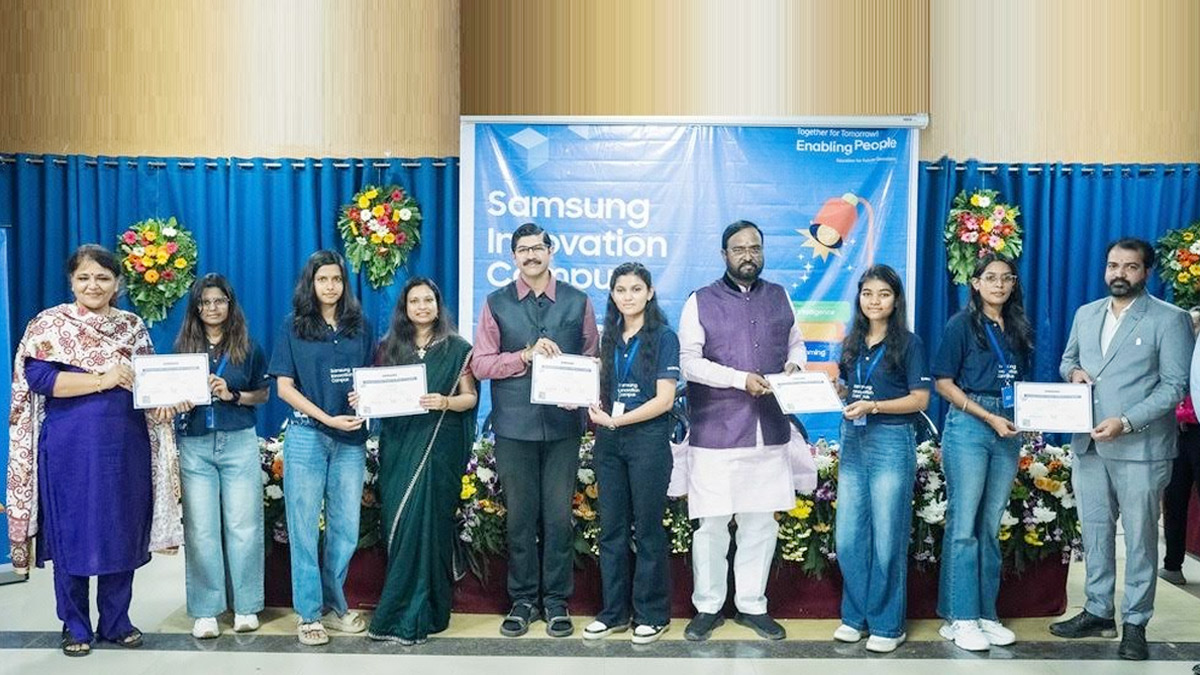
PUNE: Samsung has put 1,000 students in Maharashtra through a certified training programme in artificial intelligence and coding, the largest such drive the South Korean electronics company has run in the state and a signal that corporate India’s skilling ambitions are moving well beyond the boardroom brochure.
The certifications were awarded under Samsung Innovation Campus (SIC), the company’s flagship corporate social responsibility programme, which launched in India in 2022 with the stated aim of democratising access to future-technology education. The 1,000 graduates were drawn from four institutions: 127 from Savitribai Phule Pune University, 373 from Pimpri Chinchwad University, 250 from D.Y. Patil University’s Ramrao Adik Institute of Technology and 250 from Anjuman-I-Islam’s Kalsekar Technical Campus. All completed training in either AI or coding and programming, the two disciplines Samsung has identified as the critical pillars of the digital economy.
The programme does not stop at technical training. Soft-skills development and career-readiness modules are baked into the curriculum, a deliberate attempt to close the gap between what universities teach and what employers actually want.
“India’s digital growth story will ultimately be shaped by the quality of its talent pipeline,” said Shubham Mukherjee, head of CSR and corporate communications at Samsung Southwest Asia. “As technologies like AI move from the periphery to the core of industries, skilling must evolve from basic training to building real-world capability. This milestone in Maharashtra reflects how industry and academia can come together to create a future-ready workforce that is both globally competitive and locally relevant.”
The Maharashtra drive sits within a rapidly scaling national effort. Samsung Innovation Campus trained 20,000 young people across India in 2025, hitting its stated target for the year. Women account for 48 per cent of national enrolments, a figure the company cites as evidence of its push for an inclusive technology ecosystem. The programme is implemented in partnership with the Electronics Sector Skills Council of India and the Telecom Sector Skill Council.
Samsung, which is marking 30 years in India this year, runs SIC alongside two other initiatives, Samsung Solve for Tomorrow and Samsung DOST, as part of a broader effort to build what it calls a generation of innovators with both the technical depth and the problem-solving mindset to thrive in a fast-moving digital world.
A thousand certified students is a tidy headline. Whether they find jobs that match their new skills is the harder question, and the one that will ultimately determine whether corporate skilling programmes like this one are genuine pipelines or well-photographed gestures.






